Grief - an act of love


❝If there were no love, there would be no grief.❞
On the 2nd August 2020, my life as I knew it and I changed forever. My mum died, my only living parent, as my dad died 10 years prior.
We all know at the back of our minds that our parents will die, but nothing prepares you for when they really do die. As silly as it sounds, I comforted myself by telling myself that my mum will die in her 80's. My mum died suddenly at 63 years old, after a very brief hospital stay due to covid-19 complications.
Healing from trauma is possible with the right therapist. TherapyRoute lists trauma-informed professionals ready to support you.
Find a trauma therapistTo say the grief process has been difficult does not begin to scrape the surface of how hard grief really is and has been for me and many others in the world, especially given the current circumstances. I have realised through my experience that grief will forever be my lifelong journey, given that I will forever love my mum. This is a shift in thought for me as I was previously believed that grief could be worked through in a certain amount of time, granted that this amount of time is different for everyone.
Grief is not a linear process. There are days where it seems as if you can cope with it. It is always there, but on some days, it feels manageable. This tricks you into thinking you are okay. Then out from nowhere, with a bang, it all comes rushing back. Knowing this helps ease the process of recognising that this is all a normal part of grief.
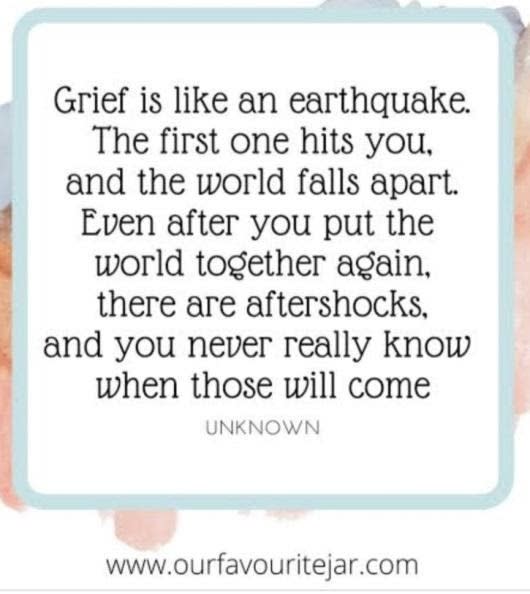
If I wrote this piece a few months ago, I imagine it would be a different version and more focused on grief and less on love. My version today is focused more on a balance of grief and love. Many quotes speak about grief being an act of love.
Jamie Anderson states:
“Grief, I’ve learned, is really just love. It’s all the love you want to give, but cannot. All that unspent love gathers up in the corners of your eyes, the lump in your throat, and in that hollow part of your chest. Grief is just love with no place to go.”
So, the essence of grief is love. If there were no love, there would be no grief. As we go on our grief journey, it seems that what's needed is to balance the grief - the hard raw emotions with acts of love. Love for your deceased loved one, love for yourself, and love for your other loved ones that are still alive with you. Early on in the grief process, there seem to be more signs of raw grief; however, as the months or even years progress, there seems to be a transformation from raw grief to love. We need to start to honour our deceased loved ones by becoming the best version of ourselves and living a life, and being the person they and you are proud of. The biggest shift seems to be realising that they are gone, but our love for them and their love for us lives on, and we can continue to live life in a way that honours that love.

I have heard many clients speak to me about wanting to stay in their grief and not wanting to attend to normal daily life responsibilities’. I experienced this first-hand. This is a normal, understandable reaction. Life moves on, however, even though we are not ready or want to integrate into life again fully. I want to encourage you to trust yourself and to trust life. If we sit in our grief for too long, we get too comfortable being there and struggle to move out of this space. If we focus on life responsibilities and ignore our grief, this is also not useful. Find a balance that works for you to balance these two out. Don’t feel bad for doing too much of either; a balance does not mean equal. Some days or moments, we want to sit in our grief. On other days, we want just to feel normal again and put the grief to the back of our minds. There is no script for grief. Do what works for you in the moment.
In closing, if you are going through a grief process right now, take care of yourself more now than you ever have before because grief is especially hard work and taxing on the mind and body.
Written by Counselling Psychologist Shenila Maharaj (Johannesburg, South Africa).
In dedication of my mum, Mrs H. Persaram. Forever in my heart, you still stay.
Important: TherapyRoute does not provide medical advice. All content is for informational purposes and cannot replace consulting a healthcare professional. If you face an emergency, please contact a local emergency service. For immediate emotional support, consider contacting a local helpline.
Find Therapists
Must Read
Creating Space for Growth: How Boundaries Strengthen Relationships
Setting healthy boundaries fosters respect, protects emotional well-being, and strengthens relationships by defining personal limits and maintaining self-care.
International Mutual Recognition Agreements for Mental Health Professionals
Mutual recognition agreements for mental health professions are rare and uneven, with major gaps in counselling, social work, and allied therapies. Read on to understand ...
Sexual violence statistics worldwide
How many people experience sexual violence worldwide and in countries on most continents, how often it begins in childhood, how men and boys are affected, how many surviv...
Phobia statistics worldwide
How many people have a specific phobia, social anxiety disorder or agoraphobia, which fears are most common, when phobias start, how many people get treatment, and which ...
Autism statistics worldwide
How many people are autistic worldwide and in countries on every continent, how diagnosis differs between boys and girls and across ages, which conditions often occur alo...
About The Author

“A passionate psychologist who works with adults, couples and teenagers and uses a Cognitive Behavioural Approach, Dialetical Behaviour Therapy Approach and a Solution Focused Approach.”
Shenila Maharaj is a qualified Counseling Psychologist, based in Midrand, Johannesburg, South Africa. With a commitment to mental health, Shenila provides Relationship Counseling, Trauma Counseling, Psychology, Stress Management, Therapy, Individual Therapy, Counseling, Online Therapy and Psychotherapy.