Mood and Food – What Exactly is Emotional Eating

❝This is how food is links with emotions.❞
We’re joined by Emily Burton, Psychologists and Director at Positive Wellbeing Psychology, a Melbourne private practice. In this article, Emily explores mood and food. In the following article, we aim to bring you a bit of a breakdown of how food may be linked with emotions.
Once we have an increased level of awareness then we can start to implement gradual change and strategies to assist with managing emotions such as anxiety, depression, stress, and frustration. In doing so, we often find ourselves developing a healthier relationship with food ✨
Looking for evidence-based support? Find a qualified psychologist near you through TherapyRoute.
Find a Psychologist
What is the link between food and mood?
Have you noticed after a long and stressful day at work or study, you get home and find yourself heading to find the sweets? Or perhaps you find yourself driving home and considering the food that you may like to order on Deliveroo or UberEATS?
Most of us have heard the saying comfort eating. Having an understanding and increasing self-awareness on what drives emotional eating is the first step to help make a positive change. It is also extremely common to find yourself using food to help regulate feelings of boredom, loneliness, flat affect and being overwhelmed.
Often in therapy, the goal may be to establish a healthy relationship with food and/or to learn strategies to stop binge eating.
What is emotional eating?
Emotional eating is when an individual tends to use food as a way to regulate emotions or deal with certain feelings instead of to satisfy hunger cues. We've all been there - finishing a party size bag of chips out of boredom. Eating a bag of cookies whilst feeling stressed and cramming for a big test. At recent, I share my own experience, when I noticed myself looking in the cupboard to pair my coffee with a sweet dessert or at minimum, a chocolate. Noting this was getting towards the end of the work from home day when I often begin to feel a little tired.
Food is commonly be used to regulate all sorts of feelings and emotions, often even to distract oneself from more uncomfortable feelings or even stress.
Emotional eating can occur when we’re in ‘autopilot’ mode. With binge eating comes challenges with our health and overall wellbeing. This is therefore an important reason to speak to a health professional or one of our psychologists at Positive Wellbeing Psychology.
Is emotional eating only linked to feelings of stress or boredom?
As I am sure most of you can relate, food can be used as a way to celebrate a birthday, uni achievement, resting after surgery, so forth. One thing these have in common is they are learnt behaviours.
How does comfort eating develop?
As noted above, comfort eating is a learnt behaviour. Emotional eating usually stems from our early life experiences from a young age. A child who is given their favourite chocolate bar after a big achievement may grow up using chocolate as a reward for a job well done. A child who is given hot chips to stop crying may grow up using takeaway as a comfort food. In adult years, this may result in KFC as a comfort food on a Friday night a stressful work week.
Whilst it is challenging to unlearn patterns of emotional eating, it is possible with an increased level of self-awareness. In therapy, you will likely be introduced to self-monitoring records early on to determine the eating patterns and any connection with mood. However, this is certainly a task that you can implement yourself by keeping a journal and reflecting on thoughts that arise with feelings of sadness or anxiety. Do you find yourself using food to regulate difficult emotions?
What other problems arise when using food to regulate emotions?
The trouble with emotional eating is that once the enjoyment of eating is gone, the feelings of stress and feeling heightened remains. And you often may feel worse about eating the amount or type of food you ended up eating.
It helps to pause and observe any other feelings and thoughts that show up for you when you are eating outside of the regular eating patterns of breakfast, morning snack, lunch, afternoon snack, dinner, evening snack. It is normal to have six times of eating within the day. Implementing regular eating at set times and stopping to observe feelings when eating outside of these set eating times does in fact allow us to lean and understand the differences between physical hunger and emotional hunger cues.
Next time you find yourself grabbing a snack outside of the usual snack time, perhaps check-in with yourself - your body physiologically, how you feel, what you are thinking, and see what is showing up for you today.
What are the physical hunger cues to look out for?
- physical hunger comes on gradually and can usually be postponed
- can be satisfied with any number of foods and food groups
- with physical hunger we’re likely to maintain a sense of control and stop eating when full
-
usually does not result in feelings of guilt or shame
What are the emotional hunger cues to look out for?
- emotional hunger cues usually come about sudden and feels urgent
- causes very specific cravings with foods such as pizza or ice cream
- with emotional hunger cues you can find yourself eating more than planned
- often is associated with feeling a loss of control
- usually when feeling tired and shut down in auto pilot
-
causes feelings of guilt and shame afterward
Ask yourself these questions about your eating patterns:
- do I feel a loss of control around food?
- have I been eating larger portions than usual?
- do I eat at unusual times?
- am I anxious over something, like school, a social situation, or an event where my abilities might be tested?
- has there been a big event in my life that I'm having trouble dealing with?
- am I in the healthy weight range?
- has there recently been a significant weight gain or weight loss?
- do other people in my family use food to soothe their feelings too?
If you answered yes to many of these questions, then it's possible that eating has become a coping mechanism instead of a way to fuel your body. You can discuss this further with one of our highly skilled Melbourne psychologists at Positive Wellbeing Psychology. Our Melbourne based psychologists have a special interest in delivering evidence-based strategies to help improve your relationship with food and to consider strategies for emotion regulation.
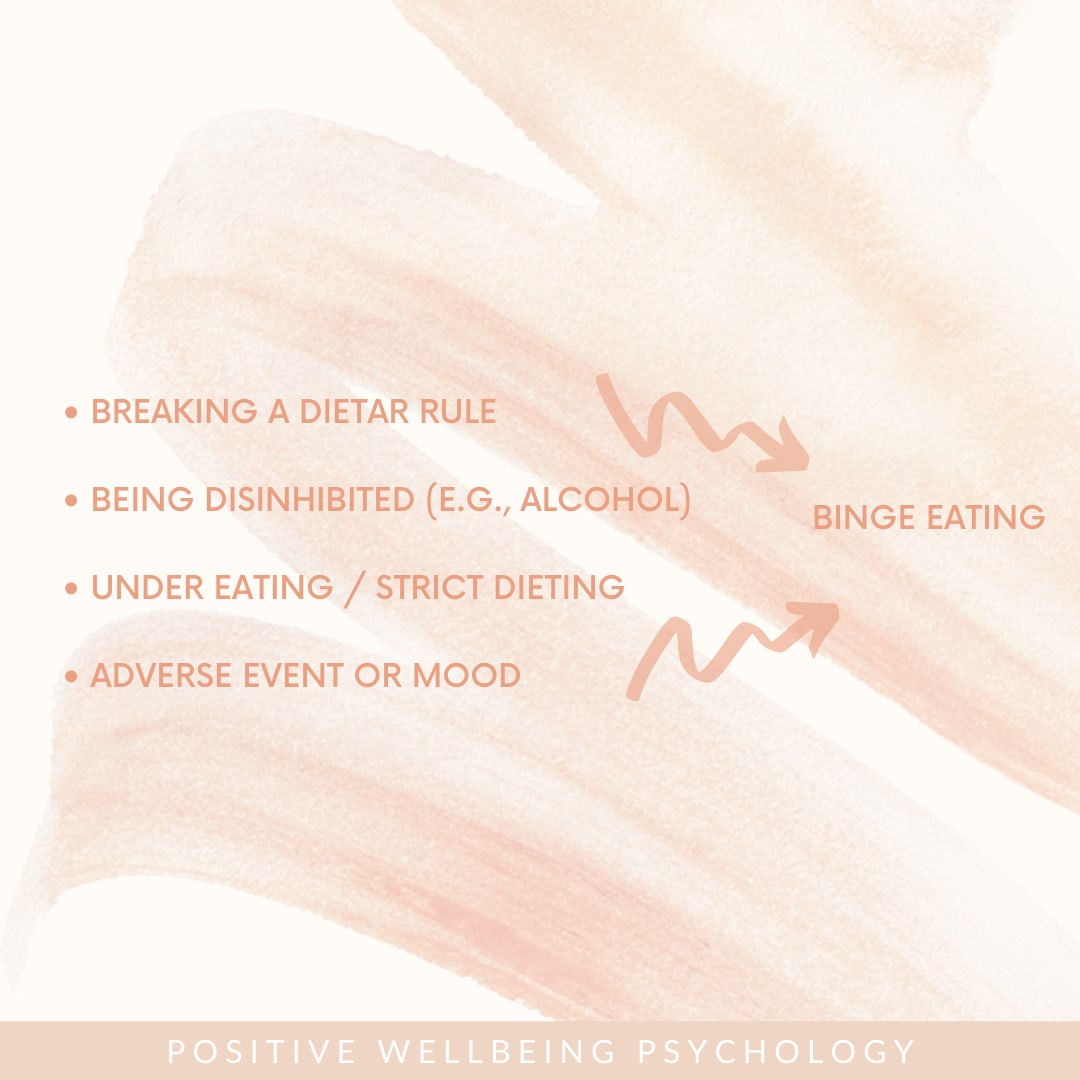
Information sourced from: From C. G. Fairburn, Cognitive behavior therapy and eating disorders, Guilford Press, New York, 2008. Image Designed by: Positive Wellbeing Psychology ©
How to unlearn emotional eating patterns?
First recommendation would be to establish regularity of eating and habits that help prevent binge eating patterns towards the end of the day. This is behavioural technique, but really is one of the very first steps – and the most important step! When you are eating at regular and consistent times each day of the week, you are less vulnerable to overeating or binge eating. You may also be less likely to become overly hungry and feel out of control of your eating.
As humans, we tend to function best when we eat regularly throughout the day. This means eating every 3-4 hours. For many of us, regular eating involves eating 3 meals and 2-3 snacks, although sometimes it’s helpful to think of it simply in terms of 5-6 eating occasions throughout the 16 or so hours you are awake. Regular eating play an important role to manage comfort eating and to start reducing binge episodes or overeating.
What are other reasons regular eating is so important?
A lot of benefits point to regular eating patterns for everyone. In particular, regular eating is so important during treatment of an eating disorder.
A few of these benefits are listed below. Regular eating helps:
- give structure to your eating habits, so that eating can start to become a regular, normalised part of your life.
-
keeps your blood sugar level steady, which minimises tiredness, irritability, and poor concentration.
- helps to combat delayed or infrequent eating.
- helps to combat unstructured eating, such as grazing or picking, which may increase vulnerability to binge eating.
-
improves metabolic functioning and prevents your body from going into “starvation mode”.
Changing your eating habits can feel overwhelming, so regular eating is a great place to start. Once the routine of eating every ~3 hours is in place, you can then begin to modify your food choices and portion sizes. You can also start to observe when you are reaching to food as a way to regulate a emotions.
What are other useful tips to help get emotional eating under control?
Once regular eating is underway you can start to observe feelings and thoughts associated with certain foods. A few common emotions that are found in self-monitoring records include: feeling bored, lonely, stressed, tired, flat in affect, frustrated, procrastination with an assignment.
A few activities to try when noticing these feelings show up in your body, include:
- BORED or LONELY = call or text a friend or family member.
- STRESSED = try a yoga routine or listen to some feel-good tunes. let off some steam by jogging in place, or around the block, doing jumping jacks, or dancing around your room until the urge to eat passes.
- TIRED = rethink your bedtime routine. Tiredness can feel a lot like hunger, and food won't help if sleepless nights are causing daytime fatigue.
- PROCRASTINATION = open those books and get that homework over with. You'll feel better afterwards (honestly!). Set up more routine so that you do not mind yourself with more time to handle as this often results in delaying study.
How can Positive Wellbeing Psychology assist?
Our Melbourne psychology practice has a special interest in poor body image and eating disorder treatment. Talk to one of our Melbourne psychologists at Positive Wellbeing Psychology with a specialist in eating disorder treatment for binge eating, restriction and deprivation of certain food groups, bulimia, anorexia nervosa, and orthorexia.
Make An Appointment at Positive Wellbeing Psychology
Important: TherapyRoute does not provide medical advice. All content is for informational purposes and cannot replace consulting a healthcare professional. If you face an emergency, please contact a local emergency service. For immediate emotional support, consider contacting a local helpline.
Find Therapists
Must Read
Creating Space for Growth: How Boundaries Strengthen Relationships
Setting healthy boundaries fosters respect, protects emotional well-being, and strengthens relationships by defining personal limits and maintaining self-care.
International Mutual Recognition Agreements for Mental Health Professionals
Mutual recognition agreements for mental health professions are rare and uneven, with major gaps in counselling, social work, and allied therapies. Read on to understand ...
Mental Health Licensing & Regulation in New York State: 2026 Guide
Mental Health Licensing & Regulation in Singapore: 2026 Guide
Jumping to Conclusions
Jumping to conclusions is a thinking habit where we assume the worst or make judgments without enough evidence. By recognising this pattern, therapy can help you slow dow...
About The Author

“We offer psychological support for adolescents and adults, with experience in a range of evidence-based treatment.”
Emily Burton is a qualified Psychologist, based in Armadale, Melbourne, Australia. With a commitment to mental health, Emily provides ACT (Acceptance & Commitment Therapy), Disability Psych & Diagnostic Assessment, Counseling, Wellness Support, Mindfulness-Based Cognitive Therapy (MBCT), Online Therapy, Psych & Diagnostic Assessment, CBT and Schema Therapy.