
Therapist vs Psychologist: Which One’s Right for You?

❝Therapist vs psychologist — what's the difference? Find out who diagnoses, who listens, and who you should see depending on your emotional or clinical needs.❞
Not all therapists are psychologists — and not all psychologists offer therapy. So how do you know which one you need?
If you’re feeling stuck, overwhelmed, or simply looking for clarity in your life, seeking mental health support is a strong first step. But figuring out who to turn to — a therapist or a psychologist — can feel confusing. The titles sound alike, but they come with different qualifications, tools, and areas of focus.
Whether you’re navigating anxiety, relationship challenges, burnout, or something deeper, knowing the difference between a therapist vs psychologist can help you choose the right kind of support — so you can stop guessing and start healing.
In this Article
- Quick Summary
- Therapist vs Psychologist: What's the Key Difference?
- Still Confused? Here's a Quick Comparison Table At a Glance
- How Do They Compare On Education, Expertise, and More?
- Therapist vs Psychologist: What Services Do They Actually Offer?
- Specialisations in Therapy and Psychology Explained
- How to Choose the Right Mental Health Professional?
- When You’re Ready, We’re Here to Simplify the Search
- Conclusion
- Frequently Asked Questions
Quick Summary
Therapists and psychologists are both qualified mental health professionals who address mental health concerns, but they differ in education, training, and scope of practice.
A therapist typically holds a master’s degree and focuses on talk therapy and emotional support.
A psychologist usually has a doctoral degree and may offer therapy, assessments, research, or academic work.
Choosing between them depends on your mental health needs, personal preferences, and sometimes your budget or insurance.
Therapist vs Psychologist: What's the Key Difference?
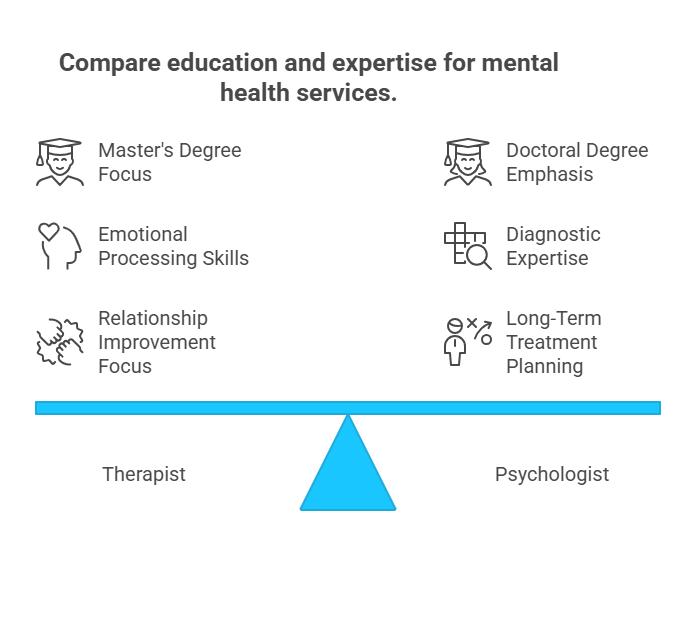
Both therapists and psychologists support mental and emotional wellbeing — but they do so with different training, tools, and scopes of practice.
Looking for evidence-based support? Find a qualified psychologist near you through TherapyRoute.
Find a PsychologistTherapists primarily offer talk-based support to help individuals, couples, and families work through life’s challenges — from anxiety and grief to relationship struggles, including substance use issues. Psychologists may also offer therapy but are additionally trained to diagnose mental health conditions, conduct psychological testing, and work in academic, legal, or clinical research settings.
Let’s break down the two roles using four key categories:
Therapist
1. Education & Credentials
Therapists typically hold a master’s degree in counselling, psychology, social work, or a related mental health field. Common credentials include LPC (Licensed Professional Counsellor), LMFT (Licensed Marriage and Family Therapist), and LCSW (Licensed Clinical Social Worker). They must also complete supervised clinical hours and pass a licensing exam to practise independently.
Disclaimer: Education and training for psychologists can vary by country. In regions like India and South Africa, a Master's degree is typically required for clinical practice. Always consult local guidelines for specific qualifications.
2. Scope of Practice
Therapists use structured talk therapy techniques like CBT (Cognitive Behavioural Therapy), solution-focused therapy, or mindfulness-based approaches. They help clients process emotions, build coping skills, and navigate relationship or life transitions. While they can’t formally diagnose disorders in most regions, they can recognise symptoms and refer to psychologists or psychiatrists when needed.
3. Specialisations
Therapists often focus on:
- Anxiety and depression
- Trauma and grief
- Family or couples therapy
- Life transitions or stress management
- Child and adolescent therapy
4. Work Settings
Therapists commonly work in private practices, clinics, schools, wellness centres, and online platforms.
Psychologist
1. Education & Credentials
Psychologists hold a doctoral degree (PhD, PsyD, or EdD) in psychology. To become a licensed psychologist, their training includes coursework in psychological theory, research methods, and diagnostics, along with a clinical internship focused on patient care. After graduation, they must pass national and regional licensing exams.
Disclaimer: Education and training for psychologists can vary by country. In regions like India and South Africa, a Master's degree is typically required for clinical practice. Always consult local guidelines for specific qualifications.
2. Scope of Practice
Psychologists are licensed to diagnose mental health disorders, perform psychological evaluations and testing, and provide evidence-based therapy. Some psychologists also conduct research, teach at universities, or consult in various settings, including corporate and legal environments.
3. Specialisations
Psychologists may specialise in:
- Clinical psychology (mental illness diagnosis and treatment)
- Counselling psychology (emotional growth and adjustment)
- Neuropsychology
- Forensic or legal psychology
- Organisational or workplace psychology
4. Work Settings
Psychologists can be found in hospitals, universities, private practices, research institutes, and courtrooms — in addition to therapy clinics.
If you’re wondering how to choose the right therapist, it helps to look at how their education and credentials compare.
Still Confused? Here's a Quick Comparison Table At a Glance
Not sure whether to see a therapist or a psychologist? This quick side-by-side comparison breaks it down for you.
| Features | Therapist | Psychologist |
| Education | Master’s degree (e.g. counselling, psychology, social work) | Doctorate (PhD or PsyD in psychology) |
| Can Diagnose? |
Sometimes (depends on qualification and location) |
Yes, trained to diagnose mental health conditions |
| Can Prescribe Medication? | No | No (unless specially trained and licensed in certain regions) |
| Typical Focus | Emotional support, relationship issues, stress, grief | Mental health disorders, assessments, research, and advanced therapy techniques |
| Session Style | Talk therapy, goal-based counselling, supportive techniques | Therapy plus possible assessments, deeper analysis |
| Where They Work | Private practice, clinics, schools, hospitals | Same settings, plus universities, research, and courts |
| Cost (Typical Range) | Moderate (often lower than psychologist fees) | Higher (due to advanced qualifications and services) |
How Do They Compare On Education, Expertise, and More?
When it comes to psychologist vs therapist qualifications, the biggest difference lies in their level of education, and that difference affects the services they’re allowed to provide.
Both professionals complete extensive supervised training and must be licensed to practise. But while therapists typically finish a master’s degree, psychologists go several steps further with a doctorate and often pursue academic or clinical specialisations.
Let’s break it down.
Therapist: Education & Training Path
To become a licensed therapist, an individual usually completes:
- A master’s degree in counselling, psychology, social work, or a related mental health field
- A set number of supervised clinical hours (this varies by country or state)
- A licensure exam to legally offer therapy services
During their clinical training, therapists work directly with clients under supervision, gaining real-world experience with talk therapy techniques, client care, and ethical responsibilities.
Therapists focus on helping clients:
- Process emotions
- Improve relationships
- Develop healthy coping strategies
- Address mild to moderate mental health challenges
Many therapists also choose to specialise in trauma recovery, child and adolescent therapy, or marriage counselling, for example, as part of their ongoing professional development.
Psychologist: Education & Training Path
Psychologists, on the other hand, follow a longer academic route. To qualify as a psychologist, one must typically complete:
- A doctoral degree (PhD, PsyD, or EdD) in psychology, which includes coursework in various psychological theories and practices, as well as research methods.
- A clinical internship involving supervised work in hospitals, clinics, or academic settings
- Additional licensure requirements, including exams and continuing education
This rigorous training allows psychologists to:
- Diagnose complex mental health conditions
- Conduct psychological testing and evaluations
- Offer therapy (if licensed to do so)
- Contribute to research or teach in universities
Because of their advanced education, psychology degrees are especially equipped for deep diagnostic work and long-term treatment planning — ideal for clients dealing with conditions like OCD, PTSD, or personality disorders.
Disclaimer: Education and training for psychologists can vary by country. In regions like India and South Africa, a Master's degree is typically required for clinical practice. Always consult local guidelines for specific qualifications.
Also Read: Therapy vs Counselling: Understanding the Key Differences
Therapist vs Psychologist: What Services Do They Actually Offer?
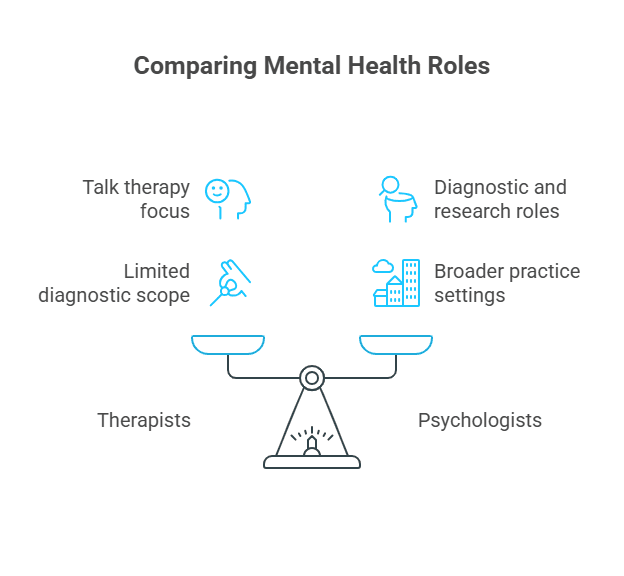
Therapists primarily focus on talk therapy, while psychologists offer both therapy and diagnostic services. Though both support mental health, their day-to-day roles can look very different in practice.
What Do Therapists Do?
Therapists provide structured talk therapy sessions tailored to emotional, behavioural, or relationship needs. Their goal is to create a safe, non-judgmental space to help clients work through:
- Stress and anxiety – manage daily overwhelm and fear-based patterns
- Depression or mood challenges – develop resilience and self-compassion
- Grief and loss – process emotions and rebuild meaning
- Trauma recovery – heal from past experiences and restore safety
- Family and relationship issues – improve communication and resolve conflict
Some therapists also help clients set personal goals, manage life transitions, or explore past experiences using tools like mindfulness techniques, mental health care, journaling, or cognitive reframing.
Note: While most therapists can’t formally diagnose mental health disorders, they’re trained to recognise symptoms and refer clients to specialists (such as clinical psychologists, or in some cases psychiatrists) when deeper assessment or medication is needed.
What Do Psychologists Do?
A psychologist’s role includes therapy, but their scope of practice is broader and more diagnostic. In addition to talk therapy, psychologists can:
- Diagnose mental health conditions (e.g. ADHD, PTSD, bipolar disorder)
- Administer psychological assessments and personality tests
- Work in diverse settings such as hospitals, universities, courtrooms, or clinics
- Provide therapy using evidence-based methods like CBT, DBT, or psychodynamic therapy
Some psychologists pursue non-clinical roles in behavioural research, corporate consulting, or academic teaching — blending mental health expertise with systemic or policy-level insights.
Filter professionals by therapy type, assessment need, or qualification — only on TherapyRoute. Whether you're seeking emotional support or formal diagnosis, we make your search simpler, faster, and stress-free.
Also Read: Therapy vs Counselling: Understanding the Key Differences
Specialisations in Therapy and Psychology Explained
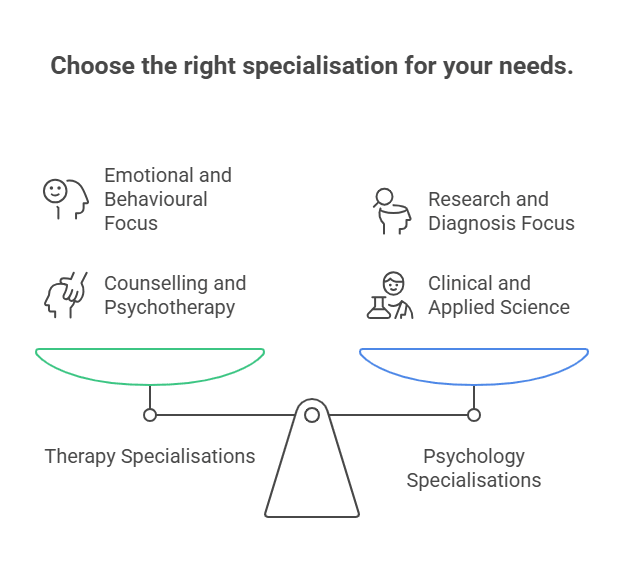
When choosing between a therapist vs psychologist, it’s not just about the title — it’s also about the type of help you need. Both fields offer a wide range of specialisations tailored to different emotional, behavioural, and psychological challenges.
Whether you’re dealing with anxiety, trauma, family issues, or workplace stress, finding the right specialisation can make a big difference in your healing journey.
Therapy Specialisations
Therapists often choose a focus area based on the populations or problems they feel most passionate about helping, including social anxiety. Common therapy specialisations include:
- Cognitive Behavioural Therapy (CBT) – Helps reframe negative thought patterns
- Psychodynamic Therapy – Explores past experiences and unconscious patterns
- Humanistic Therapy – Emphasises self-awareness and personal growth
- Marriage and Family Therapy (MFT) – Focuses on relationships and communication
- Substance Abuse Counselling – Supports addiction recovery
- Clinical Social Work – Combines emotional support with social service advocacy
These approaches can fall under what’s broadly called “counselling” or “psychotherapy.” While the terms are often used interchangeably, some professionals use “psychotherapy” to refer to deeper or longer-term mental health work.
Psychology Specialisations
In the field of psychology, specialisations are typically aligned with research, clinical diagnosis, or applied behavioural science. Some of the most common include:
Counselling Psychology – Supporting emotional and behavioural growth
School Psychology – Helping students with academic and social challenges
Forensic Psychology – Applying psychology in legal and criminal justice systems
Industrial-Organisational Psychology – Improving workplace mental health and performance
A psychologist vs therapist choice may come down to whether you need therapy alone, human services, or therapy combined with a formal diagnosis, evaluation, or specialist intervention.
How to Choose the Right Mental Health Professional?
So, how do you decide between a therapist and a psychologist with clinical experience?
The answer depends on what kind of support you’re looking for — and how complex your mental health needs are. Whether you’re navigating stress, severe mental illnesses, processing trauma, or seeking a formal diagnosis, understanding the difference between subfields of psychology vs therapy can point you in the right direction.
Here are three key steps to help you make the right choice:
Step 1: Know What You’re Dealing With
Start by asking yourself:
- Am I looking for emotional support, coping strategies, or personal growth?
- Do I need help with a specific issue (like anxiety, grief, or relationships)?
- Am I experiencing symptoms that might need a diagnosis or psychological testing?
When to See a Therapist
If your concerns are primarily emotional or situational — like adjusting to a life change, managing stress, or navigating relationship dynamics — a therapist can be a great first step. They’ll guide you through practical tools and emotional support strategies.
When to Consider a Psychologist
If you're facing persistent symptoms like mood swings, panic attacks, obsessive thoughts, or disordered thinking, you may benefit more from working with a psychologist — especially one trained in diagnosis and long-term treatment planning.
🔍 Not sure what you need? TherapyRoute lets you search by concern or condition so you can match with the right professional faster.
Step 2. Check Credentials and Experience
- Once you know what you’re looking for, check the professionals:
- Degree and license (e.g. MA, MSW, PsyD, PhD)
- Years of experience with your issue (e.g. trauma, child psychology, relationship therapy)
- Therapeutic approach (e.g. CBT, EMDR, talk therapy)
Whether you’re comparing a psychologist vs a therapist, always look for someone who is licensed and has experience working with people like you in different areas.
Bonus tip: Read bios and check for keywords that match your concern, like “stress management,” “family therapy,” or “depression in teens.”
Step 3. Consider Cost and Insurance
Before booking:
- Ask if the provider accepts your insurance company
- Inquire about sliding scale fees if you're paying out of pocket
- Explore lower-cost options like online therapy or community mental health services
Also Read: Psychotherapy vs Counseling: Which One’s for You?
When You’re Ready, We’re Here to Simplify the Search
Trying to get help for your mental health shouldn’t feel like another source of stress, but too often, it does. You’re already dealing with anxiety, low moods, or relationship strain... and now you're Googling job titles, reading bios, and second-guessing your choice.
At TherapyRoute, we get how overwhelming that can be.
That’s why we make it simple to find licensed therapists and psychologists all in one place. No confusing jargon. No guessing games. No hours of training. Just verified professionals, clearly listed by location, speciality, and approach — so you can find the right support without the mental load.
Your healing shouldn't be delayed by logistics. Let's help you start where it feels a little easier.
Conclusion
Choosing between a therapist and a psychologist isn’t about titles — it’s about finding the right fit for what you need. If you want someone to talk to and guide you through emotional challenges, a therapist is a great place to start. If you’re looking for a diagnosis or deeper mental health support, a psychologist may be the right call, as there are significant differences in their approaches and expertise.
What matters most is taking that first step. Whether it’s therapy or psychological support, help is out there — and TherapyRoute can guide you to the right match.
Frequently Asked Questions
What is the difference between a therapist and a psychologist?
A psychologist has more advanced education and holds an advanced degree, while therapists have various levels of certification and degrees. Psychologists understand human behaviour and mental processes, and provide more in-depth treatments for mental health issues and case management.
What is the difference between a therapist and a psychiatrist?
Therapy vs psychotherapy- A therapist is a mental health professional specialising in talk therapy to help you understand your emotions and navigate life’s challenges, while a psychiatrist is a medical doctor trained to diagnose and treat mental health conditions with medication1 in a professional practice.
What does a therapist do?
A therapist provides psychological and emotional support to individuals facing challenging life issues. They listen to and analyse the patient’s concerns and specific goals, assess their mental health problems and emotional health and relationship problems, diagnose any psychological or mental illnesses, and develop a treatment plan.
What is the difference between therapy and counselling psychology?
Counselling typically addresses specific issues, while therapy seeks to uncover deeper underlying issues or provide a longer-term approach to mental and emotional health and emotional disorders as social scientist.
Can psychologists prescribe medication?
No, in most cases, school psychologists are not authorised to prescribe medication, as this is primarily the responsibility of psychiatrists with medical doctorates in daily life with different approaches. However, some American states have passed laws allowing psychologists with advanced psychopharmacology training to prescribe certain medications.2
Don't Miss These Reads:
In-Person or Online Therapy - Which one is the right one for me?
Stress vs Depression: Why Knowing the Difference Matters?
Psychotherapy vs Counseling: Which One’s for You?
References
- [1] American Psychiatric Association. What is Psychiatry? https://www.psychiatry.org/patients-families/what-is-psychiatry
- [2] Munsey, C. (2008). Psychopharmacology: Prescriptive authority in the states. Monitor on Psychology, American Psychological Association. https://www.apa.org/monitor/feb08/prescriptive
Important: TherapyRoute does not provide medical advice. All content is for informational purposes and cannot replace consulting a healthcare professional. If you face an emergency, please contact a local emergency service. For immediate emotional support, consider contacting a local helpline.
Find Therapists
Must Read
Creating Space for Growth: How Boundaries Strengthen Relationships
Setting healthy boundaries fosters respect, protects emotional well-being, and strengthens relationships by defining personal limits and maintaining self-care.
International Mutual Recognition Agreements for Mental Health Professionals
Mutual recognition agreements for mental health professions are rare and uneven, with major gaps in counselling, social work, and allied therapies. Read on to understand ...
Mental Health Licensing & Regulation in New York State: 2026 Guide
Mental Health Licensing & Regulation in Singapore: 2026 Guide
Jumping to Conclusions
Jumping to conclusions is a thinking habit where we assume the worst or make judgments without enough evidence. By recognising this pattern, therapy can help you slow dow...
About The Author

TherapyRoute
Cape Town, South Africa
“Our in-house team, including world-class mental health professionals, publishes high-quality articles to raise awareness, guide your therapeutic journey, and help you find the right therapy and therapists. All articles are reviewed and written by or under the supervision of licensed mental health professionals.”
TherapyRoute is a mental health resource platform connecting individuals with qualified therapists. Our team curates valuable mental health information and provides resources to help you find the right professional support for your needs.
