How to Handle Relationship Anxiety Before It Breaks You?

❝Can’t tell if it’s relationship anxiety or something deeper? This blog breaks down the signs, root causes, and what you can actually do.❞
You’re with someone who treats you well.
There are no red flags, no obvious problems—just this constant, nagging feeling that something’s off. You replay conversations, overanalyse their texts, and wonder if you’re “too much” or not enough. And then comes the thought you can’t shake:
“What if this isn't love? What if it’s just me?”
In this Article
- What Is Relationship Anxiety?
- How to Know If It’s Relationship Anxiety or Something Else?
- What Causes Relationship Anxiety?
- How to Deal With Relationship Anxiety Without Losing Yourself?
- Not Every Therapist Gets What You Mean by ‘Overthinking’, We Do At TherapyRoute
- Conclusion
- Frequently Asked Questions
If that sounds familiar, you’re not alone.
Many of us grow up without learning how to feel safe in relationships—especially when love is healthy and stable. What you’re feeling might not mean your relationship is wrong. It might just be relationship anxiety.
In this blog, we’ll talk about what relationship anxiety really is (beyond the Instagram quotes), how to tell it apart from gut instinct, and what to do when your thoughts keep getting in the way of your connection.
Because the goal isn’t to overthink less—it’s to feel secure enough that you don’t need to.
What Is Relationship Anxiety?
Relationship anxiety isn’t just nervousness at the start of dating. It’s a deeper, ongoing sense of unease — even when you’re in a good, stable relationship.
You might feel:
Managing anxiety is easier with the right support. TherapyRoute connects you with qualified therapists who specialise in anxiety and stress.
Find an Anxiety Therapist- Constant doubt about your partner’s feelings
- Fear that things will fall apart without warning
- Pressure to analyse every interaction for hidden meaning
At its core, what people often search for as “relational disorder” is relationship anxiety: the fear that your intimate relationships will fail, even in the absence of any obvious problems.
This anxiety doesn’t come out of nowhere. It’s often shaped by deeper emotional patterns.
What are the Key Signs of Relationship Anxiety?
- Overthinking everything – You replay conversations and search for signs something’s wrong.
- Doubting the relationship – Even when things feel good, you question if it’s real or lasting.
- Need for constant reassurance – You keep checking if your partner still cares.
- Fear of emotional loss – You feel like any small issue could lead to a breakup.
Also Read: Difference Between Anxiety and Depression: When to Seek Help
What are the Common Root Causes?
- Fear of abandonment – Worrying your partner might leave, even without clear signs.
- Feeling not “enough” – Believing you have to earn love or prove your worth.
- Self-sabotage – Pulling away or picking fights when things feel too safe.
- Past trauma – Old emotional wounds resurface in the present, especially if you’ve had inconsistent or hurtful relationships before.
How to Know If It’s Relationship Anxiety or Something Else?
Sometimes, relationship anxiety doesn’t feel like ‘anxiety’ at all. It feels like intuition. Like you’re being careful. But one caveat matters before reading any of the patterns below as anxiety: if what you feel is fear of your partner — of their anger, their control, or how they will react — that is not relationship anxiety, and it deserves to be taken at face value. Persistent fear can be a response to controlling or abusive behaviour. If that might be you, a domestic-violence service or a therapist of your own is the right first stop (find local services here), not an anxiety technique.
Here’s how to tell if what you're feeling could be relationship anxiety — and what those patterns are really telling you.
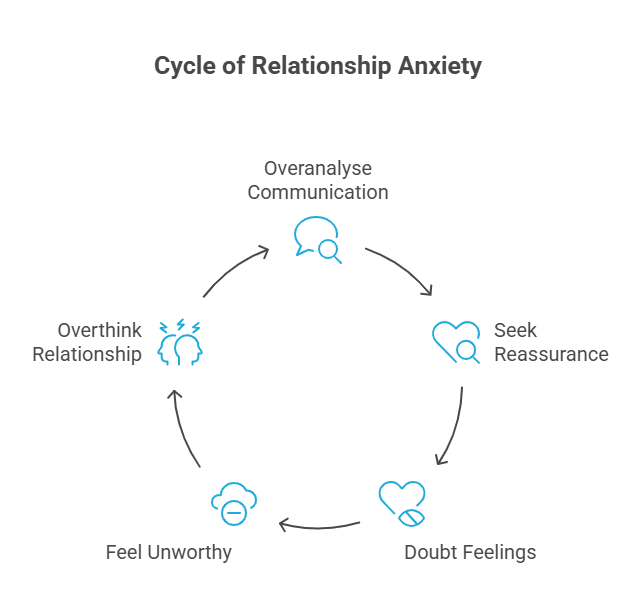
1. You overanalyse texts and silences
You replay conversations in your head — not once, but five or ten times. A “Hey” without a heart emoji? A “Call you later” instead of “Miss you”? Suddenly, your brain fills in a whole story about emotional distance or lost interest.
If you find yourself thinking:
- “Why didn’t they use a full stop?”
- “They said they were busy… but they liked a post on Instagram.”
- “They used to reply faster. Something must be wrong.”
You’re not being irrational — you’re trying to stay emotionally safe. But sometimes, anxiety can trick you into thinking normal fluctuations in communication are signs of disconnection. Learning to tolerate emotional ambiguity is a key step in healing.
2. You seek reassurance again and again
You know they care. You’ve heard it. But your mind keeps asking: “Do they still feel that way today?” So you find small ways to check,F through repeated questions, tone analysis, or “joking” about whether they still like you.
This often sounds like:
- “You still like me, right?”
- “Promise you’re not mad?”
- “Just checking — are we okay?”
Reassurance-seeking isn’t about being needy. It’s your nervous system craving certainty. But no amount of “We’re fine” will ever feel like enough — because anxiety always wants one more layer of proof. The work is learning to build safety within yourself, so you don’t rely solely on others to regulate your sense of worth.
3. You doubt their feelings even when things are good
You could be having a great weekend together — laughing, talking, connecting — and still think, “Maybe they’re pretending. What if they’re planning to leave?”
Common signs include:
- Disbelieving compliments or affection
- Questioning whether they’re “just being nice”
- Feeling a disconnect between what you see and what you fear
This is often the result of past emotional inconsistency — when people said one thing but did another. So now, even safe love feels suspicious. Healing starts with separating your current partner from past patterns.
4. You feel unworthy or like a burden
You may think your emotional needs are “too much” — even when they’re basic. You hold back feelings, apologise often, or worry that if you show your full self, your partner will walk away.
This might show up as:
- Saying “sorry” every time you ask for comfort
- Avoiding deeper conversations because “they have enough to deal with”
- Believing your partner is doing you a favour by staying with you
But you’re not a burden. You’re just someone who hasn’t always been made to feel safe in love. That doesn’t mean you have to shrink yourself — it means it’s time to give your own needs some respect.
5. You’re constantly overthinking the relationship
You’re always in your head:
What did that look mean?
Why did they say that like that?
What if this is the beginning of the end?
Overthinking relationship anxiety often looks like:
- Overanalysing tone, timing, or phrasing
- Imagining breakups that haven’t happened
- Feeling like the relationship is one mistake away from ending
Still can’t tell if it’s fear, intuition, or something deeper?
You don’t need to untangle it all in your head.
TherapyRoute connects you with experienced therapists who can help you make sense of your patterns, without judgment, pressure, or second-guessing.
Find clarity with someone who truly understands. Take the first step by speaking with a therapist who can help you understand and manage these feelings. →
What Causes Relationship Anxiety?
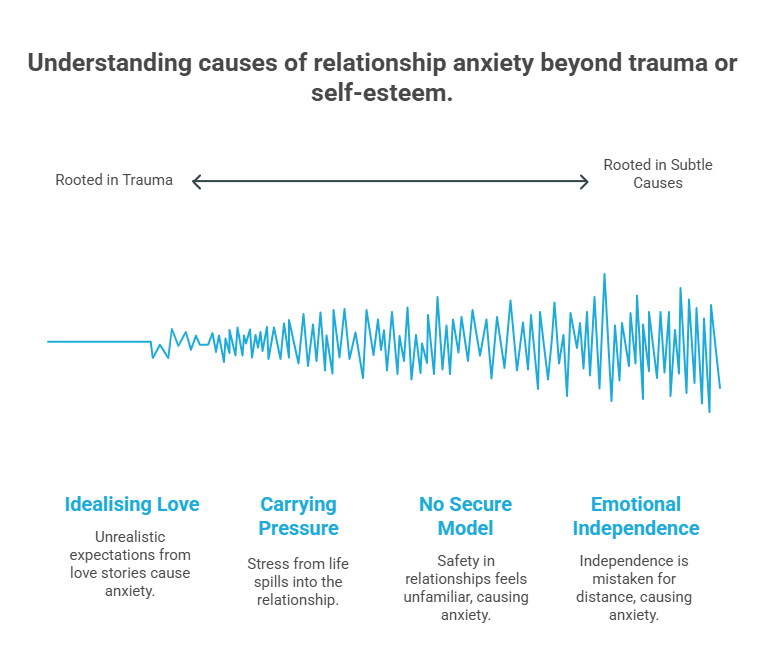
Not all relationship anxiety is rooted in trauma or low self-esteem. Sometimes, it comes from more subtle — even well-intentioned — common causes in your emotional life. You might not even realise these patterns are shaping your thoughts until the effects of anxiety begin to affect your connection.
Here are a few overlooked but very real contributors to relationship anxiety
1. Idealising love instead of learning it
If you grew up on a steady diet of love stories — whether through films, books, or just watching couples around you — it’s easy to develop a picture of what relationships should feel like, and a lack of communication skills can disrupt that image. The spark. The certainty. The effortless communication.
But real love often doesn’t look like a fantasy. And when it doesn’t match, you might start to wonder if something is wrong.
You may find yourself:
- Questioning your feelings when things feel “normal”
- Believing love should always be exciting, romantic, or dramatic
- Panicking when comfort replaces intensity
Relationship anxiety can creep in not because something’s off, but because it doesn’t look like the version you expected.
2. Carrying emotional pressure from other areas of life
Sometimes, anxiety in a relationship isn’t about the relationship at all. When your job is stressful, your family dynamic is messy, or your self-worth is tied up in achievement, your romantic connection can unintentionally become the place where all that pressure lands.
You might notice:
- Taking minor relationship issues very personally
- Becoming hyperaware of conflict or tone
- Projecting fears about failure or inadequacy onto your partner
This doesn’t mean you’re “too much.” It means your emotional bandwidth is stretched, and your relationship becomes the mirror.
3. Having no model for emotionally secure relationships
If you’ve never seen a relationship that’s grounded, communicative, and non-defensive, it can feel unfamiliar — even unsafe — when you finally experience one. Your mind might interpret peace as boredom, or consistency as a trap.
It could sound like:
- “This feels too easy — what’s the catch?”
- “They don’t get jealous. Do they even care?”
- “Why don’t we fight more? Is something wrong?”
You’re not creating problems or being overtly jealous — your nervous system is trying to make sense of safety it doesn’t recognise.
4. Misinterpreting emotional independence as distance
A secure partner might not constantly text, initiate, or reassure you — not because they’re pulling away, but because they trust the safe space between you.
But if you associate love with intensity, reassurance, or emotional labour, that space can feel terrifying.
You might start to feel:
- Unloved when your partner isn’t expressive
- Anxious when they seem “too okay” without you
- Worried that independence means disconnection
This doesn’t mean they’re too distant — it may mean they’re securely attached. And it may be an opportunity to build that sense of self and inner steadiness yourself.
Not all relationship anxiety comes from obvious wounds. Sometimes, it comes from what you didn’t learn — how to sit with calm love, how to be with someone without losing yourself, or how to let relationships unfold without gripping tightly.
Want to unlearn old patterns and make space for healthy connection? TherapyRoute helps you find therapists who work with modern relationships, emotional regulation, and real-world intimacy — not just textbook love.
How to Deal With Relationship Anxiety Without Losing Yourself?
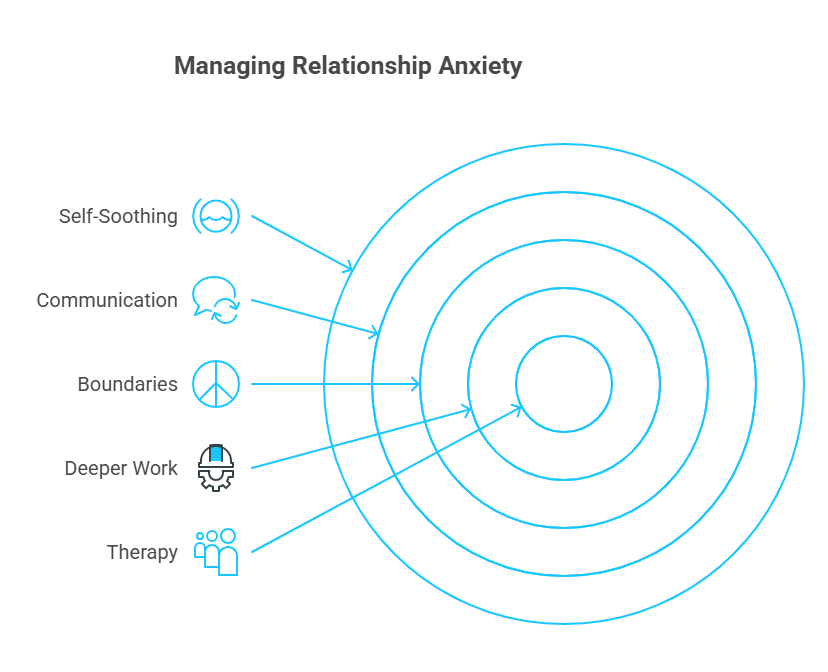
Knowing what relationship anxiety is doesn’t always stop the spirals. You can understand every term in the book and still feel overwhelmed by the “what ifs.” That’s normal. The good news is the goal isn’t to stop feeling anxious overnight — it’s to respond to that anxiety with a little more clarity and care.
Here are a few grounded ways to start managing it:
1. Start with self-soothing techniques
This isn’t about “calming down” in the way people often dismissively say it. It’s about supporting your nervous system when your thoughts are running wild.
Try:
- Journaling your feelings (especially what triggered them)
- Taking a few slow, deep breaths
- Reframing spirals like “They’ll leave me” into “This is a fear, not a fact”
When you learn how to deal with relationship anxiety in the moment, you create space between the thought and your reaction, and that space changes everything.
Also Read:
How to Stop Shaking from Anxiety Immediately: Quick Tips
2. Communicate honestly (without blame)
Your partner isn’t a mind reader, and silence often makes anxiety louder. Instead of bottling things up, practice active listening and name what you’re feeling in a gentle, grounded way.
Try saying something like:
“This isn’t about something you’ve done. I just feel anxious sometimes, and I’d like to talk through it.”
When you name your fear, it loses some of its grip. And more often than not, honest communication brings you closer, not further apart.
Have you found yourseld questioning- Is it him? Or is it me? Find your answer in our article here.
3. Set boundaries — especially with yourself
Overchecking, rereading texts, or second-guessing every conversation often feels helpful in the moment, but it feeds anxiety over time.
Small, self-supportive boundaries can help, like:
- “I’ll reread that message only once.”
- “I’ll wait 30 minutes before texting again.”
- “I’ll ground myself before jumping to conclusions.”
These boundaries aren’t about controlling someone else — they’re about protecting your peace.
4. Do the deeper work, not just damage control
If you want to know how to overcome relationship anxiety and maintain a healthy relationship, and mental health issues, it’s not just about managing triggers. It’s about understanding the roots — where those fears began, what they’re protecting you from, and how cognitive behavioral therapy, along with addressing cognitive distortions, and couples therapy can help you gently shift the negative thought patterns and other patterns over time.
This part takes patience. It might look like self-reflection, solo time, or inner child work. And if that sounds overwhelming, therapy can guide you through it.
5. Consider therapy — when you’re ready
Sometimes, the best way to calm the noise in your head is to speak it out loud in a safe, non-judgmental space. Therapy, including online therapy services, gives you that.
If your anxiety keeps interrupting even the good moments…
If you’re exhausted from carrying these questions alone…
If you’re not sure what’s real and what’s fear anymore...
A licensed therapist can help you untangle it all — gently, clearly, and with care.
TherapyRoute makes it easier to find someone who understands both relationships and the way anxiety works.
Start your search when you’re ready.
Not Every Therapist Gets What You Mean by ‘Overthinking’, We Do At TherapyRoute
You’re not just re-reading texts. You’re trying to decode tone, timing, silence, and subtext and protect yourself from emotional drop-off.
That’s not insecurity. That’s vigilance. And it makes sense.
TherapyRoute helps you find someone who sees that for what it is through filtered navigation— not something to fix, but something to understand.
You don’t need advice.
You need to be seen.
Find a therapist who helps you feel safe, not scrutinised →
Conclusion
Relationship anxiety doesn’t mean your love isn’t real. It just means your mind is trying to protect you — sometimes a little too hard. Whether you’re navigating fears, gut feelings, or emotional patterns that won’t let up, you’re not broken — and you’re not alone.
The goal isn’t to never feel anxious. It’s to feel safe enough to stay connected, even when anxiety shows up.
Frequently Asked Questions
Is it relationship anxiety or a gut feeling?
It can be hard to tell the difference between relationship anxiety or gut feeling. A gut feeling is usually calm, steady, and rooted in your deeper intuition — it tends to feel like quiet certainty. Relationship anxiety, on the other hand, is noisy, urgent, and often tied to past experiences or fears. If your thoughts change day to day and feel emotionally overwhelming, it’s more likely anxiety than instinct. One exception matters: if what feels like a gut feeling is fear of your partner — of their anger, their control, or how they will react — treat it as a safety signal rather than anxiety, and consider talking it through with someone you trust or a professional.
How do I know if it’s relationship anxiety or not being in love?
This is one of the most common questions people ask. If you feel emotionally connected but often fearful, it might be anxiety. But if you feel emotionally checked out or indifferent, it could be that you're not in love. The difference between relationship anxiety or not in love often comes down to emotional desire versus emotional detachment. A therapist can help you explore this without judgment.
What causes anxiety in a relationship?
There are many reasons you might experience anxiety in relationships, including past trauma, fear of abandonment, low self-esteem, or feelings of unworthiness and an anxious attachment style. Even if your current partner is kind and supportive, unresolved emotional patterns can resurface. due to an underlying anxiety disorder. It’s not a sign you’re doing something wrong; it’s a sign that something inside you is asking to be seen.
Why do I keep overthinking everything in my relationship?
Overthinking relationship anxiety is often a way for your mind to seek control in situations that feel uncertain, impacting the health of your relationship. When you're unsure of where you stand emotionally, your brain tries to fill in the blanks — sometimes with worst-case scenarios. The good news? Overthinking isn’t a personality flaw. It’s a protective habit you can unlearn with time, self-awareness, and support for healthy communication and emotional connection.
Keep Reading:
Important: TherapyRoute does not provide medical advice. All content is for informational purposes and cannot replace consulting a healthcare professional. If you face an emergency, please contact a local emergency service. For immediate emotional support, consider contacting a local helpline.
Find Therapists
Must Read
Creating Space for Growth: How Boundaries Strengthen Relationships
Setting healthy boundaries fosters respect, protects emotional well-being, and strengthens relationships by defining personal limits and maintaining self-care.
International Mutual Recognition Agreements for Mental Health Professionals
Mutual recognition agreements for mental health professions are rare and uneven, with major gaps in counselling, social work, and allied therapies. Read on to understand ...
Mental Health Licensing & Regulation in New York State: 2026 Guide
Mental Health Licensing & Regulation in Singapore: 2026 Guide
Jumping to Conclusions
Jumping to conclusions is a thinking habit where we assume the worst or make judgments without enough evidence. By recognising this pattern, therapy can help you slow dow...
About The Author

TherapyRoute
Cape Town, South Africa
“Our in-house team, including world-class mental health professionals, publishes high-quality articles to raise awareness, guide your therapeutic journey, and help you find the right therapy and therapists. All articles are reviewed and written by or under the supervision of licensed mental health professionals.”
TherapyRoute is a mental health resource platform connecting individuals with qualified therapists. Our team curates valuable mental health information and provides resources to help you find the right professional support for your needs.