
“The Portable Analyst” - Containment

❝This is how it feels to sit with another person as we turn a story from something toxic, to something healing.❞
“A story is not like a road to follow … it's more like a house. You go inside and stay there for a while, wandering back and forth and settling where you like and discovering how the room and corridors relate to each other, how the world outside is altered by being viewed from these windows.” (Munro, 1996)
Also available in four parts - Click for Part 1
Let us take our seats and begin the work.
A young man in his late 20s, very tall, is trying to look comfortable in the patient’s seat opposite me when he says something revealing about a childhood memory, and then asks how I might have felt in similar circumstances. He withdraws slightly. “Oh,but I forgot. You are not you. You are ‘the therapist’.” It is my final year of training, and he has brought me up short. After a perceptible pause, out of some internal depth I choose not the neutral words of analytic inquiry, but the forceful words “On the contrary”. For in that moment, I know that in that room and with the patient I am my most essential self. The patient looks at me. “Ah, I'll think about that.”
I think about that, often. Why did I feel compelled to speak those words, and not the tried and tested neutral words designed to elicit a response from the patient addressing a person he does not know, who is not yet real, “the therapist”? It seems important that I acknowledge my own authenticity.
I call these essays a personal clinical memoir. I am trying to make accessible to a general audience, as well as to the psychotherapeutically trained, and to myself, what it feels like to sit with another person as we turn a story from something toxic, to something healing. Each essay that I begin is haunted by the echo of voices from my training foundation, especially when I feel that in order to do my work, I’m defying shibboleths. It can be painful to silence those voices in order to hear only my own and those of my patient. And the shibboleth in the vignette above, was the choice of words that belonged to me rather than the accepted phrases of an analytical session. The work proved to be therapeutic.
The young man and I worked together for a further six months after I qualified and when I asked how he was experiencing the ending he said, “sad but grateful.” And the room we went to had windows.
1. The Room
Here, step into this room. It is big enough for two to sit at a comfortable distance from one another. Light falls through a six- paned window, with two small casements that fill the top half of a wall, facing south-east. A patient sitting on the red sofa here could see, by late summer, tossing leaves of beech, oak, quince, apple and rosa rugosa, and the red tile roofs of the house at the end of the garden.
This room is a container, it has a door to enter, and perhaps as importantly, a door by which to leave. The room has windows and light. That is my choice. Not all consulting rooms have windows. For many that can represent womb-like safety. I learned in my training days in rooms below ground with no windows that my mind and other minds became shadowed. Perhaps the shadows were the thoughts of the patient, as they wandered in the unfamiliar space. Since I am inviting you into this room, for a moment it may seem as if it is my voice that is first heard. But of course, if someone has come here, they have spoken first when they asked to do so. And often for the people who come here, the experience of someone listening to their voice is a new one. The purpose of this safe room is to make it possible for each of us to listen. For one of us to speak. There is a story to be told.
Therapy should be personal. Therapists listed on TherapyRoute are qualified, independent, and free to answer to you – no scripts, algorithms, or company policies.
Find Your TherapistThis consulting room is a room in my house. The walls are the dividing space between our internal worlds and the world outside. But, as I write this I am in another house in another room on the shores of the Atlantic. As Alice Munro says, the world can be altered by looking at it from the windows. The morning after my arrival I stepped into the cool day, sunny and glittering with drops of the previous night’s rain on the ravaged old apple trees.
The air was full of the salt tang, as fresh in my nose as when I smelt it as a child on visits to the warmth and protection of my grandmother, who would wrap me in a hug full of the deep rose scent of Madame Rochas. For two months every summer she gave me a safe place to be; a quiet room, time to read, no punishment for errors for which I could never make reparation. And, just as my patient’s words had distilled for me the essence of my work, looking out the window distilled a memory of safety that has unconsciously informed my belief that such places can exist, and that I can share them with others who need them. The memory creates a boundary around the fear that there is no safe place.
People find themselves in pain when all the familiar fabric of life seems to be failing them; moth holes of pain letting in the chill. At that point some ask for help, and somehow, they must find some sheltered place to speak; to find again a thread that helps to make life coherent. Patient and therapist use this space to build insight into the experience and its sources. They explore fears and loss; memories and hope. Some even see the analyst’s mind as “a house that the patient slowly inhabits…a place where the patient can find shelter and be hosted” (Resnik, 2007).
2. The People
2.1 The analyst
No wonder, then, that when I qualified in 2009, I left with such a clear sense that containing was central to the work, and that it was up to me to use discipline and a framework to hold the patient (and myself) in safety. The frame , seemed to me at the time to be very material, consisting of time and space. Time, in its material sense represented the day and the hour at which a therapeutic session began and ended. Space meant the room in which the session took place; the arrangement of chairs, the table, the tissues, the lighting. And the way in and the way out. What was left with me as I moved on from my training was that the physical space was sacrosanct; objects could not move, lights must be tuned to the same level, chairs must be aligned in the same way. Only now do I recognise the irony that this was my belief when the inevitable consequence of moving on was to take myself, and those patients who chose to come with me into a new space.
Firmly seated in my imaginary armchairs of theory, were Wilfrid Bion and Donald Winnicott. Both men reflected deeply on contained clinical space. Both, inheritors of Melanie Klein, understood the powerful fabric of understanding between two minds, specifically the maternal mind and the infant. Winnicott speaks of “maternal preoccupation”, that time when the mother absorbs herself intently in the infant, and the infant brain takes in all it knows of the world (Rayner, 2015) . Having practiced first as a paediatrician, Winnicott was acutely aware of the emotional needs and growth of the child, whose traces he found in his adult psychotherapeutic patients. Bion described a “metabolism” of thinking in which a “container”, the mother takes in all the infant’s emotions, and quandaries; metabolises them in the “maternal reverie” of her own mind and returns them in some useful way to the infant; for example, understanding the meaning of a wordless cry as a call for food or dry nappies, and then delivering them (Caper, 1999) . Research of the human mind from the late 1940s through until today, has sought to observe, to describe and to understand the at once robust and delicate capacity of human minds to relate to one another. The therapeutic relationship between analyst and patient seeks to recreate the sense, when all is going well, of safety and profound understanding between two minds. Paralleling the maternal reverie, is the “analyst’s reverie”, a capacity to pay attention to as yet unspoken thoughts or feelings, and to interpret them. (Akhtar, 2009)
In the containing room I have invited you to enter there is a wooden bowl, silky smooth and curving to a wide lip. Many colours of inlaid tiles made from 12 different woods flow around the bowl. I bought it from the M’ikimaw artist who made it in Nova Scotia, because in addition to its being a lovely object, I could think of it as being able to hold the thoughts of many sessions. While some of my training supervisors were a bit censorious about personal objects in the room, I’ve always taken comfort in objects that hold light or are smooth to the touch. Cosimo Schinaia observes that objects create a kind of intimacy in the consulting space, a subtle self-disclosure, which can “become part of the analysand’s fantasies.” (Schinaia C. , 2016).
2.2 The Analysand (Patient)
“Has anyone else ever said you remind them of Tony Soprano’s analyst?” The patient was an English actor, starting six sessions of time-limited therapy. So we both had to work quickly. And he got in first, with that question. Hard not to feel a little frisson of pleasure in being compared to Jennifer Melfi, husky-voiced empathic listener, perhaps the first to listen to the painful truths of the sociopathic Tony.
And here is a signal point for the analyst; one’s own foibles need to be heard and reflected upon, as much as the patient’s are. What might that frisson of pleasure mean? It is nicer than being attacked, certainly. But, reluctantly I must step away a little, and wonder if I am perhaps hearing a self-protective act on the part of the patient – keeping the unknown person at bay. And then I need to remember that in the beginning I am not myself to the patient. I am who they imagine me to be. Although I feel fully authentic in the work, that authentic person is not yet known to the other person in the room. On my part I need to be aware, not only that it’s a pleasure to be imagined as such a charismatic person, but that it is not useful for the work for me to be seduced by the idea. There is every possibility that hate and anger may now or soon form part of the communication. And all of this reflecting happens simultaneously with listening as intently as I can to what the patient is saying.
2.2.1 Louise Bourgeois; analysis and reparation in a room
…I come from that background where we repaired the damage on the tapestries and the idea of repairing has stayed with me….Wanting to repair the past involves the experience of guilt, and guilt is present in all my work. (Bourgeois, 2019)
Louise Bourgeois (1911-2010), the Franco-American artist famous for her enormous spider scultptures, was in analysis with Dr. Henry Lowenfeld from 1952 until his death in 1985. Towards the end of her life a dossier of “dreams, symptoms, memories, fantasies, anxieties, desires and complaints, interleaved with drawings, notes from her reading, post-session reflections, and occasional nuggets of analytic wisdom” (Nixon, 2012) emerged. It cannot be said on reading the notes and uncompromisingly honest reflections on her own internal landscapes or viewing the often tortured expressions of that internal world in her art, that she would have been a comfortable patient. Frances Morris, Director of Tate Modern interviewed her and said that she always felt intimidated by her. (Tate Museum of Modern Art, 2022)
A lightening discharge runs between my 2 temples and the challenge is experienced as terror, it is the chapter of Fear...fear or rather terror slays me, confuses me and makes me spinning around and completely deprived. It is not a question of learning for I am totally destroyed by fear…I am on the other side of despair, and this happens to me 4 times a day, I am fed up. (Bourgeois, 2019)
This is an extraordinary trove of the work of psychoanalysis continuing outside the consulting room. Rooms often appear in her work, some of them almost life size representations of uncanny homes and houses; some created as cells; reflecting the “container contained”. There is so much that one can distill from her thoughts, her work and her life that the temptation is to run away with her altogether. But for the purposes of the portable analyst perhaps we can focus on Bourgeois’ exhausting daily terror, from which she transforms “hate into love” (Tate Museum of Modern Art, 2022) . The terrors can drive her into states of rage, for which she must make reparation; and from which she creates archetypes of the alchemy of the therapeutic relationship. Let us take a closer look at the Lady in Waiting in her room.
We see the room through a window, so it has light. There is a small figure in a beautifully tapestried chair, so we have the image of the joint work of patient and therapist, the tapestry of a narrative. If you see the original work, you will become aware that what look like piercing pins, are in fact spider legs. Spiders fascinated and inspired Bourgeois representing for her a protective maternal nature. Many people who see her artwork are disquieted by a fear of spiders in Western European culture while trying to accept her view. Disquiet is part of the work, too. (Küster, 2018)
If she breaks free might the tapestry be damaged and need to be repaired? Is she the patient? Or might she be the therapist pinned forever in the chair, not free to take breaks or leave without permission until repairs are completed?
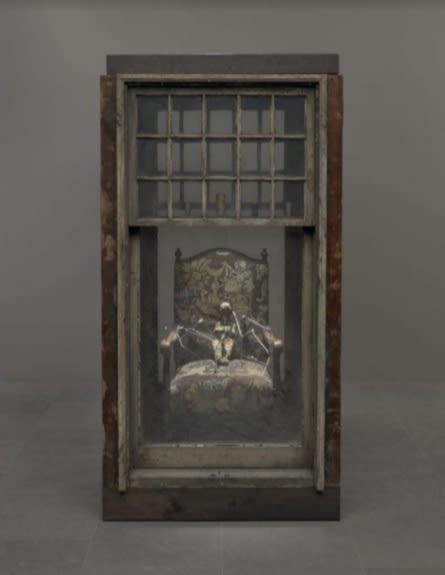
Figure 1 Louise Bourgeois, Lady in Waiting, 2003, tapestry, thread, stainless steel, steel, wood and glass, 82 x 43 ½ x 58 inches (208 x 110 x 147 cm) © The Easton Foundation/VAGA at Artists Rights Society.
2.3 Nomads – refugees from the outside world
One of the sources of Bourgeois’ guilt had roots in her leaving France, with her American husband in 1939. Staying behind were her father and brother Pierre. (Her mother had died in 1932). She thus became a nomad, while her family remained in the wreckage of World War II.
…I can complain and I find excuses to my failures as a woman of my femininity-I despise myself and vilify myself and I despise women. It is a pretext to be a man- at that time Jacques Bourgeois is a good student. I have to give up the piano and math… (Bourgeois, 2019)
It is perhaps no surprise that in the 1940’s she created among other sculptures in a series called Personnages, one called the Portable Pierre which she carried from room to room. (Nixon, 2012) Pierre was her brother, missing from her life as the consequence of war. So Bourgeois also gave us a portable personnage to represent a companion who comes with us from room to room.
The room in which I have been seeing patients for the past two years is an archetype of the containing rooms. And so far, only I have physically sat in it. It came into being during the first lockdown of the pandemic, in March 2020, so while many of my patients have seen it, it is only what can be seen in the frame of a video screen. It is a room in my house in Buckinghamshire, a rural county about an hour from London. I had been using another room two days a week to see local patients before lockdown. But that room had unsatisfactory network connections, so for a few weeks, my patients “saw” me in a study in a hut at the bottom of the garden, where the network periodically disappeared altogether. Finally we all came together in this room with the six-paned window and the M’ikimaw bowl. So, like nomads we wandered for a bit until finding a resting place, near the warmth of a local area network node.
I had to reimagine the safe space, and then enable it to function reliably. The first casualty was the shared material container. But time, and the therapist remained, along with a reimagined room, one end of which is the patient’s creation.
It is surprising to describe me and my patients since 2020 as nomads when physically we were often only permitted out of our homes for half an hour, and not permitted to go farther than five miles. Even my Buckinghamshire patients had to adapt because they could not enter my house. In contrast to my countryside patients, some of my London patients had wandered with me through four moves I had made over 12 years. The first two of such moves I planned over several months, preparing the patients carefully for the shift, and allowing several weeks afterwards to find room for their anger or despair. More than once I heard the impatient variation on the theme “Well, you’re here” and an instant return to what mattered most, that is the communication of pain and a deep need to be heard.
Ideally, one does not want to spring a fundamental shift on patients. But sometimes it is unavoidable. A sudden lockdown means we must be prepared to move instantly and be able to travel instantly to another safe place. In this environment I heard variations on the theme, “But you are the constant.” I’ve come to wonder whether we infantilise our patients in all the careful wrapping and unwrapping of material space, as if they did not have the capacity to work their way into an alternativee safe space.
3. A form of alchemy – in the contained space, analyst and analysand learn from each other
I spoke above of an idealised engagement between two minds. In the past the concept of the “blank screen” described an idealised analytic stance in which the complete neutrality of the analyst appears as a blank screen on which the analysand can project fears and feelings.
If two minds are to engage then one mind cannot be an imperviable surface. Even in my training years this analytic position was fading (Ogden T. H., 1994) . The blank screen, while possibly only a metaphor, can become a withholding of care and attention. It does not support the human engagement needed for the growth of the infant mind or the injured mind. In my mind it held the seeds of abuse. Somehow, I needed to maintain a stance that did not judge but did engage. And at the same time, I had to withold from the patient my internal reflections of my “own stuff”. The engagement is real but not a social exchange, where the listening therapist also demands to be heard. It is not that the analyst’s personal material is not the patient’s business. It is that it must not be the patient’s burden.
The epigraph of this essay continues “And you, the visitor, the reader, are altered as well by being in this enclosed space… You can go back again and again, and the house, the story, always contains more than you saw the last time.” (Munro, 1996) This could be a description of therapeutic creativity, and the relationship between writer and reader is a poignant metaphor. The relationship that therapist and patient experience, leads to growth and new understanding. I think it is the therapist who is the “reader” understanding not just the words, but also the currents of thought not yet known or expressed. The patient is the author.
We jointly weave a new narrative that helps to give form to the unthought and the, until now, unthinkable furnishings of the mind. With this new thread of knowledge the patient is ready to go on to a new stage of her life; as a person who has built a sense of her own freedom and integrity. This must be the therapist’s hope, too. (Cardinal, 1993)
Wandering has also become part of the work. All my consulting room moves in London were the result of external forces, for instance outgrowing the limited hours offered by the owner of the room or a landlord ending the lease. Or fleeing the plague. Part of the work and part of the life.
Containment and boundaries remain non negotiable bases for therapeutic work. The question is where are these boundaries built? And how solid are they? In another perspective of containment, Carlo Rovelli reflects that conceptualizing the world is always changing; reality is made up of relations rather than objects. (Rovelli, 2021)
If there are no relationships, there are no objects. This suggests that it is within the bonds of attachment between two people that a safe space, what Winnicott describes as a transitional space, has the potential to exist. That space has been found not only, nor even most importantly, in the consulting room, but also in the analyst’s mind and in the creative space created by analyst and patient together.
So, The “Portable Analyst” emerges from the containing space, as a convenient device in which to carry away essential elements. And even a kind of knapsack for the analyst in these testing times. From my point of view nothing could be more welcome to the analyst than to know that s/he is not needed for the patient to continue to grow; to know that she will engage not only with her version of the analyst, but also with springs of knowledge from the living world, is the greatest reward the analyst can imagine. Indeed, usually one must depend upon imagination, for after the work ends, the analyst can know no more.
Note:
“The portable analyst” - This is the second in a series of Clinical Memoirs. The first, Therapists and Patients at the Epicentre of a Pandemic of Not Knowing can be found here.
Anne Foster, MA, FPC (Fellow), UKCP is a psychodynamic psychotherapist in private practice in Buckinghamshire, UK, although one of the strange gifts of the pandemic is the ability to be present for people through technology that makes borders truly liminal. She is a writer and presenter. anne@annefosterpractice.com
Works Cited - This bibliography refers to works consulted and cited in all four parts, and will be repeated in each part
Abram, J. B. (Ed.). (2019). The Enigma of the Hour: Display Case Compendium: 100 years of Psychoanalytic Thought curated by Simon Moretti with Goshka Macuga and Dana Birksted-Breen. International Journal of Psychoanalysis 100:1481-1613, 100. Retrieved February 2, 2022, from https://pepweb.org/search/document/IJP.100.1481A?page=P1548&preview=IJP.100.1481A&q=blank%20screen%20
Akhtar, S. (2009). Comprehensive Dictionary of Psychoanalysis. London: Karnac.
Arquitectura-G. (2021). Leopold Banchini: Not Nomadic. apartamento(27), pp. 193-216.
Bourgeois, L. (2019). The Spider and the Tapestries. Berlin: Hatje Cantz Verlag.
Bronfen, E. (2012). Contending with the Father: Louise Bourgeois and her Aesthetics of Reparation. In P. Larratt-Smith (Ed.), Return of the Repressed (Vol. 1, pp. 101-114). London: Violette Ltd.
Caper, R. (1999). A Mind of One's Own. London: Routledge.
Cardinal, M. (1993). Les mots pour le dire. London: British Classical Pressan imprint of Gerald Duckworth & Co. Ltd.
de Waal, E. (2010). The Hare with Amber Eyes. London: Chatto & Windus.
Foster, A. (2020). Therapists and Patients at the Centre of a Pandemic of Not knowing. Retrieved 2021, from Therapy Route.com: https://www.therapyroute.com/article/therapists-and-patients-at-the-epicentre-of-a-pandemic-of-not-knowing-by-a-foster
Hirsch, E. (2021). Derek Walcott; The art of poetry no. 37. In Poets at Work; Interviews from the Paris Review (pp. 230-271). New York: Paris Review of Books.
Hockney, D., & Gayford, M. (2016). A History of Pictures. From the Cave to the Computer Screen. London: Thames & Hudson.
Holmes, J. (2001). The Search for the Secure Base; Attachment Theory and Psychotherapy. Hove: Routledge.
Holmes, J. (2020). The Brain has a Mind of its Own. London: Confer.
Indiana, G. (2019). Gary Indiana on the psychoanalytic writings of Louise Bourgeois –Hauser & Wirth. Retrieved from www.hauserwirth.com/ursula: https://www.hauserwirth.com/ursula/25821-gary-indiana-psychoanalytic-writings-louise-bourgeois/
Kuspit, D. (2012). Louise Bourgeois in Psychanalysis with Henry Lowenfeld. In P. Larratt-Smith (Ed.), The Return of the Repressed (Vol. 1, pp. 17-30). London: Violette.
Küster, U. (2018). Louise Bourgeois. Berlin: Hatje Cantz Verlag.
Leader, D. (2019). Bacon and the Body. In Bacon and the Mind; art, neuroscience and psychology (pp. 62-97). London: Thames and Hudson; Estate of Francis Bacon.
McLane, M. (2021). Susan Howe; The Art of Poetry No. 97. In V. Seshadri (Ed.), Poets at Work; Interviews from the Paris Review (pp. 272-303). New York: Paris Review Editions.
Munro, A. (1996). Selected Stories. Toronto: McClelland and Stewart.
Nixon, M. (2012). L. In P. Laratt-Smith (Ed.), The Return of the Repressed (pp. 85-100). London: Violette.
Ogden, T. (2015). On Potential Space. In M. Boyd Spelman, & F. Thomson-Salo (Eds.), The Winnicott Tradition; Lines of Development - Evolution of Theory and Practice over the Decades (pp. 121 - 137). London: Karnac Books.
Ogden, T. H. (1994). The Analytic Third: Working with Intersubjective Clinical Facts. International Journal of Psychoanalysis, 75:3-19.
Preta, L. (Ed.). (2015). Geographies of Psychoanalysis; Encounters between cultures in Iran. Mimeses International.
Rayner, E. (2015). Two Pioneers in the history of infant mental health; Winnicott and Bowlby. In M. B. Spelman, & F. Thomson-Salo (Eds.), The Winnicott Tradition (pp. 363-370). London: Karnac Books.
Resnik, S. (2007). Biografie dell'Inconsio. Rome: Borla.
Rovelli, C. (2021). Helgoland. London: Allen Lane an imprint of Penguin Books.
Schinaia, C. (2016, 05 22). Psychoanalysis and Architecture: The Inside and the Ouside, by Cosimo Schinaia. Retrieved 05 29, 2018, from https://karanacology.com: karnacology.com/2016/05/22/psychonalysis-and-architecture
Schinaia, C. (2016). Psychoanalysis and Architecture; The Inside and the Outside. London: Karnac.
Singer, L. (. (2021, spring/summer). Louise Bourgeois. apartamento, pp. 82-113.
St Clair, K. (2016). Secret Lives of Colour. London: John Murray Press.
Street, S. (2020). The Sound of a Room; Memory and the Auditory Presence of Place. Abingdon, Oxon: Routledge.
Tate Museum of Modern Art. (2022, March 18). The Art of Louise Bourgeois. Retrieved 2022, from www.tate.org.uk/art/artists: https://www.tate.org.uk/art/artists/louise-bourgeois-2351/art-louise-bourgeois
The Art Of Memory; Pierre Bonnard. (2019, January 2021). London, England. Retrieved November 14, 2021, from https://www.tate.org.uk/art/artists/pierre-bonnard-781/art-memory
Verhaeghe, P., & De Ganck, J. (2012). Beyond the Return of the Repressed: Louise Bourgeois's Chtonic Art. In Larratt-Smith (Ed.), Louise Bourgeois The return of the repressed (pp. 115 - 128). London: Violette Editions.
Verhaegue, P. (2008). On Being Normal and Other Disorders. London: Karnac.
Vickers, N. (2020). Winnicott's notion of 'holding' as applied to serious physical illness. BJP, 36(4), 610-620.
Who is Louise Bourgeois. (2022, March 18). Retrieved from www.tate.org.uk/kibds: https://www.tate.org.uk/kids/explore/who-is/who-louise-bourgeois
Zagajewski, A. (2021, May 14). Tart Cherries, Sweet Cherries. Times Literary Supplement, 11. (C. Cavanagh, Trans.)
Important: TherapyRoute does not provide medical advice. All content is for informational purposes and cannot replace consulting a healthcare professional. If you face an emergency, please contact a local emergency service. For immediate emotional support, consider contacting a local helpline.
Find Therapists
Must Read
Creating Space for Growth: How Boundaries Strengthen Relationships
Setting healthy boundaries fosters respect, protects emotional well-being, and strengthens relationships by defining personal limits and maintaining self-care.
International Mutual Recognition Agreements for Mental Health Professionals
Mutual recognition agreements for mental health professions are rare and uneven, with major gaps in counselling, social work, and allied therapies. Read on to understand ...
Mental Health Licensing & Regulation in New York State: 2026 Guide
Mental Health Licensing & Regulation in Singapore: 2026 Guide
Jumping to Conclusions
Jumping to conclusions is a thinking habit where we assume the worst or make judgments without enough evidence. By recognising this pattern, therapy can help you slow dow...
About The Author

“I work with people who want to find or rediscover their resources to overcome the states of mind that are blocking pleasure in life.”
Anne Foster is a qualified Psychotherapist (Registered), based in Speen, United Kingdom. With a commitment to mental health, Anne provides Psychodynamic Therapy.



