“The Portable Analyst” Part 2


❝Part 2 - How it feels to sit with another person as we turn a story from something toxic, to something healing.❞
Part 2 of 4 The discovery of self ; Louise Bourgeois; analysis and reparation in a room, in which we explore more deeplythe experience of an individual.
Therapy should be personal. Therapists listed on TherapyRoute are qualified, independent, and free to answer to you – no scripts, algorithms, or company policies.
Find Your Therapist…I come from that background where we repaired the damage on the tapestries and the idea of repairing has stayed with me….Wanting to repair the past involves the experience of guilt, and guilt is present in all my work. (Bourgeois, 2019)
Louise Bourgeois (1911-2010), the Franco-American artist famous for her enormous spider scultptures, was in analysis with Dr. Henry Lowenfeld from 1952 until his death in 1985. Towards the end of her life a dossier of “dreams, symptoms, memories, fantasies, anxieties, desires and complaints, interleaved with drawings, notes from her reading, post-session reflections, and occasional nuggets of analytic wisdom” (Nixon, 2012) emerged. It cannot be said on reading the notes and uncompromisingly honest reflections on her own internal landscapes or viewing the often tortured expressions of that internal world in her art, that she would have been a comfortable patient. Frances Morris, Director of Tate Modern interviewed her and said that she always felt intimidated by her. (Tate Museum of Modern Art, 2022)
A lightening discharge runs between my 2 temples and the challenge is experienced as terror, it is the chapter of Fear...fear or rather terror slays me, confuses me and makes me spinning around and completely deprived. It is not a question of learning for I am totally destroyed by fear…I am on the other side of despair, and this happens to me 4 times a day, I am fed up. (Bourgeois, 2019)
This is an extraordinary trove of the work of psychoanalysis continuing outside the consulting room. Rooms often appear in her work, some of them almost life size representations of uncanny homes and houses; some created as cells; reflecting the “container contained”. There is so much that one can distill from her thoughts, her work and her life that the temptation is to run away with her altogether. But for the purposes of the portable analyst perhaps we can focus on Bourgeois’ exhausting daily terror, from which she transforms “hate into love” (Tate Museum of Modern Art, 2022). The terrors can drive her into states of rage, for which she must make reparation; and from which she creates archetypes of the alchemy of the therapeutic relationship. Let us take a closer look at the Lady in Waiting in her room.
We see the room through a window, so it has light. There is a small figure in a beautifully tapestried chair, so we have the image of the joint work of patient and therapist, the tapestry of a narrative. If you see the original work, you will become aware that what look like piercing pins, are in fact spider legs. Spiders fascinated and inspired Bourgeois representing for her a protective maternal nature. Many people who see her artwork are disquieted by a fear of spiders in Western European culture while trying to accept her view. Disquiet is part of the work, too. (Küster, 2018)
If she breaks free might the tapestry be damaged and need to be repaired? Is she the patient? Or might she be the therapist pinned forever in the chair, not free to take breaks or leave without permission until repairs are completed?
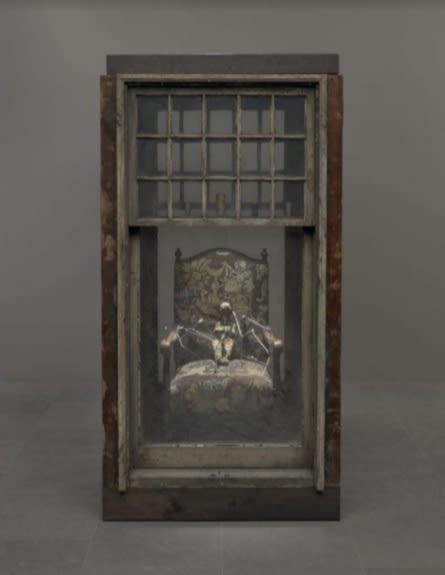
Figure 1 Louise Bourgeois, Lady in Waiting, 2003, tapestry, thread, stainless steel, steel, wood and glass, 82 x 43 ½ x 58 inches (208 x 110 x 147 cm) © The Easton Foundation/VAGA at Artists Rights Society.
Note:
“The portable analyst” - I borrowed the title from Mignon Nixon, describing a sculpture of Lowenthal by Louise Bourgeois. (Nixon, 2012)This is the second in a series of Clinical Memoirs. The first, Therapists and Patients at the Epicentre of a Pandemic of Not knowing can be found here www.therapyroute.com/article/therapists-and-patients-at-the-epicentre-of-a-pandemic--of-not-knowing-by-a-foster
Anne Foster, MA, FPC (Fellow), UKCP is a psychodynamic psychotherapist in private practice in Buckinghamshire, UK, although one of the strange gifts of the pandemic is the ability to be present for people through technology that makes borders truly liminal. She is a writer and presenter. anne@annefosterpractice.com
Works Cited - This bibliography refers to works consulted and cited in all four parts, and will be repeated in each part
Abram, J. B. (Ed.). (2019). The Enigma of the Hour: Display Case Compendium: 100 years of Psychoanalytic Thought curated by Simon Moretti with Goshka Macuga and Dana Birksted-Breen. International Journal of Psychoanalysis 100:1481-1613, 100. Retrieved February 2, 2022, from https://pep-web.org/search/document/IJP.100.1481A?page=P1548&preview=IJP.100.1481A&q=blank%20screen%20
Akhtar, S. (2009). Comprehensive Dictionary of Psychoanalysis. London: Karnac.
Arquitectura-G. (2021). Leopold Banchini: Not Nomadic. apartamento(27), pp. 193-216.
Bourgeois, L. (2019). The Spider and the Tapestries. Berlin: Hatje Cantz Verlag.
Bronfen, E. (2012). Contending with the Father: Louise Bourgeois and her Aesthetics of Reparation. In P. Larratt-Smith (Ed.), Return of the Repressed (Vol. 1, pp. 101-114). London: Violette Ltd.
Caper, R. (1999). A Mind of One's Own. London: Routledge.
Cardinal, M. (1993). Les mots pour le dire. London: British Classical Pressan imprint of Gerald Duckworth & Co. Ltd.
de Waal, E. (2010). The Hare with Amber Eyes. London: Chatto & Windus.
Foster, A. (2020). Therapists and Patients at the Centre of a Pandemic of Not knowing. Retrieved 2021, from TherapyRoute.com: https://www.therapyroute.com/article/therapists-and-patients-at-the-epicentre-of-a-pandemic-of-not-knowing-by-a-foster
Hirsch, E. (2021). Derek Walcott; The art of poetry no. 37. In Poets at Work; Interviews from the Paris Review (pp. 230-271). New York: Paris Review of Books.
Hockney, D., & Gayford, M. (2016). A History of Pictures. From the Cave to the Computer Screen. London: Thames & Hudson.
Holmes, J. (2001). The Search for the Secure Base;Attachment Theory and Psychotherapy. Hove: Routledge.
Holmes, J. (2020). The Brain has a Mind of its Own. London: Confer.
Indiana, G. (2019). Gary Indiana on the psychoanalytic writings of Louise Bourgeois –Hauser & Wirth. Retrieved from www.hauserwirth.com/ursula: https://www.hauserwirth.com/ursula/25821-gary-indiana-psychoanalytic-writings-louise-bourgeois/
Kuspit, D. (2012). Louise Bourgeois in Psychanalysis with Henry Lowenfeld. In P. Larratt-Smith (Ed.), The Return of the Repressed (Vol. 1, pp. 17-30). London: Violette.
Küster, U. (2018). Louise Bourgeois. Berlin: Hatje Cantz Verlag.
Leader, D. (2019). Bacon and the Body. In Bacon and the Mind; art, neuroscience and psychology (pp. 62-97). London: Thames and Hudson; Estate of Francis Bacon.
McLane, M. (2021). Susan Howe; The Art of Poetry No. 97. In V. Seshadri (Ed.), Poets at Work; Interviews from the Paris Review (pp. 272-303). New York: Paris Review Editions.
Munro, A. (1996). Selected Stories. Toronto: McClelland and Stewart.
Nixon, M. (2012). L. In P. Laratt-Smith (Ed.), The Return of the Repressed (pp. 85-100). London: Violette.
Ogden, T. (2015). On Potential Space. In M. Boyd Spelman, & F. Thomson-Salo (Eds.), The Winnicott Tradition; Lines of Development - Evolution of Theory and Practice over the Decades (pp. 121 - 137). London: Karnac Books.
Ogden, T. H. (1994). The Analytic Third: Working with Intersubjective Clinical Facts. International Journal of Psychoanalysis, 75:3-19.
Preta, L. (Ed.). (2015). Geographies of Psychoanalysis; Encounters between cultures in Iran. Mimeses International.
Rayner, E. (2015). Two Pioneers in the history of infant mental health; Winnicott and Bowlby. In M. B. Spelman, & F. Thomson-Salo (Eds.), The Winnicott Tradition (pp. 363-370). London: Karnac Books.
Resnik, S. (2007). Biografie dell'Inconsio. Rome: Borla.
Rovelli, C. (2021). Helgoland. London: Allen Lane an imprint of Penguin Books.
Schinaia, C. (2016, 05 22). Psychoanalysis and Architecture: The Inside and the Ouside, by Cosimo Schinaia. Retrieved 05 29, 2018, from https://karanacology.com: karnacology.com/2016/05/22/psychonalysis-and-architecture
Schinaia, C. (2016). Psychoanalysis and Architecture; The Inside and the Outside. London: Karnac.
Singer, L. (. (2021, spring/summer). Louise Bourgeois. apartamento, pp. 82-113.
St Clair, K. (2016). Secret Lives of Colour. London: John Murray Press.
Street, S. (2020). The Sound of a Room; Memory and the Auditory Presence of Place. Abingdon, Oxon: Routledge.
Tate Museum of Modern Art. (2022, March 18). The Art of Louise Bourgeois. Retrieved 2022, from www.tate.org.uk/art/artists: https://www.tate.org.uk/art/artists/louise-bourgeois-2351/art-louise-bourgeois
The Art Of Memory; Pierre Bonnard. (2019, January 2021). London, England. Retrieved November 14, 2021, from https://www.tate.org.uk/art/artists/pierre-bonnard-781/art-memory
Verhaeghe, P., & De Ganck, J. (2012). Beyond the Return of the Repressed: Louise Bourgeois's Chtonic Art. In Larratt-Smith (Ed.), Louise Bourgeois The return of the repressed (pp. 115 - 128). London: Violette Eidtions.
Verhaegue, P. (2008). On Being Normal and Other Disorders. London: Karnac.
Vickers, N. (2020). Winnicott's notion of 'holding' as applied to serious physical illness. BJP, 36(4), 610-620.
Who is Louise Bourgeois. (2022, March 18). Retrieved from www.tate.org.uk/kibds: https://www.tate.org.uk/kids/explore/who-is/who-louise-bourgeois
Zagajewski, A. (2021, May 14). Tart Cherries, Sweet Cherries. Times Literary Supplement, 11. (C. Cavanagh, Trans.)
Important: TherapyRoute does not provide medical advice. All content is for informational purposes and cannot replace consulting a healthcare professional. If you face an emergency, please contact a local emergency service. For immediate emotional support, consider contacting a local helpline.
Find Therapists
Must Read
Creating Space for Growth: How Boundaries Strengthen Relationships
Setting healthy boundaries fosters respect, protects emotional well-being, and strengthens relationships by defining personal limits and maintaining self-care.
International Mutual Recognition Agreements for Mental Health Professionals
Mutual recognition agreements for mental health professions are rare and uneven, with major gaps in counselling, social work, and allied therapies. Read on to understand ...
Mental Health Licensing & Regulation in New York State: 2026 Guide
Mental Health Licensing & Regulation in Singapore: 2026 Guide
Jumping to Conclusions
Jumping to conclusions is a thinking habit where we assume the worst or make judgments without enough evidence. By recognising this pattern, therapy can help you slow dow...
About The Author

“I work with people who want to find or rediscover their resources to overcome the states of mind that are blocking pleasure in life.”
Anne Foster is a qualified Psychotherapist (Registered), based in Speen, United Kingdom. With a commitment to mental health, Anne provides Psychodynamic Therapy.