
Taking Care of your Mental Health

❝Small changes can make an enormous difference. Here are some that you should focus on.❞
When any of the factors in the image below are not in good shape, that's an indicator that you need a change. Setting just one goal for each can do more good than you think. All of these, at their extreme ends, play a critical role in promoting, or adversely affecting, your mental health. A poor sleeping routine can affect your information processing speed and affect your cognition. However, the reverse is healthy brain development and improved mental processing.
Therapy should be personal. Therapists listed on TherapyRoute are qualified, independent, and free to answer to you – no scripts, algorithms, or company policies.
Find Your Therapist
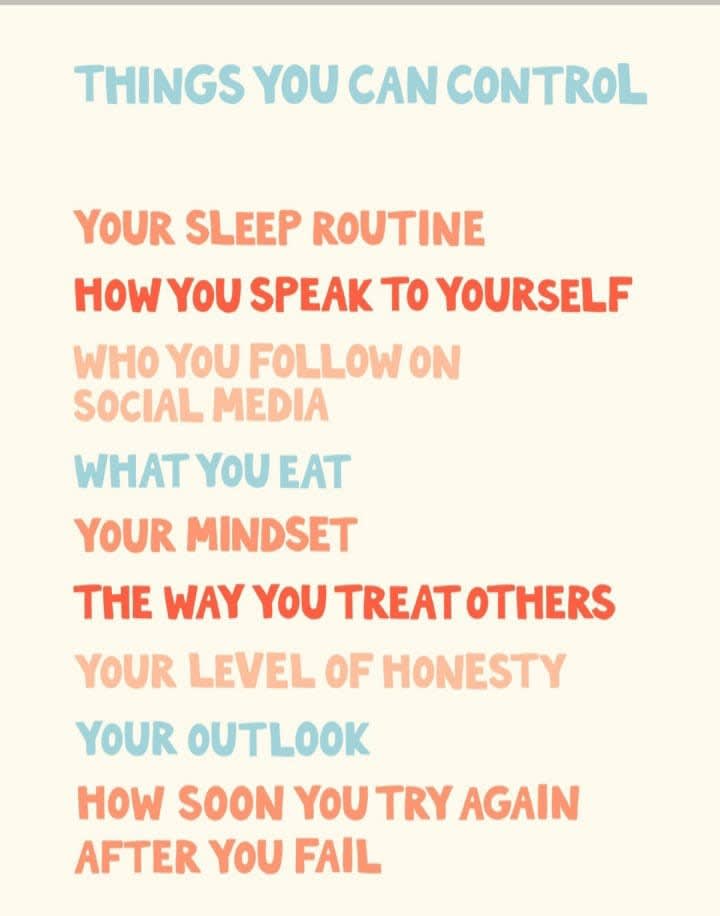
How you speak to yourself affects how you think, and how you think affects how you feel, and how you feel affects how you act in return. Negative self-talk is damaging to your mental health. Fostering positive self-talk is positively related to yielding positive thoughts, which can elicit positive feelings.
How/what you follow on social medial can either promote your self-esteem and your ideal self or damage them. A deficit in any of these two can cause problems to your mental wellbeing. Regulate your social media consumption.
What you eat; what your diet comprises of can build or destroy your physical wellbeing. Physical wellbeing is closely linked to our self-image. A distorted self-image affects our self-worth, resulting in an unhealthy perception of us and the world around us. We must take care of what we ingest and what our mind consumes (starting with what we tell ourselves). A side note to this is that it is also important to remember that good physical exercise coupled with good nutrition are crucial in reducing stress.
Your mindset can be a great tool in boosting or affecting your self-confidence. People with a positive mindset are more resilient even in the face of stressful life events. On the other hand, individuals with a negative mindset are less resilient and easily affected by stressful situations. Furthermore, those with more resilience, built on a positive mindset, amidst problematic life occurrences tend to bounce back and navigate harsh life hurdles.
The spirit of ubuntu calls for us for us, me for them and them for me. This means that our actions can either build or break them - How we treat someone can promote or destroy their mental health. It is important to consider whether our actions or what we say can affect or build someone's emotional wellness. The best way to take care of this is to go ahead of others and view their world through their lens before acting—even the smallest act of just listening to them and thinking before speaking can build empathy. With EMPATHY, we will treat others well, and we will be mindful of them. Treat others the way you would like to be treated if you mind both your mental health and theirs as well.
Being honest would take a slightly different trajectory from how genuine we are, honest individually with our emotions. You cant have emotional intelligence if you cant acknowledge how you feel and safely be expressive of our of them. These two are among the tenets of emotional Intelligence. It is something most of us struggle with. I am not saying I am exceptional. Being genuine is important. It can spare us from unforeseen, highly negative emotions such as guilt, self-blame or even shame in future.
Your outlook entails how you perceive yourself. A negative perception is not healthy for your mental health, whereas reversing your negative perception to a positive one is really paramount to you mental state. Positive self talk and being grateful for the small wins can help sustain a good perception towards oneself.
Life is full of potholes, and we sometimes fall into them, and they became crises that we need to overcome. How well we overcome is dictated by how soon we try to stand up again after failing. A person with good mental health is likely to have a high level of resilience, and our level of resilience is pinned to how soon we try after failing. Therefore, resilience and mental health marry each other. A person with poor mental health can have low levels of resilience, and conversely, a highly resilient individual is likely to have good mental health.
In conclusion, the state of our mental health lies in our sleeping hygiene, what we feed our minds, our use of social media, what we eat and how our physical health is, our mindset, how we treat others and how we are treated in return, our honesty to ourselves and how we feel, our perception and our level of resilience. Take care of these measures of wellness, and you would have taken care of your mental health.
Important: TherapyRoute does not provide medical advice. All content is for informational purposes and cannot replace consulting a healthcare professional. If you face an emergency, please contact a local emergency service. For immediate emotional support, consider contacting a local helpline.
Find Therapists
Must Read
Creating Space for Growth: How Boundaries Strengthen Relationships
Setting healthy boundaries fosters respect, protects emotional well-being, and strengthens relationships by defining personal limits and maintaining self-care.
International Mutual Recognition Agreements for Mental Health Professionals
Mutual recognition agreements for mental health professions are rare and uneven, with major gaps in counselling, social work, and allied therapies. Read on to understand ...
Mental Health Licensing & Regulation in New York State: 2026 Guide
Mental Health Licensing & Regulation in Singapore: 2026 Guide
Jumping to Conclusions
Jumping to conclusions is a thinking habit where we assume the worst or make judgments without enough evidence. By recognising this pattern, therapy can help you slow dow...
About The Author

“My area of expertise include: Trauma, Anxiety, Depression, Post-Traumatic Stress Disorder(PTSD),suicide, loss and grief, anger management,”
Simon Aukot is a qualified Counselor, based in Nairobi, Kenya. With a commitment to mental health, Simon provides Psych & Diagnostic Assessment, Clinical Supervision, Conflict Management, Counseling, Psychology, Stress Management and Individual Therapy.



