
When to Get Marriage Counseling: 10 Key Signs

❝Wondering when to get marriage counseling? Discover 10 key signs you shouldn’t ignore, plus practical tips and guidance to help strengthen your relationship today.❞
In this Article
TL;DR
|
Every relationship experiences its share of ups and downs. But when the low points start to stretch on longer than expected, it’s natural to ask yourself: When do you need marriage counseling? Or even more quietly, Do I need relationship counseling if something doesn’t feel right? These questions often arise not during loud arguments but in the quieter moments of growing distance, frequent tension, or emotional fatigue.
Many couples delay getting help, hoping things will improve on their own. But unresolved issues, whether around communication, intimacy, or trust, can slowly create patterns that become harder to break. Recognising the signs early can help you address them before deeper disconnection sets in.
What is Marriage Counseling?
Marriage counseling, or couples counseling, is a form of professional support that helps partners address challenges in their relationship. It involves guided sessions with a trained counselor who facilitates open, honest conversations about issues such as communication, conflict, or emotional disconnect.
Unlike advice from friends or family, counseling provides a neutral, structured space where both partners feel heard. It's not just for relationships in crisis, but it can also strengthen healthy ones by improving understanding and connection.
Sometimes you just need someone qualified to talk to. Find a counsellor near you — independent, professional, and ready to listen.
Find a CounsellorA 2012 review found that couple therapy positively affects around 70% of couples who receive it, with effectiveness rates comparable to individual therapy and well ahead of couples in untreated control groups.
Whether you're dealing with parenting stress, repeated arguments, or a growing sense of distance, marriage counseling offers tools to help you reconnect and move forward.
Facing recurring issues in your relationship? Explore our blog on common marriage problems and how to handle them for practical insights and support.
What are the 10 Key Signs it Might Be Time for Marriage Counseling?
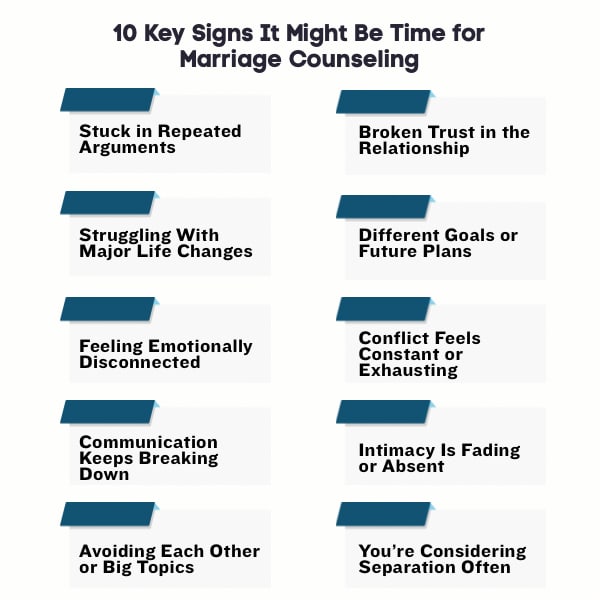
Problems in a marriage don’t always announce themselves clearly. More often, they show up gradually, through repeated arguments, silence, or the growing feeling that you’re no longer on the same page. If any of the signs below sound familiar, it may be worth reflecting on how to move forward, together or with the guidance of a couples therapist.
1. Are You Repeating the Same Arguments?
Whether it’s money, in-laws, daily routines, or digital boundaries, some disagreements seem to circle endlessly. These are not just random fights; they often point to deeper frustrations, misaligned expectations, or feeling unheard over time.
A skilled therapist helps you move beyond surface-level disagreements to understand what's really driving the conflict. Through structured tools like active listening and conflict-resolution techniques, you’ll learn how to break these cycles and create lasting change.
2. Are Life Transitions Putting a Strain on Your Relationship?
Transitions like becoming parents, relocating for work, grieving a loss, or starting a second marriage can deeply affect emotional dynamics. These changes, while sometimes positive, often bring stress, uncertainty, or shifts in roles that many couples aren’t fully prepared for.
Schedule check-ins with each other during or after big life events. Talk about how each of you is coping emotionally. If tensions persist, consider short-term relationship therapy to navigate these transitions with better tools and shared understanding.
3. Are You Feeling Emotionally Disconnected?
You may live under the same roof, share responsibilities, and even laugh occasionally, but the emotional intimacy you once had feels like a distant memory. You’re growing apart, not because of one major event, but from slowly drifting away over time.
Spend intentional time together doing activities that once brought you joy. Couples counselling helps identify what has changed and why. A therapist facilitates open, non-judgmental dialogue so each partner can share needs, concerns, and desires. Together, you can work on rebuilding emotional closeness and reconnecting around shared values and goals.
4. Is There a Breakdown in Communication?
Are conversations with your partner laced with sarcasm, silence, or avoidance? Poor communication isn’t always about arguing, but it can also be about the lack of openness, or emotional withdrawal when things get hard.
If attempts to improve dialogue fail, couples counselling may offer structured techniques like active listening or emotion-focused communication, led by a skilled therapist. Over time, this can improve not just how you speak, but how you feel heard.
5. Are You Avoiding Each Other or Important Topics?
Are you dodging conversations about finances, family planning, or future goals? Or worse, are you avoiding each other entirely? This kind of avoidance can quietly erode connection and prevent real emotional closeness from developing.
Instead of postponing hard conversations, pick a neutral time and environment. Keep it short, honest, and judgment-free. If you're struggling to break the silence, seeking professional help, even solo, can help bring clarity and courage.
6. Has Trust Been Broken?
Whether it’s infidelity, financial secrets, or broken promises, once trust is broken , even small interactions can feel loaded with suspicion. Over time, this damages not just the relationship, but your self-esteem and sense of safety.
Rebuilding trust is difficult but possible. A neutral, supportive environment allows both partners to process what happened and what it means. With patience and guidance, marriage counseling can rebuild a stronger foundation, based on transparency and accountability.
Struggling with overthinking or emotional insecurity in your relationship? Don’t miss our guide on how to handle relationship anxiety before it breaks you .
7. Do You Feel More Like Roommates Than Partners?
Many couples slowly slip into roommate dynamic, sharing space, chores, and maybe even parenting, but not intimacy, dreams, or emotional connection. It can happen after years of marriage or even within the first few.
Reintroduce practices that strengthen bonding like weekend coffee chats, tech-free dinners, or gratitude journaling. Counseling helps couples revisit what brought them together in the first place, shared goals, intimacy, and joy. You’ll work to restore connection and meaning, moving from mere cohabitation to true partnership.
8. Are You Struggling to Cope with Parenting Stress?
Parenting, though fulfilling, can also become a major stressor in a relationship. Differences in parenting styles, lack of time for each other, or disagreements about discipline can create tension.
In counseling, couples can learn to navigate parenting challenges together with greater clarity and cooperation. Marriage counseling encourages mutual respect, helps align parenting values, and supports couples in nurturing their relationship while managing the demands of raising children.
9. Has Physical or Sexual Intimacy Declined?
All relationships evolve over time. But when sexual intimacy fades or physical closeness disappears completely, it’s often a signal of deeper emotional or physical disconnection. Health issues, stress, or mental health challenges may also contribute.
Couples counseling can help you identify emotional barriers to closeness. You’ll work on rebuilding both emotional and physical connection, without blame or pressure.
10. Have You Thought About Separation, or Are You Already in Crisis?
Thinking about separation or frequently saying, “I can’t do this anymore,” is a strong indicator of distress. For some, this may follow years of unresolved disagreements; for others, a sudden emotional disconnect or a painful argument may have triggered a sense of crisis.
Even in times of crisis, discernment counseling or intensive marital therapy can help clarify the path ahead. Whether you choose to work on the relationship or end it peacefully, therapy ensures the decision comes from reflection, not reactivity.
Working to mend your relationship? Don’t miss our blog on 7 key truths to understand when rebuilding a broken marriage .
Find the Right Marriage Counselor on TherapyRoute
Every couple’s journey is different, so the support you choose should reflect that. Whether you prefer in-person sessions or feel more comfortable talking from home, TherapyRoute helps you find a marriage counselor who understands your unique story.
With filters for therapy style, format (online or in-person), location, language, and cultural background, you can choose someone who truly fits, not just your schedule, but your relationship’s needs. No confusing directories or hidden agendas, just independent, verified professionals committed to helping you grow together.
Your marriage deserves personalised support; visit TherapyRoute now to connect with a counsellor who can help you navigate challenges and nurture your bond, one step at a time.
Final Thoughts
Knowing when to seek marriage counseling isn’t always easy. If you’ve been wondering how to tell if you need marriage counseling, trust your intuition. You don’t have to wait for things to fall apart. And if you’ve asked yourself, do I need marriage counseling, more than once, that may already be your answer.
Let counseling be the space where both of you are heard, seen, and supported, moving together from conflict to connection.
This is where discernment counseling can help. Whether you’re facing trust issues, lack of commitment, or emotional burnout, a skilled couples counsellor can guide you in choosing the best path forward.
Frequently Asked Questions
1. Can one partner start marriage counseling alone?
Yes, you can start counseling individually. It can help you understand your feelings, improve communication skills, and reflect on relationship patterns. Often, one partner’s growth encourages the other to participate once they see the benefit.
2. How long does marriage counseling usually take?
It varies. Some couples attend 6–12 sessions, while others may need longer support. The duration depends on the nature of your concerns, how regularly you attend, and your goals as a couple. Your therapist will guide the process.
3. Is marriage counseling only for couples in crisis?
No, counseling isn’t just for serious problems. Many couples seek support to improve communication, strengthen emotional connection, or navigate life changes. Early intervention often prevents small issues from becoming larger, long-term problems in the relationship.
4. Will the counselor take sides during sessions?
A professional couples therapist remains neutral throughout. Their role is to support both individuals, help you understand each other’s perspectives, and guide constructive conversations. Therapy focuses on patterns, not blame or judgment, to encourage mutual growth.
5. How do I convince my partner to try marriage counseling?
Share how much the relationship means to you. Explain that counseling is a shared space to reconnect, not to assign blame. Suggest attending one session together before making a decision; it’s often enough to reduce resistance.
Important: TherapyRoute does not provide medical advice. All content is for informational purposes and cannot replace consulting a healthcare professional. If you face an emergency, please contact a local emergency service. For immediate emotional support, consider contacting a local helpline.
Find Therapists
Must Read
Creating Space for Growth: How Boundaries Strengthen Relationships
Setting healthy boundaries fosters respect, protects emotional well-being, and strengthens relationships by defining personal limits and maintaining self-care.
International Mutual Recognition Agreements for Mental Health Professionals
Mutual recognition agreements for mental health professions are rare and uneven, with major gaps in counselling, social work, and allied therapies. Read on to understand ...
Mental Health Licensing & Regulation in New York State: 2026 Guide
Mental Health Licensing & Regulation in Singapore: 2026 Guide
Jumping to Conclusions
Jumping to conclusions is a thinking habit where we assume the worst or make judgments without enough evidence. By recognising this pattern, therapy can help you slow dow...
About The Author

TherapyRoute
Cape Town, South Africa
“Our in-house team, including world-class mental health professionals, publishes high-quality articles to raise awareness, guide your therapeutic journey, and help you find the right therapy and therapists. All articles are reviewed and written by or under the supervision of licensed mental health professionals.”
TherapyRoute is a mental health resource platform connecting individuals with qualified therapists. Our team curates valuable mental health information and provides resources to help you find the right professional support for your needs.



