The Roles In Your Head - Therapy And Psycho Drama

❝Psychodrama - a rich, long-standing and powerful therapeutic method offering rich potential despite its lows visbility.❞
In our heads, scenes play out endlessly. Vivid moments we’ve had, we want to have, wish we’d had: intimate, shaming, wished for, sexualised, tense, regretted moments. These are the stuff of talk in therapy . But we can recreate these scenes in many other ways.
One powerful, little understood way is through psychodrama. Psychodrama works through action, often in groups, but it works through words in the therapy room, too. And it often brings an immediate, concrete quality when it does.
Family dynamics can be complex. A family therapist can help you navigate challenges and strengthen your relationships.
Find a Family TherapistPsychodrama is a remarkable system developed by Jacob Moreno, first in Vienna and then in the US last century. This multidimensional method emphasises human spontaneity and vitality, exploring how it becomes restricted and depleted in individuals, groups and society at large. Moreno investigated everything from the origins of spontaneity before birth, to assisting boxers to prepare for prize fights, to charting how good factory relationships could be developed.
A central feature in all these scenarios was the roles individuals took up, consciously or unconsciously, and how they play these out with others. Moreno wasn’t the first or only person to analyze roles like this, but he actively debated his approach with sociologists, social psychologists and others.
What he brought was an acute way to understand the dynamics, conflicts and congruence of role systems we all manifest.
Here’s an example that illustrates just two of the variety of ways psychodrama discloses these
A woman tells me of her dying father. The catch in her voice and her breathy tone signals the attachment and the anxiety she feels towards him. Immediately, a variety of competing role states are voicing themselves in her: warmth, and ambivalence; fear alongside concern; worry and determination. As she talks, she reveals roles towards me, too: trustfulness and dependence, a hint of alarm about how I’ll respond to her doubts and vulnerability. I, too, develop roles towards her: concern, care and a softness of heart. At another time, I could concretise each of these role states in both of us: trace what's familiar and what’s new about each of these responses, and how they express themselves visually, actively or viscerally. I could do this verbally, we could set it using objects or we could map it on paper. In my own supervision, I could link these states to my counter-responses or to other psychodynamic models: our attunement, co-regulation, our mutual object relations, or the transferential and projective elements in play.
At this moment, though, I ask a different question. It’s one psycho dramatist, mindful of the systems in which we all live, might ask. ‘Who is there around you?’ She replies: ‘My mother is with him at the moment’. She adds, ‘and my brother and sister are coming to town tomorrow. All four of us are getting together in the evening to discuss the next steps. Oh, and my daughter will be there, too.’
At once, new scenes become present, with each family member occupying different roles in them. Even in her few words, each scene evokes an imaginative potential that can be amplified and enlivened. They offer me many choices as a therapist. Which of them do I want to expand, and why?
For instance, I might invite her to explore what it means to have the family present so rapidly, or ask her to unfold her relationship with any one of them. Each such conversation would enrich our understanding of her family system. Imaginatively, as she talks, she would reverse roles with each of them: what is their experience, not hers, of this difficult world they are encountering? This might help her navigate her own experience, and theirs, around the conflicted dynamics at the end of life.
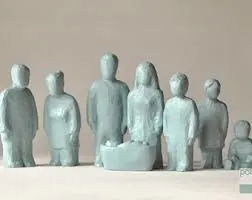
Since I have small figures in my room, soft puppets and little plastic kinder toys, we could explore all this in other ways. I might say: ‘Choose a figure that represents you, and place it on this table.’ Next, ‘choose others to be your family members and place them around you. Place them near or far, facing or turned away.’ I would add: ‘Where will you place your father in this scene?’ As she does this, she reveals her inner world: who is close, who distant; who is comforting or who is unhelpful. And this sociogram reveals all their relationships towards her dad. More than that, where she places her daughter related to the others speaks of three generations. Likewise, the way she constellates and clusters her figures says much, too. Of course, we are looking at her family system - a system that is immediately and densely peopled, and alive. It is also richly populated with therapeutic possibilities.
For instance, in a later meeting, I could ask her to set out her place in her family when she was small. Then we could compare this evocative picture of her family of origin with how she experiences her family now. This approach echoes family constellation therapy, but it can be expanded intergenerationally, cross-culturally over time and space.
Each approach allows us to bring out the known and unknown, the conscious and the implicit, about her inner world and about many of the close relationships which inhabit and inform it. This is Moreno’s sociometry: the strengths or weaknesses of our intimate ties, and how these constitute our understanding and experience of ourselves. It can be easily related to any psychotherapy or psychoanalytic system because it draws on similar components to them. For example, where Freud develops the unconscious, Moreno expands to the co-unconscious.
Yet psychodrama is, now, surprisingly little know apart from this one word it has bequeathed to the English language. This, despite the fact there are thriving communities across the world, whether Europe, the US, South America, Australia or New Zealand. To explore it is to stumble across its potency. What I’ve described here discloses only a fragment of its imaginative power, its immense healing potential and its rich collaborative possibilities with other methods.
Important: TherapyRoute does not provide medical advice. All content is for informational purposes and cannot replace consulting a healthcare professional. If you face an emergency, please contact a local emergency service. For immediate emotional support, consider contacting a local helpline.
Find Therapists
Must Read
Creating Space for Growth: How Boundaries Strengthen Relationships
Setting healthy boundaries fosters respect, protects emotional well-being, and strengthens relationships by defining personal limits and maintaining self-care.
International Mutual Recognition Agreements for Mental Health Professionals
Mutual recognition agreements for mental health professions are rare and uneven, with major gaps in counselling, social work, and allied therapies. Read on to understand ...
Mental Health Licensing & Regulation in New York State: 2026 Guide
Mental Health Licensing & Regulation in Singapore: 2026 Guide
Jumping to Conclusions
Jumping to conclusions is a thinking habit where we assume the worst or make judgments without enough evidence. By recognising this pattern, therapy can help you slow dow...
About The Author

“I am known as a warm practitioner. I have over twenty years experience with individuals, groups and collectives. I work long- and short-term, easily in person and online. This is true for therapy or professional supervision. ”
John Farnsworth is a qualified Psychotherapist, based in Dunedin, New Zealand. With a commitment to mental health, John provides Clinical Supervision, Corporate Workshops, Psychotherapy and Group Therapy.