The Possibility of Multiple Models for Oedipal Development

❝A reconsideration of the Oedipus complex and its culture-specific and variable nature.❞
For nearly 100 years and at least in certain prominent psychoanalytic subgroups, the Oedipus complex remained a defining construct that determined a boundary for those within and outside psychoanalysis .
The time is ripe for reconsidering its culture-specific and variable nature and its failure inter alia to explain with any degree of cogency ongoing internecine conflict in a community of clinicians and theoreticians who have had the benefit of oedipally-mediated training analyses.
Looking for evidence-based support? Find a qualified psychologist near you through TherapyRoute.
Find a Psychologist“I postulated a primary wish to rediscover a universe without obstacles, rough edges or differences ... The world in which the subject takes total possession of the mother can never be fully attained .... The mother’s thoughts are not totally taken up with the child.” (J. Chassaguet-Smirgel, The Archaic Matrix of the Oedipus Complex, p 511-515)
The Œdipal: “A psychoanalytic construct representing a fundamentally human problem: the initiation and entrance of the child into the adult world, into the moral order, into becoming an individual.” H. Loewald (paraphrased by Sacks in APA Panel, 1985)
Three-quarters of a century ago, in a polemic against religion and theoretical anarchism, Freud (Introductory Lectures XXXV, S.E. 1933a, p. 158) queried: “Does psychoanalysis lead to a certain Weltanschauung?” Answering this question in the negative, Freud counterpoised empirical science against illusion and
emotion
. Science, in Freud’s way of thinking, was about capturing the truth or, at least, about approximating closely towards the truth, while illusion was of and about the magical fulfilment of the wishes of childhood. Freud hoped, apparently, that Psychoanalysis could be established as one of the Natural Sciences, where it is assumed that researches are independent of value, meaning and notions of good and evil.
Alas! In the Psychological and Social Sciences, such theoretical neatness is a luxury, at best. I have argued elsewhere (Covitz, 1996) that psychological theories of development, as well as the nosologies that arise from them, are inextricably intertwined with idiosyncratic views of the healthy polity, of the well individual and even with ethico-religious and literary images of the good life. How can we possibly, after all, specify a developmental growth towards wholeness that is independent of the definitions that boundary these very notions? And how can we reasonably hope to conceptualize any aspect of human development without attending to — or at the very least allowing for — the exigencies of social and political life as manifested in human culture. I implicitly disagree with the view of Science that precipitates from such thought as Freud’s on this matter. Loosely speaking, I have little more to say in what follows than: the Spartan and Athenian œdipals must be fundamentally different, as must mine which arises from my own values.
In what follows, I briefly review conclusions from a twenty-five-year-old suggestion for an alternative theory of Œdipal development that ultimately demonstrated to me the failure of extant researches to permit an unambiguous choice between this novel theoretical model and Freud’s now classical one. Thereafter, I shall proffer a number of impetuses for continuing to maintain such an alternative view. Before proceeding, I would repeat the words of Freud (1940E: S.E. 23:273): “I find myself for a moment in the interesting position of not knowing whether what I have to say should be regarded as something long familiar and obvious or as something entirely new and puzzling.” In any case, what I have to say has not proven to be popular, as it simultaneously goes against a beloved shibboleth for inclusion under the psychoanalytic umbrella and offers up some criticisms of the broad analytic community, in general.
A Perfidious Excursion
In 1978, I sat listening to Loewald’s “On the waning of the œdipus complex” (Loewald, 1979) — a work that I had already examined. As the author read, I found myself entering into a quiet reverie about the dreams of the more flamboyant of the two biblical Josephs:
And he said to them: “Please, listen up to this dream which I have dreamt. And behold we were gathering sheaves in the midst of the field and behold my sheaf stood up and was erect and behold your sheaves arose and bowed to my sheaf... And behold I dreamt yet another dream and behold the sun and the moon and eleven stars were bowing down to me.”
It struck me, that day, as curious that Joseph would be so brazen as to present these dreams but odder still, that his brothers would be willing to consider fratricide to solve their frustration with this irksome adolescent. Noting, as perhaps only an ex-Mathematician might be expected to do, a similarity between the geometric structures of these dreams, on the one hand, and the productions of certain types of people suffering from narcissistic defences and/or disorders, on the other, I later argued that (Covitz, 1981):
(by) letting go of the content of the dreams ... and concentrating on the evanescent choreography of its characters, we see something else. There is a sameness in his mode of relating with each family member; each plays the same role, each a duplicate of the other. Beyond this, we note an absence of communication between the dreams’ faceless dancers. For instance, we may note that the celestial bodies are individually in orbit about Joseph; each separately relates to Joseph and to no one else.
Who among us, I asked, would not contemplate homicide to avoid a redaction of our personhood to the status of being just another face in a chorus of faceless dancers?
In the months and years that followed, I came to believe that Freud in his work on the Œdipus, not unlike the European sea-going discoverers who sought the East by sailing West, had discovered something else than what he had anticipated and imagined. The Œdipus was there in my reveries and in Loewald’s revisions ... but its driving dynamic was, perhaps, not the conjoin of sexuality and parricide but a certain ilk of narcissism. I thought of the pressing need to distinguish between complex multidyadic object relationships, on the one hand, and the sum of two or more dyadic relationships, on the other. Triadicity was different than multi-dyadicity. Joseph’s dreams contained representations of many dyads; but, in the sense that they were duplicates of each other, they were, after all, the same. These Josephean structures were apparent, I now imagined, in the relationships described by both neurotic and narcissistic patients for whom a capacity to appreciate the world from another’s vantage point, to empathize, was missing or damaged. Without empathy, I reasoned, there is, after all, but one Other! Put another way, triadic/social relationships required a capacity to see the other as subject-in-their-own-right, to allow the other to be centre of his or her cosmos. For the maturing child, I concluded, to enter the Œdipal situation, it would be necessary for him to have achieved adequate dyadic relations with both parents. But for him or her to successfully leave the Œdipus, a representation of the relationship that exists between the parents must have developed in the Psyche and have become acceptable – even cherishable. In this sense, I opined, the mastery of the Œdipus Complex brings with it or is brought by the psychological acceptance, on the part of the child, that two people can have a relationship independent of the child — a process first attempted within the family and with the parents – producing a restructuring of the vorstellungen (endopsychic images) that Freud postulated to be the atomic elements of Syst. Ucs. (Freud, S.E. 14:1915E and G.W. X ). Das Uber-ich (the superego), was similarly reconceptualized as a canonical precipitate of this acceptance. To accept the other's subjectivity and thereby to be able to identify and empathize with that Other as a subject in his or her own right diminishes the likelihood of cavalier and gratuitous damage to that other.
As readers are aware, Freud had, indeed, introduced three Œdipus complexes. The one bandied about most often, the Positive complex, charts the toddler’s progress through stages in which he or she seeks to incestuously attach to the hetero-sex parent and to parricide the same-sex parent. But together with this, Freud early-on postulated the general existence, and not just under the influence of pathology, of a Negative complex in which attachment towards the same-sex parent was sought, together with the violent removal of the hetero-sex parent. Confusing matters still more sharply, was Freud’s contention that the general rule was an alternating of these two Simple complexes in a dance-step that moved back-and-forth between them; this he labelled the complete Œdipal situation. In all three models, success in leaving this limited mode of relating was contingent on parental threats, which deterred this doomed-to-failure set of childhood fantasies and behaviours. A bit more about this later.
In later position papers and a recent volume (Covitz, 1998), I outlined the following five-stage developmental process that was, I posited, at the core of Freud’s Œdipus complexes:
Stage I. A period dominated by a (paranoid-like) incapacity to accept the thoughts, desires, or needs of another – whether self-referenced back to the child or not – begins the process.
Stage II. A more progressed stage follows in which the child develops a capacity to recognize the inner stirrings of another, though an unconscious recoiling from the recognition of another’s inner world remains except when the related thoughts are specifically self-referenced back to the child.
Stage III. The toddler’s capacities to allow for the inner stirrings of another fail, during a third phase, but only when confronted by another’s thoughts or deeds that relate specifically to a third person. Stage IV. A period follows during which the above potentials are consolidated but continue to fail when the child directly witnesses relationships external to him- or herself (corresponding to Freud’s Primal Scene).
Stage V. Finally and in the best of circumstances, the child comes to accept in certain limited intimate contacts — and betimes even to cherish — relationships external to him- or herself and begins to carve out capacities for empathy, intersubjectivity and socialized object love, as well as a canonical precipitate of these functions, that we may associate with an awareness of the need for social order and laws. Dyads – at this stage infused with a sense of mutuality between two subjects/actors – are notably different than dyads of earlier stages.
In 1995 (Covitz, 1998). I committed myself to testing my own and Freud’s models against the weight of extant experimental studies and offered-up hypotheses that might – via informal meta-analysis – support one model or the other ... and I reviewed ... and informally crunched numbers ... and reviewed ... and crunched some more.
And while it may have been facile to note that support for my Elemental Œdipal was more robust than for Freud’s, and that Freud’s model was – in substantive matters – inconsistent with empirical research, in fairness, at the close of this study, I had to admit that he who begins in a sceptical Cartesian Dubito, sometimes ends in that self-same position. In any case, I had agreed to let the cards fall where they might – and they did, indeed, do so – they fell on doubt. In the years that followed that volume, I came to the additional conclusion that any theoretician's political views, their weltanschauungen, either predetermine their model for social-triadic development or, at the very least, are interdependent with those world views.
My Primus inter Pares Œdipal, indeed, remained and remains central to my thinking, as it serves as an ultimate kind of Spitzian organizer giving new meaning, for instance, to what constitutes the sanguine dyad. Before Œdipal resolution, any mutuality that may develop in the dyad is, indeed, of a restricted variety. Mutuality and intersubjectivity are not possible until object-object differentiation is made possible with the full acceptance of dyads external to the self. Time does not permit a fuller explication. I should like to close this section by suggesting that such a model, to my mind, represents a middle position between one and two-person psychologies — one in which while we are indeed differentiated beings we can attempt to become cordial visitors to another’s inner world of objects and relationships.
The Gambit
Do you wish to forfeit even that little to which your efforts may have entitled you? Only if your endeavours are inspired by a devotion to duty in which you forget yourself completely, can you keep your faith in their value? This being so, your endeavour to reach the goal should have taught you to rejoice when others reach it. (Dag Hammarskjøld - 1957 in Markings, p. 153, 1964)
Our mythological theory of instincts makes it easy for us to find a formula for indirect methods of combating war. If willingness to engage in war is an effect of the destructive instinct,... bring Eros, its antagonist into play against it. Anything that encourages the growth of emotional ties between men must operate against war. These ties may be of two kinds. In the first place, they may be relations resembling those towards a loved object, though without having a sexual aim. ... 'Thou shalt love thy neighbour as thyself.' This, however, is more easily said than done. The second kind of emotional tie is by means of identification. Whatever leads men to share important interests produces this community of feeling, these identifications. And the structure of human society is to a large extent based on them. (Freud, 1933B, S.E. 22, p. 212)
My thinking took me shamelessly far afield. I argued, for instance, that the rhetoric, chauvinism, and reasoning of nations did strike me as involving the self-same mad processes that possess neurotics. Like a hysteric, one state might utilize its economic infirmities or boundary-weaknesses as reason enough to subjugate its neighbours. Like a paranoiac-obsessional neurotic, some theocracy could rationalize incursions into or impose sanctions upon other states based upon some differing religious perspective. And like the forthright pervert, and in various and sundry ways not so dissimilar from his obsessional cousin, a lunatic nation not infrequently — and based on some sacred wish to maintain Narcissistic integrity of its own type — may embark on a mission of racial purification, subjugating those deemed to be inferior to some theoretical principle of eugenics — in much the same way that a fetishist reduces his or her lover to the status of an object. Each, I imagined, could be placed in one of the five categories outlined for the novel model of the Œdipus!
I suggested that das uber-ich, the Superego or Conscience or, may we even call it, the Social-Agency was birthed from three sometimes conflicting potentialities:
- the capacity to accept an-other’s relationships, which tempered Narcissism and opened the youngster to a world of considerations surrounding the subjectivity of an-other rather than seeing all others as essentially the same, the Other;
- the resulting capacity to internalize the relationship between the parents rather than recoiling from it; and
- the ability to internalize each parent’s relationship to the child, whereby each parent’s sense of justice and injustice might be transmitted to his or her progeny rather than being impelled by a need to deny all similarity to our forbears.
This directed me to a first attempt at posing a central question: How shall a choice of adherence to Freud’s Symbolic model or, instead, to an Elemental model for Œdipal development impart any difference to my thinking about the larger World in which I live or to one in which I might hope to live?
Our notions of health and illness, in fact, alter in relatively brief periods of time and across imaginary boundaries. Consider our shift in thinking that either once or now has tended to confound fervour with fanaticism, depending, that is, on our judgments concerning these matters. Fervour may well be connected with health and character while fanaticism is associated with madness. In recent years, we have witnessed those who considered a religious leader to be a madman for sentencing a blasphemous author to die for his purported heterodoxies. But who is credibly mad? There was a time when the dissemination of Bibles, no blasphemy, just the dissemination of sacred texts, was punishable by a justifiable death. And there are many, still, who might consider perfidious attitudes toward one’s country, even those neutered of overt action, as capital crimes. Are those who perpetrate or recommend these punishments men of fervour or are they indeed insane? Are fanatics, patriots, and war heroes well? Ethics change and so, apparently, do attitudes towards health, as one moves in time and place.
How might we, I then wondered, attempt to define health or illness? We could choose Freud’s dictum for emotional well-being, namely the capacity of the monadic self to reap satisfaction from Love and Work. In examining, for instance, one whom most would consider a lunatic, Adolph Hitler, we might explore the man’s biographies and breathe a sigh of diagnostic relief in realizing that he was not satisfied with his station in life, was sexually a coprophile, and, likely, was incapable of more conventional sexual gratification. Thereafter, we could justifiably code him according to this or that diagnostic disorder. Some may find it disheartening, though, to consider that other mass-murderers have been deemed sane by criminal courts, their appointed experts, or the electorate — at least, sane enough to be executed or to lead nation-states. And many fanatical religious leaders who have led their devotees to war may well pass muster in psychological and psychiatric evaluations based on this paradigm of: work + love = health. From the perspective of the Elemental Œdipal, however, health would be measured by the capacity for accepting and valuing the inner world of another within some socio-moral matrix.
Ah! I have travelled far afield of specific interests, but, perchance, I can now return and briefly respond to my most recent questions. Freud’s model for Œdipal development, sitting squarely as it does in the midst of the individual’s psychology and his or her capacity to balance the requirements of civilization with the need for instinctual gratification, would attribute healthful benefits to a society in which gratification of the individual’s instinctual needs is permitted within certain reasonable guidelines. The model that I have designated the Elemental Œdipal, however, would require much of this, not all of this, but something else as well. We say much of this for we can envision a society in which certain sexual gratifications and even certain work gratifications are restricted, but where healthful development may proceed and feelings of well-being may accrue, nonetheless. The good deal more, as you may have anticipated, refers directly to a societal norm centred on a primus inter pares view of others. Those who cannot accept or refuse to accept and value the inner stirrings and relationships of others in such a society would comprise its population of psychologically ill individuals, considered, that is, from this most idiosyncratic perspective.
Freud did, indeed, allude to a different model for health in the “Varum Krieg” correspondence with Einstein:
“If willingness to engage in war is an effect of the destructive instinct ... bring Eros, its antagonist into play against it. Anything that encourages the growth of emotional ties between men must operate against war. These ties may be of two kinds. In the first place, they may be relations resembling those towards a loved object, though without having a sexual aim. ... 'Thou shalt love thy neighbour as thyself.' This, however, is more easily said than done. The second kind of emotional tie is by means of identification. Whatever leads men to share important interests produces this community of feeling, these identifications. And the structure of human society is to a large extent based on them.” (Freud, Varum Krieg? 1933B, S.E. 22, p. 212)
My Ongoing Problems with The Sexual-Symbolic Œdipal
I shall briefly list four difficulties that brought me to or maintain me at a distance from re-accepting Freud's Sexual-Symbolic Model. I have in the back of my mind Bennett Simon's comment and question (1991):
"One goal … has been to help clarify the psychopolitics of the Oedipus complex, the unresolved issues of authority within psychoanalysis. Psychoanalysis has definitely entered its Œdipal phase, and it is smack in the middle of an only very partially resolved Oedipus complex. The question is: can it emerge from its Œdipal phase and resolve its Œdipus complex?"
I should say from the beginning that I find it more helpful to think of psychoanalysis as being in an adolescent phase reworking Œdipal dynamics, one dominated by intellectualizations, an efflorescence of narcissism and a rigidity in the face of contradictory evidence, in addition to a wish to demonstrate that one has travelled considerably further than one’s theoretical forebears – supervisory and training analysts – and has analyzed more deeply. I shall list – in brief – some of these discomforts with re-embracing a sexual-symbolic Œdipal.
Critique 1. I won't review the results from my lengthy work on the Œdipal. It will suffice to offer a singular example and to note that the extant literature is full of results that fail to distinguish between significance and statistical significance. In study after study, researchers would use something akin to the Blacky projective test or card- or toy-selection methods to demonstrate that this or the other gender class has a more than expected frequency of responses consistent with the Positive Oedipus complex. As a single example, Friedman (1950A,B) proudly announces: "boys will produce a significantly greater proportion of conflict themes than girls when the stimulus presented is a father figure." Boys choose the Father-Child card some 60% of the time and the Mother-Child card some 41%. Alas, such results are not helpful in light of an ongoing hypothesis concerning the ubiquity of the Complete Œdipal (Freud, particularly, in 1923B Ego and Id and the 1924D Dissolution of Œdipus paper).
Critique 2. With reference, indeed, to the above example, the model, itself, has theoretical/epistemological problems. Freud postulated that a going back and forth between Positive and Negative stances was the typical case. And while I'm not certain where I come down on Popper's requisite falsifiability criterion for scientific models, this one is particularly grievous. If a study examines the Positive Œdipal and the opposite from expected results obtain, we can fall back on a claim that the child has entered a Negative Œdipal phase and vice versa. This, I might add, is consistent with my take on many clinical presentations – Melanie Klein's work being typical – wherein every possible sort of interpretation is heaped on the clinical material. In Klein's lengthy Narrative of a Child Analysis, for instance, it is hard to find a session in which any given dynamic is not proffered and articulated to her young child.
Critique 3. Empirical research has failed to support the existence of many particulars of the Sexually-Symbolic model, such as: a Latency phase, a primary penis envy or castration anxiety, or the efficacy of aggressive counterbehaviour as a deterrent to unwished-for human behaviours – the presumptive reason for the child relinquishing his Œdipal wishes. (Perhaps, some work on the counter-Œdipal start to address some of these concerns.) Additionally, I am not yet convinced of a primary relationship between a stable Gender Identity and health (cf. Tabin, 1985). Karen Horney warned us in the "Flight from Womanhood" polemic against the Œdipal as it stood in the late 1920s that there was always a danger in theorizing – that once a construct had been introduced, the steps to canonization were very few.
"Science has often found it fruitful to look at long-familiar facts from a fresh point of view. Otherwise, there is the danger that we shall involuntarily continue to classify all new observations among the same clearly defined groups of ideas."
Horney went on, at length, to demonstrate how this played out in theorizing about the Œdipal and readers are well aware of the manner in which Freud's thinking about the little girl's development went from a possibly but I'm not certain to likely and all the way to it is clear that in three papers over some 5 years (see Chapter 1, Covitz, 1997). Post hoc ergo propter hoc thinking is difficult to exclude.
Critique 4. But I have in mind to put forth another critique – to my way of thinking, a far more damaging one – and for this, I shall digress and introduce a bit of history. I begin with some questions.
A Bloody Century of Psychoanalysis
What happened to us? What of the sense of excitement that captured the minds of so many of the early psychoanalytic pioneers and their witnesses? Where gone the philia, the brotherly and collegial love that flowed in letters back and forth through the states of Central Europe. It is difficult to imagine any other scientific endeavour that catalyzed so much in so brief a time. Maybe the archaeology that was capturing the world’s attention at just about the same time as the heyday of Psychoanalysis is a counterexample? Perhaps?
The frontis piece of the dream-book proudly reads (1900A, S.E. 4):
“FLECTERE SI NEQUEO SUPEROS, ACHERONTA MOVEBO”.
If we couldn’t always bend the upper gods (of consciousness), then maybe, indeed, we should seek to move the lower gods (of the unconscious?) that dwell on the rivers that run through (humanity’s) hell. It was just the next year in 1901 that Freud still quite exuberantly opened his exploration of parapraxes (S.E. 6:vii) with lines from Faust:
Now fills the air so many a haunting shape
That no one knows how best he may escape.
Our psychoanalytic forebears felt they had their fingers on the frightening pulse of the Universe and the group travelled excitedly to meet each other. Those near Freud met weekly to fascinate about their latest discoveries. The cafes were abuzz with talk about each new foray into the Unconscious.
Together, they planned to map the Psyche, to chart the internal universe. Excitement, exuberance and a level of hopefulness saturated the movement that Freud captained through dangerous seas teeming with ferocious leviathans that were not often in harmony with Freud’s chosen destination – a sexually based theory of neurosis. The enemy, in any case, was without. Within things were well; the world of psychoanalysis was unshakable.
Or, at least, so it seemed. By November 1907, Freud was responding to Adler’s “doubts that psychoanalysis can be taught or learned” by emphasizing:
“There should not be any doubt that the psychoanalytic method can be learned. It will be possible to learn once the arbitrariness of individual psychoanalysts is curbed by tested rules.”
So much for freundlichkeit – from Adler to Freud and right back at him, as today’s kids are prone to say! By 1914, after the splits with Adler and the once beloved Jung, Freud was to begin his discussion of the history of his psychoanalytic movement by comparing it to a ship which is tossed about but does not sink – “Fluctuat nec mergitur” (SE 14:7). As he goes on to discuss Jung, however, positive spirits ebb and rancour flows from cited words of Goethe (p. 42): Mach es kurz! Am Jungsten Tag ist’s nur ein Furz! Make it snappy! On the Day of Judgment, it’s little else but a singular fart. It was during this time that Freud and others began to articulate their sense that resistance to the theories of psychoanalysis or any lack of fealty to the movement was motivated by resistance to its discoveries. Dissenters were akin to – if not identically the same as – neurotics (p. 48). And with this, I would suggest, we have together the ingredients of jingoistic politicizing, perhaps employed by anthropos since the times that correspond with or just following the age of the primal hordes, which Freud described in Totem and Taboo (1912, S.E. 13). In the political situation, binary splits of the group are putatively set in motion in order to prevent complete fragmentation and in order to protect the purity of the group’s legacy. Marginalization of subgroups restores integrity with the expulsion or, at the very least, the disenfranchisement of the split-off group. Thereafter, the process iterates, eventually weakening the inside structure, until such a time that some reunification is necessary for survival in light of the strengthening outside forces. That this result obtained in the broad psychoanalytic community is well known.
What happened to us, indeed? We, who were the mappers of the individual and group minds – caught up like some Pirandelloesque characters in a play of their/our own design – found and often finding themselves/ourselves acting out the very dramas that we long sought to understand – and it is fair to say ‘to avoid.’.
While the battles in London and New York are well-documented, Philadelphia, my base of operations for more than thirty years, was no exception. In the Beginning, there were English, Maeder, Pearson and Biddle in this Garden South of New York. Soon after the first formal classes, however, Pearson and Biddle accused English and maybe Maeder of fraternizing with the enemy – or at least socializing with patients. There were rumours that English had been at parties where analysands were in attendance and that Maeder didn’t always see folk every day in analysis – or some such. Pearson and Biddle formed the Association, leaving the Society behind. Waelder and a few others walked the line, retaining memberships in both groups.
Years later, folk who wondered if even the Society weren’t too rigid in discounting the purportedly heterodoxical innovations of the likes of Horney, Rosenfeld and Kardiner formed a branch of the Academy. This training institute – centred initially on the likes of Spurgeon English and Leon Saul who had been labelled as three-times-a-week analysts – managed to train, perhaps, four classes of candidates before it reverted to more of a study group. This period of time, it should be noted, from the 1970s through the early 1990s, was one in which it remained difficult for Osteopaths to be admitted to many Psychiatric residency programs and, with this as the proffered reason, Osteopathic psychiatrists were not infrequently refused admission to the Society and the Association.
In the 1950s, a time when Psychologists, Social Workers, Osteopathic Psychiatrists and so-called Lay Folk were not trainable at any of these institutes, Theodore Reik and others formed the Psychoanalytic Studies Institute (PSI). By the 1970s, this Institute had birthed two others that got along about as well as Cain and Abel, Isaac and Ishmael, Jacob and Esau and the lunatic children of Jacob (who would have crossed the eyes of most any inner city social worker plying his or her trade in one of Philadelphia’s ghettos). Over the years, members of one group referred to the other’s faculty as half-baked for not embracing certain new theories and from the other side folk accused their nemeses of being disconnected from their psychopathy. Psychologists gathered in the 1980s and formed PSPP, the local branch of Div 39, initially disallowing at least one non-psychologist from being included on their mailing lists never mind allowing him to join in the festivities.
In interviews with members from each of these groups, what was most prominent was a pervasive antipathy and sense of being wounded by members of the other groups. A member of the Academy reported being accused publicly of not being able to distinguish psychotherapy from psychoanalysis. A member of the Association reported that he really didn’t know anyone in the Society or any of the Lay Groups. Another said that his public interest in family therapy more or less signed his death notice in the traditional community. One senior analyst after cancelling our interview three times with less than 24 hours notice, indicated that nothing he said in the meeting he finally kept – which, I must say, was very little, indeed – could be reported upon. On a personal note, a medical analyst who was a neighbour of mine refused to speak to me for ten years due to my non-medical training. I asked another analyst in the 1970s for supervision on a case in an area of his specialization; he suggested that there was a great need for tutors in local colleges and showed me the door.
Psychoanalysis officially landed in Philadelphia in 1938. During the past seventy years, there have been at least six training institutes under the broad Freudian umbrella. The two institutes that were members of the American joined recently with difficulty. One of the Lay institutes and the one associated with the Academy closed in the late 1990’s. The Division 39 Psychological group remains more of an interest group than a training facility. One Lay group struggles on and a new relational institute is forming, separate from the other institutes.
In brief, one might say, a screenplay is waiting to be written – maybe to be titled: Analysts Acting Badly. But, so much for history and so much by way of introduction – if not to the matters about which we fight – but to the fact that we do. Spurgeon English’s wife – herself not an analyst – asked in a taped interview how this could be that analysts acted so contemptuously towards each other, considering that all these folk were analyzed.
So, what happened to us, indeed and how could it have happened and how can it continue to be happening, today? One hundred years of Œdipal analysis and our best-analyzed generals are still selected either for their capacities to successfully lead the troops into battle or in spite of their inclination to do so. Arnold Roth depicted it as follows:
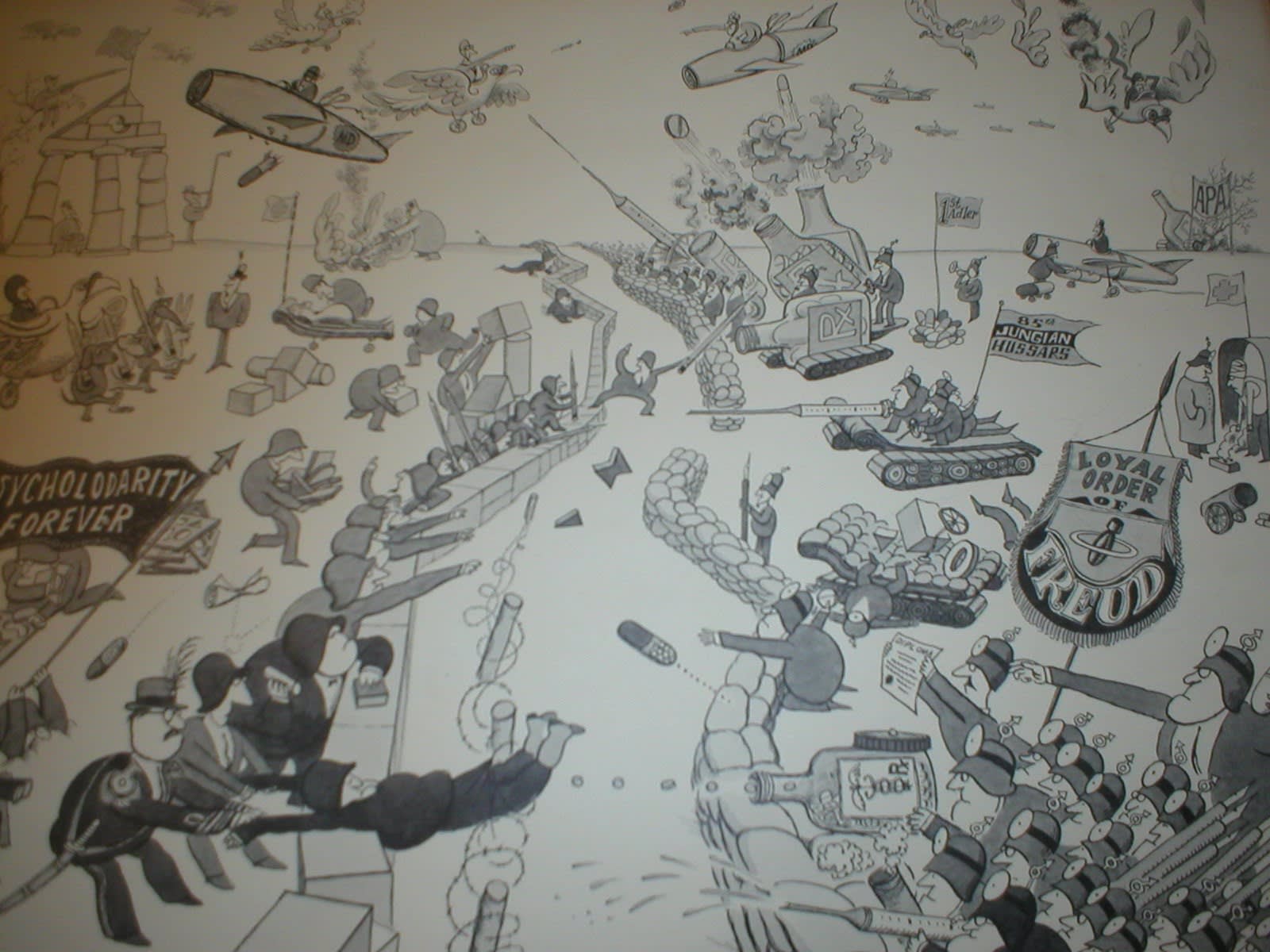
It seems reasonable to presume that the cultural transmission of values in the psychoanalytic community is – in large part – effected through the training and control analyses. It seems to be so, additionally, that among the artefacts of the training of psychoanalysts is either a greater propensity for schismatic behaviours and rancour than one finds in other professional disciplines or, at the very least, no less of such adversarialness. Furthermore, the long-time prevalent theories that relate to gender and childhood sexuality have held strongly that the resolution of incestuous and parricidal wishes precipitates the development of a sanguine Superego. How can we restrain, in light of the above, a suspiciousness of each constituent part of the training that brings candidates through the stages of development and eventually into positions of authority within psychoanalytic communities; assuredly, we must be suspicious of the Œdipal theory. To repeat, if resolution of Œdipal dynamics were central to each analysis, including the training analysis, it would be reasonable to expect that the development of the capacities for triadic social functioning would result in the form of a well-healed Superego that would move us to choose our battles carefully and to embrace the rich multi-textured fabrics that represent our diversities. As Freud suggested in his Varum Krieg? correspondence with Einstein (1933B, S.E. 22), love, pacifism and the recognition of similarities should serve as proof against the selfishness that moves Anthropos to war. And as the song asks: Why not you and I, m’Lord, why not you and I?
But here, again, different world-views may be invoked by differing psychoanalytic thinkers. For some, perhaps, the goal is an uber-ich that does not disturb sexual potency; for others, a superego that does not interfere with a general sense of agency and power; and for others, still – and I would include myself in this group – I prefer to see candidates, in particular, and patients, in general, terminating with a heightened capacity for triadic social functioning with others who are considered by them to be subjects in their own right. When this is absent, I fret a great deal in my private moments about the results of my work with that analysand. And when I wake up in a City, Country or Professional Community that knows but brief periods of peace, I do, indeed, fret a great deal about the cultural values that have been passed on from generation to generation.
There are alternative explanations that may account for these ubiquitous internecine conflicts that have plagued the psychoanalytic community for a century, just as there may be alternative Œdipal models that depend on any thinker’s weltanschauungen. I have been interviewing now, for several months, fellow analysts and asking for their impressions. Some have cited the Narcissism of Small Differences, which doesn’t yet explain for me why there is less rancour and more collegiality in, say, Mathematics. If the heir of the Œdipal is a sanguine superego and its concomitant capacity for living as a citizen in polities of mutual concern and interest, one might predict less civilized behaviour among the great unwashed-by-analysis masses, such as Mathematicians or Theoretical Physicists. Others have commented that it was just the nature of the beast, referring presumably to ever-present Thanatos or Destrudo. This explanation didn’t satisfy this admittedly argumentative beast, either, as I remembered Sandor Feldman’s (a student of Ferenczi) comment (Feldman, 1959, p. 61) that anytime a speaker invokes the word just, it belies the fact that unconsciously there must be a good deal more. Another Feldman, Harold Feldman, was fond of saying that the occupational hazards for the psychoanalyst were narcissism and psychopathy. But why? Still, others argued that the incestuous nature of psychoanalytic training and the training analyst system sows fertile ground for a religious attitude toward our inherited views. Maybe so, but if Psychoanalysis had been satisfied with such facile responses, it would have stopped with Breuer’s notion of a propensity toward hypnoid states rather than examining the underlying conflict/defence hysteria that Freud put forth in their Studies on Hysteria (Breuer/Freud, 1895D, S.E. 2) – and Psychoanalysis might never have been born.
No. I remain caught up in my sense that the theory of the Œdipal became precociously overly particularized in focusing on incest, parricide and gender as laid out in Freud’s Œdipus complex and in much of the additions to that work, to date. In so doing, the prototype for acceptance of the other was in permitting the sexual relationships of the parents. I am reminded of one of the most common expressions utilized by young and old, alike, in order to even the score with an offending party. While the offended commends the Other to please-do spend eternity indulging solo horizontal reproductive aerobics, my own weltanschauung tells me that the unconscious emphasis is more likely on the solo part than on the reproductive function, itself. As director of a psychoanalytic training institute for many years, I had no doubt that my faculty had no problems with my wife and I privately making love, though I quickly learned after presenting my perfidious model for Œdipal development that a number of them had significant discomfort in my relationship to my own theories, as have a number of reviewers who have questioned whether my thinking deserved to be situated in the ranks of contemporary Freudian analysis.
I wonder, then:
- Can we not be humbly satisfied with the acceptance that any given Weltanschauung and theory are but a first among equals whose primary status may precipitate solely from the identity of its proponent, i.e., from the fact that it is ours?
-
And, if this be the case, can we not accept the fact that our models — those that seek to represent reality by reducing the number of actual variables so that extant tools and methods may be applied to understanding the ineffable — are not even constrained to avoid mutual contradiction without one or the other being falsified?
Here I am, then — now after twenty eight years of pursuing the application of a singular paradigm to the variety of disciplines in most of which I remain uncredentialed — painfully coming to accept that while I am moved to this process of seeking out a consonance of Weltanschauungen in all these venues, I may well have done little more than fitting what I had already believed into the appearance of a scientific mode of thinking. What to say? If humility is most often the last guest to arrive at a party, then Narcissism may, indeed, be the guest that’s still there when you’re putting away the sugar-bowl. With this in mind, I recommend that similarly-minded thinkers prespecify, when they can, the guiding paradigms that they bring with them and that they consider being Sacred.
I close with the haunting commentary put forth by Ellen English, wife of one of the founders of the Philadelphia Society:
“In the beginning, it was really like a family. It was a very friendly group of four couples that we met with very regularly, the Biddles, the Englishes, the Maeders and the Pearsons. Spurge and I met with them in each other’s houses every two weeks because Gerry and Spurge were busy with the first book, titled Common Neuroses of Children & Adults. These friendly feelings came to an end when the split took place. It was amazing. These people that we had consorted with … We’d meet them at a meeting and this cruel (cool?) and cursory nod and that would be it. Amazing for people who were analyzed and were supposed to know better.” (followed by quiet tears)
Selected Incomplete Bibliography
Coles, R. (1963). Farewell to the South. Canada: Little, Brown & Company.
Chasseguet-Smirgel, J. (1988). From the archaic matrix of the Œdipal to the fully developed Œdipus complex. Psychoanalytic Quarterly, 57, pp. 505-527.
Covitz, H. (1981). Joseph and his narcissistic dreams. Philadelphia School of Psychoanalysis: Observer.
(1988). Joseph and his narcissistic dreams: the primacy of the Œdipal dilemma. In proceedings of the conference: Memorial Lectures in Honor of Harold Feldman’s XYZ of Psychoanalysis.16 April 1988, Philadelphia: Institute for Psychoanalytic Psychotherapy.
_____ (1992). Fate, choice, and retribution in Freud’s psychoanalysis. In E. Garcia (Ed.) Understanding Freud: The Man and His Ideas. New York: NYU Press.
_____ (1998). Œdipal Paradigms in Collision: A Centennial Emendation of a Piece of Freudian Canon (1897- 1997). Bern/Vienna/New York: Peter Lang.
_____ (2001). Thoughts on the Œdipus & the contingent nature of models of socialization: report on a personal journey. Psychoanalytic Arts Website: http://www.academyanalyticarts.org/covitz.htm.
Feldman (1959). Mannerisms in speech and gestures in everyday life. New York: IUP..
Freud, S. (1953-1974). The Standard Edition of the Complete Psychological Works of Sigmund Freud, vols. 1-24 (J. Strachey, Ed.). London:Hogarth. (Abbreviated below as S.E., followed by volume:page).
Friedman, SM (1950A). An empirical study of certain psychoanalytic propositions (unpublished dissertation).(1950B). An empirical study of the Œdipus complex. Am. Psychologist, 5, p. 304.
Hammarskjøld, D. (May 25, 1957). In Markings, p. 153. New York: Knopf.
Kramer, H. & Sprenger, J. (1486). Maleus Maleficarum, ed. and trans. M. Summers. New York: Dover 1971.
Loewald, H. (1979). The waning of the Œdipus complex. JAPA, 27(4), pp. 751-775.Panel (1985). The Œdipus complex revisited. JAPA 33:201-216.
Simon, B. (1991). Is the Œdipus complex still the cornerstone of psychoanalysis? . JAPA, 39(3), pp. 641-667.
Wright, K. (1991). Vision and separation: between mother and baby. New York: Aronson.
MORE POSTS
Not Confronting the Resistances in a Psychoanalytically Guided School
Important: TherapyRoute does not provide medical advice. All content is for informational purposes and cannot replace consulting a healthcare professional. If you face an emergency, please contact a local emergency service. For immediate emotional support, consider contacting a local helpline.
Find Therapists
Must Read
Creating Space for Growth: How Boundaries Strengthen Relationships
Setting healthy boundaries fosters respect, protects emotional well-being, and strengthens relationships by defining personal limits and maintaining self-care.
International Mutual Recognition Agreements for Mental Health Professionals
Mutual recognition agreements for mental health professions are rare and uneven, with major gaps in counselling, social work, and allied therapies. Read on to understand ...
Mental Health Licensing & Regulation in New York State: 2026 Guide
Mental Health Licensing & Regulation in Singapore: 2026 Guide
Jumping to Conclusions
Jumping to conclusions is a thinking habit where we assume the worst or make judgments without enough evidence. By recognising this pattern, therapy can help you slow dow...
About The Author

TherapyRoute
Mental Health Resource
Cape Town, South Africa
“Our mission is to help people access mental healthcare when they need it most.”
TherapyRoute is a mental health resource platform connecting individuals with qualified therapists. Our team curates valuable mental health information and provides resources to help you find the right professional support for your needs.