Psychic Sufferings Of Children Facing Parental Divorce


❝Psychoanalysis, Drawings and Words of Children❞
A few clinical and theoretical elements 1
Looking for evidence-based support? Find a qualified psychologist near you through TherapyRoute.
Find a Psychologist
« The child now comes to be occupied with the first , grand problem of life and asks himself the question: ‘Where do babies come from?’ ». S. Freud 2
By Jean-Luc Vannier - Psychoanalyst, Assistant Professor at Nice Côte d’Azur University, Pr. at Edhec and Ipag p.g. Business School Nice & Paris, France
Abstract
The author would like to elaborate on the psychic sufferings of children facing parental divorce, sometimes with verbal or even with physical violence during the separation process. As a psychoanalyst, he is on occasion requested by lawyers or juvenile court judges to assess the family situation and make recommendations concerning the organisation of parental visits. The author makes reference to drawings realized by children during these analytic sessions and will use these documents to highlight psychoanalytic concepts being used for children as well as for teen and adults therapies.
Introduction
My 7-year-old goddaughter came to visit me with her mother last summer. While I was talking to her mother, she discovered, on my desk, a file composed of drawings made during consultations with children. Her cheerful face suddenly became serious, almost as serious as if she directly understood, without the mediation of speech, the interrogations, even the sufferings expressed by these little coloured sketches. It seemed easy for her to decipher an unintelligible message 3 .
One must be wary of the etymology. Even if the word « child » comes from infans - who does not speak, who does not understand the language of adults - the little ones always find a way to express themselves especially when psychic pain assails them. And for a good reason: the time of surgical operations without anaesthesia for babies is over. The perception of pain is scientifically attested from the 24th week of intrauterine life.
In the event of a physical accident, this pain is visible: a radiograph reveals a fracture, an examination shows a hematoma, the child indicates with awkward gestures the location of « where it hurts ». But what about the psychic pain of the child whose parents do not perceive the pain's existence, let alone its intensity? In this article, I propose to provide some examples of this pain by using consultations with young children in the context of divorce, often with violence. These interviews took place at the request of one of the parents' lawyers. With the consent of the accompanying parent, I always write a full verbatim of the entire session 4 , enclosing the drawings if possible. This procedure has many advantages: it restores the words and gestures of the child during the session and allows both the lawyer and the judge, to better understand - with less risk of contesting - the reflections delivered. It also adds transparency and reliability to the work.
Let’s start with little Nathalie, aged five, whose biological father refused paternity and left home even before her birth. The little girl witnessed a rare scene of violence between her mother and her younger companion. Drunk and after smoking cannabis, the man, in a dispute which the little girl witnessed, verbally abused the mother and then struck her, leaving her unconscious on the floor. Notified by the neighbours, firemen and police intervened, always under the gaze of Nathalie who became mute. Three weeks later, unsatisfied with improvements in her language, the grandparents, on the advice of their daughter's lawyer, consulted me in order to establish an expert opinion for court.
After the mother explained the whole story, under the watchful eye of Nathalie, I invited the little girl to follow me into the clinic room to draw. She took the A4 white sheet of paper and in a small part of it, drew an enormous head neglecting the other parts of the body. In addition, she « framed » her drawing with an interior line.
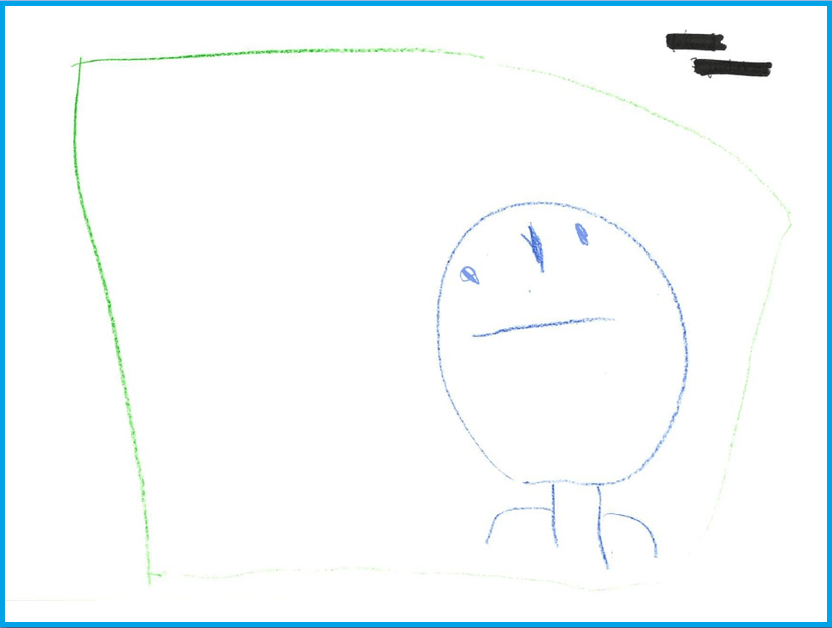
I interpreted: « Your head is big, hey!». She nodded silently. I continued: «There must be a lot in this head to make it so big. » She agreed. I added: « If you tell me what is in your head, it will become smaller again. » The child shed a few tears and said, « I can’t, it's too hard. » The « big head » represents the risk of Nathalie's mental capacities being overwhelmed by a deeply internalized, conflicting pain, which she controls only with difficulty.
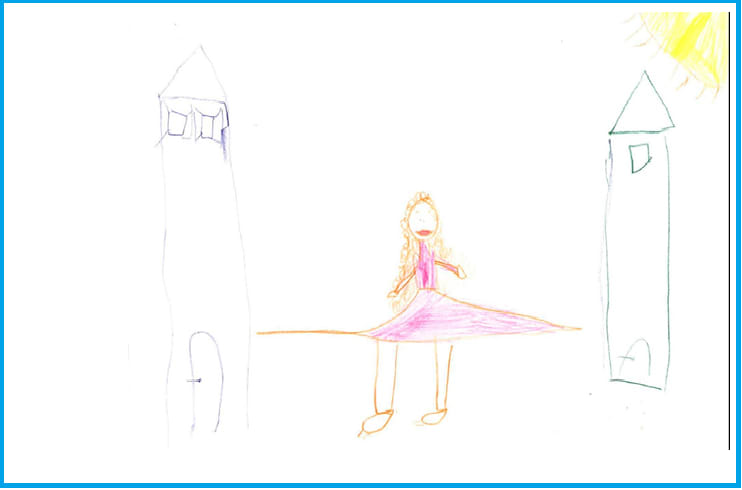
Below is another drawing by a five-year-old girl facing parental divorce. The drawing most likely explains her anxiety due to the feelings of heartbreak she is facing at the separation of her parents. She is in the middle and symbolically uses the dress-tails to show how she is split between the father and the mother 5 .
What are the most important psychoanalytic concepts while working with children?
-I- The ambivalence 6 of the mistreated child.
In spite of a real traumatic experience, children do not always manifest a pathological behaviour like a food disorder, sleep disorder, loss of sociability, academic failure or relational difficulty. In the child's psychic structure, the capacity to bury remains considerable. There is an unfortunate and well-known case about this ambivalence: Marina was a little French girl aged eight when her teacher noticed many contusions and traces on her body. The teacher reported the case to the special police team in charge of minors. The child and her parents were taken to the police station for separate investigations. Every time the little girl was asked about the contusions, she always gave a very convincing explanation. To the point that the police finally released her parents. After two weeks, the girl was found dead from the renewed blows of her parents. They are now in jail but it's too late. Why did the little girl avoid telling the truth to the police? Because above all, she was scared of being abandoned and left alone. As Anna Freud pointed out: « Te infantile Ego, while retaining an intact sense of reality, keeps the privilege of denying what, in this reality, displeases him 7 ».
While working with children, one should never forget this deeply rooted anguish in any child 8 . This was the same with little Nathalie. Her head was full of chaotic thoughts because she was thinking about this man who probably fed her, played with her and carried out simple care, to the point that she likely called him dad. But she couldn’t get rid of the scene where he was striking her mother so violently. Every time you have love, you have a resistance to this love – to fight against the feeling of one’s own passivity – which creates an impulse of hate: a kind of unconscious defence mechanism as Freud explained it 9 . Some authors, like Melanie Klein, mention the fact that the child is able to destroy this feeling of love, as an internal object, and just after, could try to restore, to repair what has been destroyed in the and by the child 10 .
-II- The infantile and fundamental fear of being abandoned : « Hilflosigkeit ».
This Hilflosigkeit or feeling of helplessness, is very probably the most accurate point to enlighten so many sensitive moments in the relationship between the child and parents : « anxiety arises directly out of libido; in other words, that the ego is reduced to a state of helplessness in the face of an excessive tension due to need, as it was in the situation of birth, and that anxiety is then » 11 . Unlike many mammals, the little human comes into the world without any means to protect or even to feed themselves. They depend completely, in the sense of life or death, on the way their parents are watching out for them. This original passivity, extensions of which we see in the theory of generalized seduction, remains deeply rooted in the toddler.
Let me give you a very significant example: during one legal proceeding, I received a five-year-old child who was literally torn between his mother and his father. Despite a judgment, his mother who lived in Paris refused to let him see his father who stayed in Nice. It took the intervention of police officers for a visit to materialise. The father then brought the child to me for consultation. What happened during this session? I explained to the child the reasons for his presence in my office in straightforward terms. And I proposed to him to go with me to the adjoining room to draw. The prospect of drawing aroused his curiosity and seemed to interest him but the idea of having to physically leave his father appeared to distress him. The child clung literally to his father grasping him and expressed great anxiety before a possible separation. He wanted his father to accompany him to the workroom. As I denied it, he asked for the door between the two rooms to remain largely opened: the fear of abandonment.
The father then entrusted him with his bunch of keys including those of the apartment and the car. The child relaxed immediately with this « transitional object » and verbally manifested the certainty that his father would not be able to leave without him. Throughout the session 12 , the little boy kept the keys carefully close to him, sometimes taking them in his hands and even moving them when he had to move to play a new game: essentially this set of keys not only had to remain visible but had to be in physical contact with any part of his body.
During another session with another little boy every time I was taking notes in my notebook on a table adjacent to the one where we worked, he asked me very directly: « Can you look at me? ». With this sentence, his narcissistic failure became evident as he looked to the adult's eyes for the support he hoped would reassure him.
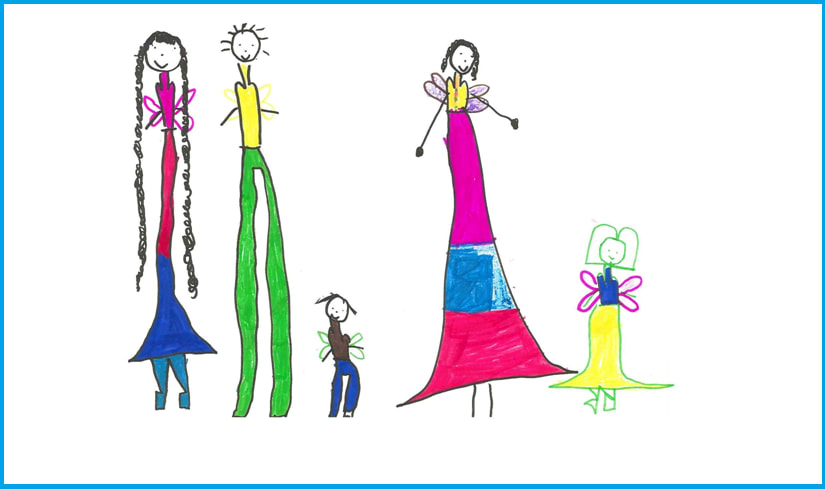
In the case of divorce, it is very important to define a secure and stable space-time framework for the child: They must know when they will see their father and mother. They can thus prepare themselves psychologically. And materially: preparing private items like clothes or school materials, and, as we know, to forget about one or the other to provoke the ire of the parents and the inner amusement of the child. Below is a drawing by a six-year-old girl in a case of parental divorce which, dare we say, is going quite well: the parents talk to each other, they share information daily about their children and, moreover, the stepfamilies on both sides, meet for the main yearly celebrations. To the point that the little girl drew her father's new girlfriend with a lot of colours and an apparent feeling of joy! During this session, the little girl explained how she used creative nicknames to identify the roles and places in the new familial constellation. It is of the utmost importance that all involved accept the nominated nicknames and not rebuke the child for using them. Although it is obvious that, to her, adults are very complex people as she draws them so much taller than children!
-III- The anxiety as a result of the inadequacy between the somatic excitement and the psychic ability to elaborate on it.
From infancy to death, the human being conducts psychical reshuffles, either acceptances or renunciations. These reshuffles routinely occur during any upheaval (separation, loss of a close relative, various suffering including the mourning of love and pubertal instinctual surges) or, primarily, with all the mutations of the human body during major « stages » of life (birth, infancy, adolescence, reproduction and parenthood, menopause, andropause (male menopause), climacteric, diseases, perspective of death).These psychological reshuffles are attempts to adapt to the changes in the body. These changes are to be seen as « breaking through » the psychic envelope, now penetrated by an overwhelming and traumatic stimulus. As Freud quoted:« the Ego is a surface and a projection of a surface » 13 . The consequence lies in anguish as a result of a conflict between the somatic arousal and the absence or the inadequacy in the ability of the psyche to elaborate on it 14 .
It may also appear as an internal attack by the sexual drive 15 . Thus, the little boy torn between his mother in Paris and his father in Nice: when leaving the session which was so intense that it had to be shortened, noticed my laptop on the coffee table. In a dramatic gesture, he grabbed one of the cushions off the sofa and threw it violently on the computer, which fell to the floor. The father wanted to rush in to scold the child but I stopped him and let him notice the child's distress. Despite the father’s angry reaction, I asked him not to punish the little boy because the child's face showed a kind of frightened surprise at his perception of the act. It was as if he looked at the scene with an astonished and distant eye, wondering if it was he who had just accomplished this reprehensible act 16 . During the session, the accumulation of reactivated anxiety in the child’s psyche caused an « internal drive attack » and a subsequent discharge of violence through projection 17 . A violence he was unable to master and which I had to explain to him.
The anecdote of the keys, and the « close/open » door indicated an anguish of separation and individuation, even an infantile feeling of abandonment 18 . His quick-calmed impulses, as well as his sudden demands, revealed the weaknesses of his « limitations » and abilities of « containment » as well as his predominant need for reinsurance. This child had already developed traits of character tinged with impulsivity, even aggressiveness, no doubt a consequence of structural disorder, coupled with palpable tensions in his family life.
-IV- The definition of the psychic trauma and the « Nachtr ä glichkeit » (afterwardsness) effect 19 .
How could we define psychic trauma in two steps?
First, sexuality breaks in from outside, reaches the subject from the other where its traces remain unintegrated and encysted. Second: after the emergence of puberty, the traumatic anxiety is traced back to the recollection of the first event which has become an inner event, an « inner foreign body 20 », which now breaks out from within the subject.
As I often explain to parents who come to consult with their very young children , most of the consequences of a violent divorce or, as it is said, a divorce that « goes wrong », will occur later, at the time of puberty. Why puberty?
The pubertal time should be seen as a discontinuity, a failure, a psychosis among the great cycles of life. It is the cleavage (gap) between the physical body changes imposed by the pubertal reality – the genital drive, or so-called instinct 21 , aimed at the reproduction of the species – and the reduced capacity of the psyche, still rooted in childhood, to grasp its scope and significance. This event reminds us of « the primary seduction »: the time of an asymmetrical relation between « adult body » and « child psyche » and reinvestment – or so-called reactivation – of old suffering. What are the main phenomena and risks at this pubertal period? The teen tries to release themselves from experiencing mental suffering by redirecting this suffering towards self-inflicted physical pain 22 . They experience strong sensations in order to feel alive until they flirt with the risk of death. They act in order to emphatically draw the attention of adults while waiting, more or less secretly, to be recognized and contained by them: what D.W. Winnicott called « hidden requests » : any delinquent act is a signal that requires a response from the environment 23 .
As already explained, the capacities of toddlers to repress remains considerable and it is often at a later stage, notably that of puberty, when reinvested by the genital drive, that these painful affects resurface in even more dramatic conditions for the child and their family: hetero or homo-aggressive behaviour, risks of addiction, eating disorders or sexual disorders. The most obvious clinical aspect probably lies in the adolescent's or adult's fear of collapse. This fear, as Winnicott points out, may be « the fear of a past event that has not yet been experienced 24 ».
-V- The difficulty to assess and to find out the truth: between sexual seduction and sexual phantasm 25 .
In a letter to Wilhelm Fliess dated 21 September 189 26 , Sigmund Freud wrote: « I do not believe any more in my neurotica » 27 . What was this neurotica? What were the reasons that Freud renounced his approach? Neurotica meant, in Freud's mind, the fact that, for several years, his patients who consulted him for psychic disorders explained that they had been victims of an episode of sexual seduction by an adult in their close family. In saying that he no longer believed in these accounts, Freud raised the question of the materiality of facts in the legal search for evidence: « There are no signs of reality in the unconscious, so that one can not differentiate between truth and emotion invested with affect 28 ». One can only deal with the manifestations of a psychic reality. A situation that we face every time we work with cases of sexual abuse of children. Freud’s renunciation could, however, be explained in another way: he surreptitiously stumbled upon his resistance to possible seduction on the part of his own parents. Not to say that all his subsequent work oscillated between upholding this abandonment and the reconfirmation of the seduction theory of the child by the adult.
We should all be very careful as we know that our sessions with children, whatever the problem may be, can reactivate our own real or fantasized infantile scenes.
-VI- The responsibility of the psychoanalyst vis-à-vis the legal investigation.
It is not up to the psychoanalyst to pronounce on the authenticity of the facts. It is up to the court to do so. To each his own. The specialist of the psyche can only listen and try to interpret words or acts (drawings, lapsus linguae, parapraxis) perceived as manifestations or rejections of the unconscious. Let us firmly reaffirm one irrefutable fact: the unconscious is a psychic instance – in fact, a real mess more than a comprehensive agency – which no one can have access to. This deserves to be clarified in view of the sensitivity of all these cases.
Let me illustrate this difficulty with a case I had for one year in therapy . During a first meeting, a mother told a story in front of her girl aged five: « It was in June 2011 that my daughter spoke of the existence of an equivocal behaviour by her father ». The girl, who listened silently to her mother, reacted to this word: « What is equivocal » she asked? The mother's embarrassment was added to by the analyst's attempt to find a corresponding adjective, more within the reach of the child. A particular circumstance of the meeting that deserves to be noted. The reasons for this can be seen below. The mother continued her history: « In July of the same year, a complaint was filed that resulted in a hearing where the girl kept repeating the same words about her father ». Mediated visits were established with the father and an investigation began. The mother specified that an expert opinion had been carried out at the request of the father's lawyer. This counter expertise concluded that «the mother had manipulated the child against the father ». A version that the mother vigorously opposed. Voluntarily, I did not take note of this report so as not to alter my own evaluation coming out of the session.
I took a short break and looked at the little girl with empathy. The nature of her gaze seemed to be a mixture of sadness and depth which gave the feeling of assuming an age that was not her own. A child who grew too fast. I told her my impression. She spoke her mind: « my brain is irritated 29 », she said, taking her small head between her two clenched fists, « because it would like me to know ». She continued: « It's not clear with Dad ». I took note but did not comment and asked her if she dreamed. « I have nightmares », she replied. « Full and too often ». In her last one: « a golden castle but all colours were collapsing ». It illuminated, if one dares to say, her drawings in black and white. In the drawing below, the little girl, after drawing herself and her mother with coloured pencils, looked very carefully to find among others the black pencil in order to draw « a person in prison » or in a coffin if one tends to consider the unconscious vow of death addressed to her father.
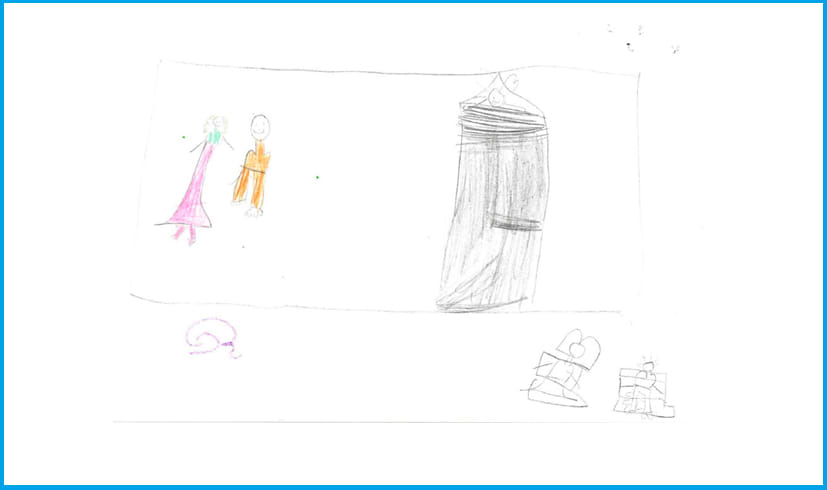
« I also had a dream where someone said we condemn you to death ». I questioned her about her possible wish to return to see me to continue this talk. She hesitated, then, with powerful emotion concluded with a sentence: « I cannot express myself, not because I do not have the vocabulary, but because the subject is difficult. Too difficult 30 ».
-VII- The asymmetric relationship between the child and the adult.
It could be argued that only sexual abuse committed by adults from the child's surroundings could create serious psychological disorders. This is not the case. Finally, the « fundamental anthropological situation 31 » as defined by Professor Jean Laplanche emphasizes how the relationship between the adult and the child is marked by unconscious sexuality.
That is the intromission, through the most innocent, the most daily and the most insignificant gesture, of enigmatic messages from the adult into the primitive body-ego of the child. The adult world confronts the nascent organism, a world of signification and communication, swamping the child’s capacity for apprehension and mastery. « Messages » do not necessarily mean verbal messages: any gesture, any mimicry functions as a signifier. What Jean Laplanche calls « enigmatic signifiers 32 ». Why enigmatic? Because they are compromised by the repressed infantile sexuality of the adults themselves 33 . These messages are opaque to the adult as well. These messages are also enigmatic because the infants 34 has no access to a code to determine the meaning or because it outstrips their capacities for understanding.
In a preliminary session with a young mother accompanied by her two young children from two different unions, the little girl discovered that her brother was only her half-brother. This discovery was made after the little girl interrupted the mother's anamnestic narrative of her history: « you forgot someone ». Most notable, however, was the behaviour of these young children during the mother's narrative. Like an adult couple of lovers, the little girl and the little boy, sitting on a separate couch from the mother, hugged and kissed each other with rare emotional intensity. This tactile symbiosis between the two, which the mother had not noticed or which she had undoubtedly seen without accepting its meaning gave the impression of a structure recreated between the children whose solidarity palliated the absence of a true family organization. Obviously, through their own fantasies, including those of a sexual nature 35 , and as a means against anxiety, these children had reproduced a family unit between themselves. These phantasms, as brightly explained by Susan Isaacs 36 , can be « used for other purposes than the satisfaction of desires: denial, reassurance, omnipotent control and reparation ».
This appears to be a usual phenomenon of the protective bubble or of restoration during difficult separations. This mother started psychoanalysis for a compulsive behaviour: she was able to form a common-law union only with violent men. As she told me: while going out and clubbing, she could meet nice and educated boys but she was in an irrepressible way attracted « like the mosquito to light » by men who she knew would make her suffer. Who, after having inflicted on her, against her will, a pregnancy and physical violence, abandoned her to her sad fate. The drawing by this little girl is very interesting from this point of view: is it her brother who is represented next to her wearing a crown, or her mother and a nasty man with a bad smile?
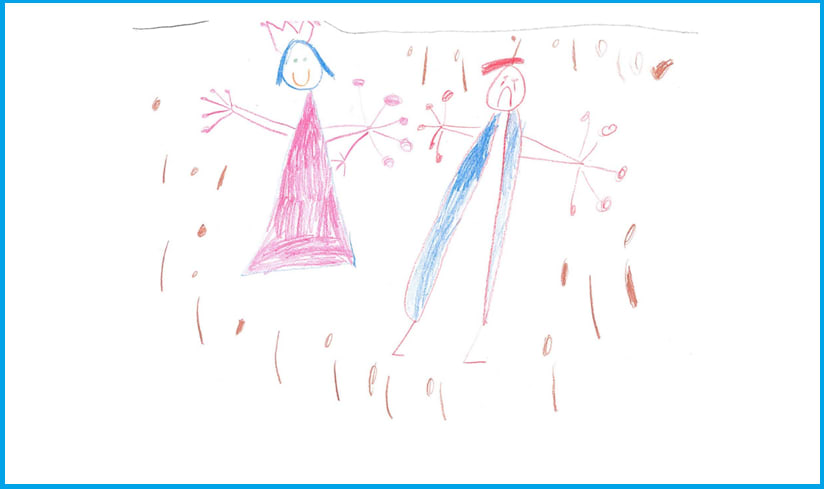
A session of analytical expertise with a child disturbed by the divorce of their parents is obviously not equivalent to a complete psychoanalysis. In the most serious cases it is advisable to recommend a treatment in order to support the infantile psyche in a process that is difficult to understand. As our daily clinical practice shows, cases of adolescents deeply disturbed by the separation of their parents confirms that the collapse of an established family structure revives multiple underlying conflicts. A fortiori for the little ones who experience them in statu nascendi.
Nice, February 2019
Notes
1 This text uses a lecture given during the first Congress on Culture, Psychopathology and Education at Al Zahra Women's University in Tehran (Iran) on May 3rd and 4th, 2017 with the support of the French Embassy in Iran. It has been reviewed and expanded with new references for Therapyroute.
2 Sigmund Freud , « Des théories sexuelles infantiles », Œuvres complètes, VIII, 1906-1908, PUF, p. 230.
3 Denis Vasse , « Le dessin et le regard », La grande menace, La psychanalyse et l’enfant, Seuil, 2004, pp. 112-115.
4 This includes the way the parent has presented their story, the way the child who accompanies them has or has not reacted. The verbatim integrates not only the factual elements but also, in a final commentary, the impressions and the conclusions of the psychoanalyst.
5 There is a saying in French which perfectly illustrates this situation « Quand tu as deux maisons, tu perds la raison » ( when you have two houses, you lose your senses)
6 Borrowed by Freud from the Swiss psychiatrist Bleuler who coined this term to make it a major symptom of schizophrenia. It is in the affective register - love and hate in the same movement of the same person - that Freud used the notion, in J. Laplanche & J.-B. Pontalis , Vocabulaire de la psychanalyse, PUF, Coll. "Quadrige", 2007, pp. 19-21.
7 Anna Freud, Le moi et les mécanismes de défense, PUF, Coll. « Bibliothèque de psychanalyse », 2001, p. 78.
8 « L’inévitable intrication d’amour et de haine, de pulsions érotiques et destructives » (The inevitable entanglement of love and hatred, erotic and destructive impulses), in Claudine Geissmann & Didier Houzel (Sous la direction de), L’enfant, ses parents et le psychanalyste, Bayard, Coll. « Compact », 2000, p. 25.
9 « Jamais nous ne sommes davantage privés de protection contre la souffrance que lorsque nous aimons, jamais nous ne sommes davantage dans le malheur et le désaide que lorsque nous avons perdu l’objet aimé ou son amour » (We are never more deprived of protection from suffering than when we love, never are we more unhappy and helpless than when we have lost the beloved object or its love), in Sigmund Freud , « Malaise dans la culture », Œuvres complètes, XVIII, 1926-1930, PUF, 2015, p. 269.
10 Melanie Klein , La psychanalyse des enfants, PUF, 1993, p. 259.
11 Sigmund Freud , « Inhibition, symptôme, angoisse », Œuvres Complètes, XVII, 1923-1925, PUF, 2016, p. 256.
12 The child was completely unable to represent himself. The drawing contained only pencil circles in all directions: an indication of a psychic destructuration and an "infernal circle" in which he struggled.
13 Sigmund Freud , « Le moi et le ça », Œuvres Complètes, XVI, 1921-1923, PUF, 2003, p. 270.
14 Sigmund Freud , « Inhibition, symptôme, angoisse », op. cit, p. 257.
15 As we described it about the case of an anorexic teen, in J.-L. Vannier, The Paternal Thumb, "Nahrungseinfuhr" of an anorexic teen. Therapyroute, 2016. https://www.therapyroute.com/article/the-paternal-thumb-nahrungseinfuhr-of-an-anorexic-teenager-by-j-vannier
16 « L’obéissance et la désobéissance à la règle se disent en termes de gain ou de perte de l’affection des parents » (Obedience and disobedience to the rule are in terms of gain or loss of parental affection), in Laurence Kahn , Cures d’enfance, Gallimard, NRF, 2004, p. 51.
17 And towards me as I was obviously the main addressee of this act.
18 « L’absence de réponse de l’autre implique que la tension reste sans solution, soumettant l’enfant au stress de l’excitation non résolue de l’état de détresse » (The absence of response from the other implies that the tension remains unresolved, subjecting the child to the stress of the unresolved excitement of the state of distress.), in Alain Braconnier & Bernard Golse (Sous la direction de), Dépression du bébé, dépression de l’adolescent, Erès, Le Carnet Psy, 2010.
19 « Le concept de l’après-coup dans l’œuvre de Freud », in Claudine Geissmann & Didier Houzel (Sous la direction de), L’enfant, ses parents et le psychanalyste, Bayard, Coll. « Compact », 2000, pp. 14-22.
20 Sigmund Freud , « Etudes sur l’hystérie », Œuvres complètes, II, 1893-1895, PUF, 2015, p. 26. Freud also mentions this concept in the letter 118 to Wilhelm Fliess.
21 About the difference between « instinct » and « drive » : Jean Laplanche « Pulsion et instinct » in Sexual, La sexualité élargie au sens freudien, 2000-2006, PUF, Coll. « Quadrige », 2007, pp. 7-25
22 « I do know now what I am suffering from » as teens often say.
23 « Il y a dans la tendance antisociale un élément spécifique qui oblige l’environnement à être important » (There is in the antisocial trend a specific element that forces the environment to be important), in D. W. Winnicott , « La tendance antisociale » in Déprivation et délinquance Paris, Payot, 1994, p. 149.
24 « Cette épreuve est une nécessité équivalente à celle de la remémoration dans l'analyse des névrosés » (This hardship is a necessity equivalent to that of remembering in the analysis of the neurotics ), in D. W. Winnicott , La crainte de l'effondrement et autres situations cliniques. NRF, Gallimard, 2000, p. 216.
25 « Freud's translators in English have adopted a special spelling of the word « Phantasm » with ph to differentiate those entirely unconscious from the word « fantasy » which designates conscious daydreams », in Susan Isaacs , « Nature et fonction du phantasme », Développements de la psychanalyse, PUF, Coll. « Bibliothèque de la psychanalyse », 1966, p. 77.
26 Called «Letter of the Equinox».
27 Sigmund Freud , Lettres à Wilhelm Fliess, 1887-1904, Edition complète, PUF, 2007, p. 334.
28 Ibid. p. 335.
29 She said in her language : énervée » (enervated).
30 One should note the same words as for Nathalie.
31 « Trois acceptions du mot inconscient dans le cadre de la théorie de la séduction généralisée », in Jean Laplanche , « Le crime sexuel » et « Le genre, le sexe, le sexual », Sexual, La sexualité élargie au sens freudien, 2000-2006, PUF, Coll. « Quadrige », 2007, pp. 195-213.
32 Jean Laplanche , Essays on the Otherness, Routledge, 1999, pp. 129-130.
33 « The adult world is entirely infiltrated with unconscious and sexual significations to which adults themselves do not have the code ». Ibid.
34 As a reminder; Infans : who does not speak, who does not understand the language of the grown-up.
35 Jean-Luc Vannier , Maltraitance et crimes contre les enfants : entre inceste et sexualité infantile, Le Carnet Psy, n° 192, pp. 45-46.
36 Susan Isaacs , « Nature et fonction du phantasme », Développements de la psychanalyse, PUF, Coll. « Bibliothèque de la psychanalyse », 1966, p. 80. p.p1 {margin: 0.0px 0.0px 0.0px 0.0px; font: 12.0px 'Lucida Grande'}
Bibliography
Braconnier A. ; Golse B. (2010) (Sous la direction de),
Dépression du bébé, dépression de l’adolescent, Erès, Le Carnet Psy.
Freud A. (1949), Le moi et les mécanismes de défense, PUF, Coll. « Bibliothèque de psychanalyse », 2001.
Freud S. (1893), « Etudes sur l’hystérie », Œuvres complètes, II, 1893-1895, PUF, 2015.
Freud S., Lettres à Wilhelm Fliess, 1887-1904, Edition complète, PUF, 2007.
Freud S. (1905), « Trois essais sur la théorie sexuelle », Œuvres Complètes, VI, 1901-1905, PUF, 2009.
Freud S. (1906), « Des théories sexuelles infantiles », Œuvres complètes, VIII, 1906-1908, PUF, 2007.
Freud S. (1923), « Le moi et le ça », Œuvres Complètes, XVI, 1921-1923, PUF, 2003.
Freud S. (1926), « Inhibition, symptôme, angoisse », Œuvres Complètes, XVII, 1923-1925, PUF, 2016.
Freud S. (1929), « Malaise dans la culture », Œuvres complètes, XVIII, 1926-1930, PUF, 2015.
Geissmann C. ; Houzel D., (2000), (Sous la direction de), L’enfant, ses parents et le psychanalyste, Bayard, Coll. « Compact ».
Isaacs S. (1966), « Nature et fonction du phantasme », Développements de la psychanalyse, PUF, Coll. « Bibliothèque de psychanalyse et de psychologie clinique ».
Kahn L. (2004), Cures d’enfance, Gallimard, NRF.
Klein M. (1959), La psychanalyse des enfants, PUF, 1993.
Laplanche J., Essays on the Otherness, Routledge, 1999.
Laplanche J. ; Pontalis J.-B. (1967), Vocabulaire de la psychanalyse, PUF, Coll. « Quadrige », 2007.
Laplanche J., « Le crime sexuel » et « Le genre, le sexe, le sexual », Sexual, La sexualité élargie au sens freudien, 2000-2006, PUF, Coll. « Quadrige », 2007.
Rank O. (1924), Le traumatisme de la naissance, Petite Bibliothèque Payot, 2002.
Tisseron S. (2011), Les secrets de famille, Que sais-je?, PUF, 2ème édition 2017.
Vannier J.-L. (2015), Maltraitance et crimes contre les enfants : entre inceste et sexualité infantile, Le Carnet Psy, n° 192.
Vannier J.-L. (2014), « Le pouce paternel, nahrungseinfuhr d’une adolescente anorexique », Autisme et psychoses infantiles, Psychiatrie Française, vol. XXXXV, 4/14, pp. 74-81.
Vasse D. (2004), La grande menace, La psychanalyse et l’enfant, Seuil.
Widlöcher D. ; Laplanche J. (2000), Sexualité infantile et attachement, PUF.
Winnicott D.W., « La tendance antisociale », Déprivation et délinquance, Payot, 1994.
Winnicott D.W. (1989), La crainte de l'effondrement et autres situations cliniques , NRF, Gallimard, 2000.
MORE POSTS
The Psyche of Jihadist Terrorists: Psychoanalytic Reflections
The Paternal Thumb, “Nahrungseinfuhr” of an Anorexic Teenager
Sexual Equality, Gender Equality, Paedophilia…
Important: TherapyRoute does not provide medical advice. All content is for informational purposes and cannot replace consulting a healthcare professional. If you face an emergency, please contact a local emergency service. For immediate emotional support, consider contacting a local helpline.
Find Therapists
Must Read
Creating Space for Growth: How Boundaries Strengthen Relationships
Setting healthy boundaries fosters respect, protects emotional well-being, and strengthens relationships by defining personal limits and maintaining self-care.
International Mutual Recognition Agreements for Mental Health Professionals
Mutual recognition agreements for mental health professions are rare and uneven, with major gaps in counselling, social work, and allied therapies. Read on to understand ...
Mental Health Licensing & Regulation in New York State: 2026 Guide
Mental Health Licensing & Regulation in Singapore: 2026 Guide
Jumping to Conclusions
Jumping to conclusions is a thinking habit where we assume the worst or make judgments without enough evidence. By recognising this pattern, therapy can help you slow dow...
About The Author

“Psychoanalyst, Clinician & Professor at the Côte d'Azur University, Edhec and Ipag Business School, Nice, French Riviera and Paris. Also Therapy online.”
Jean-Luc Vannier is a qualified Psychoanalyst, based in Villefranche-sur-mer, France. With a commitment to mental health, Jean-Luc provides Clinical Supervision, Psychoanalysis and Online Therapy.