
Electronic Footprints in Therapy

❝How many therapists are aware of the more subtle privacy and confidentiality issues associated with this modern technology?❞
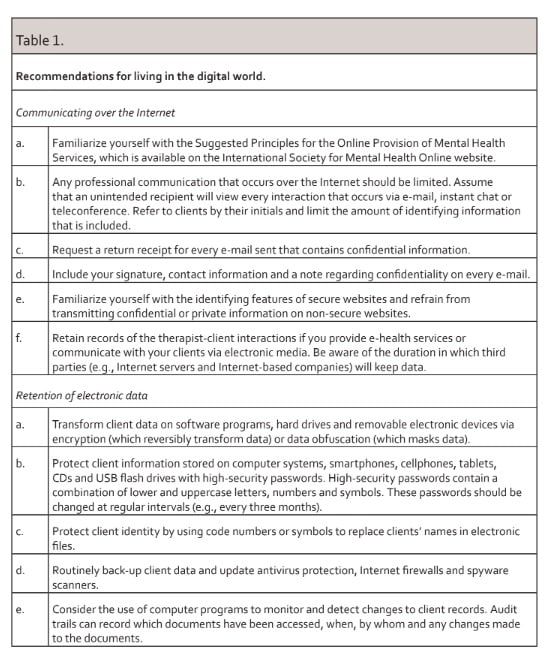
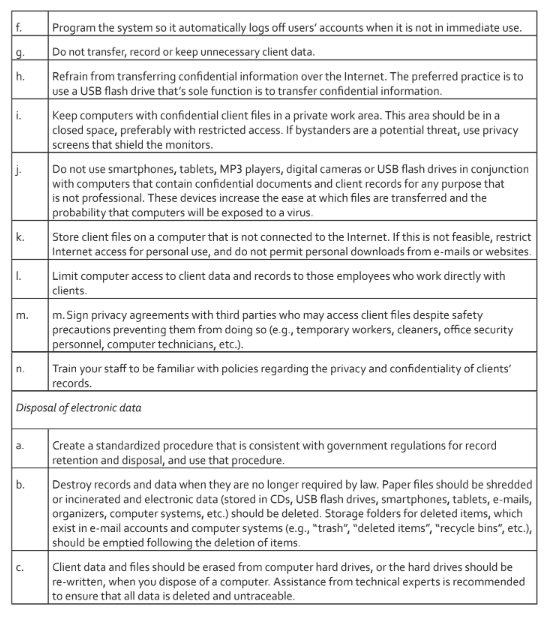
Therapists increasingly use modern technology to facilitate their practice. Therapists may use e-mail, cellphones, and teleconferencing to contact clients, as well as tablets and cellphones to store appointment times. In many cases, therapists might even provide distance care through Skype® or other similar programs. There are great advantages to these practices, but how many therapists are aware of the more subtle privacy and confidentiality issues associated with this modern technology? Although the privacy and confidentiality issues that arise from the use of modern technology have been discussed elsewhere (e.g., Welfel & Heinlen, 2010), this article reminds therapists of the subtle threats to client privacy and confidentiality that accompany modern technology, such as the covert retention of records by Internet servers and companies. Recommendations to mitigate these and other related concerns are in Table 1 and discussed below.
Therapy should be personal. Therapists listed on TherapyRoute are qualified, independent, and free to answer to you – no scripts, algorithms, or company policies.
Find Your TherapistCommunicating over the Internet
Within the past decade, there has been a surge of therapists who offer services online. For instance, some therapists provide e-therapy or advice via e-mail, instant chat, video conferencing or teleconferencing. Numerous ethical concerns accompany these practices. One issue is the retention of records by Internet companies and servers. Therapists who use distance communication ought to be cognizant of their own record-keeping procedures as well as the records retained by third party organizations. Each Internet-based company or server owns the records on their system and has access to the information sent on their network. They may retain records of interactions for a defined period of time or indefinitely. The computer system Google®, for example, has stored every keystroke associated with every computer to ever access its services since its inception, including Gmail® and Google Voice®. As such, detailed records of client-therapist interactions that occur over the Internet may be retrievable even after the client and therapist have erased their records. Although most therapists are conscientious of the risk of having their records subpoenaed for court when they are writing reports or progress notes, the same level of conscientiousness ought to be applied whenever therapists interact with clients over the Internet.
Therapists who conduct face-to-face therapy may be less cognizant of the record keeping procures of their e-mail service operators than therapists who rely on the Internet to communicate with clients. However, even among therapists who never use e-mail to contact clients, they may exchange e-mails with colleagues, trainees or insurance companies that contain private and confidential client information. Hence, all therapists should be aware that e-mails are routinely stored in the host agency’s computer system and servers even after they are removed from a user’s file system. Similarly, all therapists should be aware of the duration that their records are retained by their e-mail service operator. Case law recognizes that individuals who are employed by an agency and use its Internet services can have their e-mails reviewed with or without their knowledge or consent if there is a suspicion that the system is being misused.
Therapists may also experience pressure from clients to incorporate e-mail into their practice. For instance, clients may want to schedule therapy sessions or provide updates via e-mail. If therapists choose to use e-mail with clients, they may use free encryption software for their e-mail account (see www.about.com for a list of available programs). Other precautions involve requesting a return receipt and including a signature with contact information and a note regarding confidentiality as a footnote in every e-mail sent.
Internet-based calendars and organizers
Another increasing practice is the use of Internet-based calendars and organizers (e.g., Google Calendar®) to store client information and appointment schedules. Therapists should be aware that the Internet-based company owns the stored data and has the right to retain these records. Furthermore, the storage and electronic exchange of private information should only occur on secure websites, which ensure that data is encrypted before it is transmitted. Therapists should familiarize themselves with the identifying features of secure websites and utilize them to store or communicate information. For example, the URL address for a secure website usually begins with https, as opposed to http, and there is an adjacent icon of a lock which can be clicked on to obtain the website’s security details.
Smartphones and text messaging
Smartphones are capable of much more than simple cellular or land telephones: they enable users to schedule and organize tasks, enter and retrieve data, access e-mail and browse the Internet, play music and videos, and much more. Therapists may use their smartphone as an organizational device. Other therapists, particularly those in private practice, may additionally use their smartphone as their primary phone line for clients to contact them.
Despite the advantages of smartphone technology, there are some risks. For example, smartphones often contain access to the owner’s private e-mail account at the click of a button. A lost or stolen smartphone may thus pose an ethical nightmare for a therapist, since the small device may contain access to a large amount of confidential information. Best practice would be to use clients’ initials rather than their full names and to also password protect client information. In the unfortunate event of a lost or stolen smartphone, therapists ought to immediately contact software developers to remotely erase the data from their phone. Several software programs exist to complete this task, depending on the type of phone. Examples include Apple’s MobileMe®, Microsoft Exchange Server®, Microsoft My Phone®, SmrtGuard®, and BuddyGuard® (see Saltzman, 2010 for details). Some of these software programs are also equipped to back-up data stored on a phone, which may be particularly useful for therapists who use text messages to contact clients and want to retain records of these interactions.
Many therapists are reluctant to use text messaging to communicate with clients because of its informal nature, but research suggests that text messages limited to reminders may help improve homework adherence and appointment attendance in healthcare settings, which are two common barriers to the successful treatment of clients (Boschen & Casey, 2008; Pal, 2003). Regardless, text messaging shares the same subtle threat to client privacy and confidentiality as other electronic devices in that cellphone companies have the right to retain records of exchanged text messages. In the event of a court subpoena, records may be retrieved from the cellphone company or cellphone memory card. For this reason, it may be wise to limit the content of text messages so that they do not contain references to serious health issues or highly personal information.
Tablets
Tablets are gaining popularity in the world of electronic devices, and it is reasonable to assume that they will be incorporated into the practice of therapy. For instance, therapists with tablets can efficiently type their session notes and have the symptoms of all psychological disorders at the tip of their fingers with a diagnostic application. Clients may also use tablets in session or in the waiting room to complete questionnaires that assess their symptoms or progress. Form management software exists (e.g., Pendragon Software®; www.pendragonsoftware.com) so therapists can create personalized forms for their tablets, iPhones®, Androids® or Blackberries® to record progress notes, intake interviews and assessments. This software is valuable because of its embedded security measures (e.g., password protection for the server when synchronizing data). Therapists may also purchase more affordable apps to monitor clients’ moods (e.g., iPhone® apps for depression include Depression Test & Tracker®, Sad Scale®, and Moodifi®).
In general, tablets can be synchronized with computers to safely and rapidly back-up client data. Still, there are heightened threats to privacy and confidentiality when increased amounts of data are stored and transferred. Therapists may take extra precautions and purchase SSL certificates for their servers so that all their data is encrypted prior to transfer. In addition, seemingly deleted forms or documents off a tablet can be restored and retrieved if necessary.
Even therapists who do not own tablets may have clients who wish to use their own tablet or smartphone to aid therapy. Apps are available for iPads®, iPhones®, Androids®, and Blackberries® that are designed to complement therapy and self-help efforts. Consider the iPhone® app, Moodkit®, which contains daily mood rating charts, thought records and other tools to complement cognitive-behavioral therapy. It is not difficult to see why clients may prefer to fill-out thought records and mood charts on their smartphone or tablet. Clients live in a fast paced world, which makes the appeal of inconspicuously completing their homework while waiting for a meeting to start at work or waiting in line at a store tremendously appealing. Furthermore, many apps enable clients to e-mail their mood charts, thought records, journals, etc. to their therapist. Naturally, the same precautions discussed with respect to e-mailing clients apply to e-mailing data stored on a smartphone or tablet. As part of responsible caring, therapists may ask clients to remove their names and the names of people in their lives from the data they are e-mailing. With such precautions in place, smartphones and tablets have the potential to transform how homework is assigned and client progress is monitored in therapy.
Closing Remarks
The goal of this article is to increase therapists’ awareness of their electronic footprints, but not to deter therapists from using modern technology to assist their practice. When used appropriately and with due consideration, technology can improve therapists’ organization and efficiency. Information on psychological disorders is more readily accessible, record-keeping procedures are simplified, and communication with clients is eased as a result. However, the use of technology in psychotherapy also introduces new ethical considerations. As Norbert Wiener once said, “progress imposes not only new possibilities for the future but new restrictions.” Therapists have an ongoing ethical and professional responsibility to protect client privacy and confidentiality, especially when veering into the modern era where electronic records are retrievable from devices, servers, networks, and companies.
References
Boschen, M. J., & Casey, L. M. (2008). The use of mobile telephones as adjuncts to cognitive behavioral psychotherapy. Professional Psychology: Research and Practice, 39(5), 546-552.
Pal, B. (2003). The doctor will text you now: Is there a role for the mobile telephone in health care? British Medical Journal, 326(7389), 607.
Salzman, M. (2010, April 30). Lost a smartphone? Track it and erase data. Retrieved from http://www.techadvisory.org/
Welfel, E. R., & Heinlen, K. T. (2010). Ethics in technology and mental health. In M. A. Cucciare & K. R. Weingar (Eds.), Using technology to support evidence-based behavioural health practices: A clinician’s guide (pp. 267-290). New York, NY: Taylor and Francis Group.
About the authors
Taryn Bemister is a doctoral candidate in the Clinical Psychology Program at the University of Calgary (Alberta, Canada). She is currently completing her clinical residency with children and adolescents in London, Ontario and will obtain her PhD in the fall of 2014.
Dr. Keith Dobson is a Professor of Clinical Psychology at the University of Calgary. His research has focused on both cognitive models and treatments of depression. Dr. Dobson’s work has resulted in over 160 published articles and chapters, 11 books, and presentations in many countries. He is a Past-President of the Canadian Psychological Association, Academy of Cognitive Therapy, and the International Association for Cognitive Psychotherapy, and a principal investigator for the Opening Minds program of the Mental Health Commission of Canada, with a focus on stigma reduction related to mental disorders.
Important: TherapyRoute does not provide medical advice. All content is for informational purposes and cannot replace consulting a healthcare professional. If you face an emergency, please contact a local emergency service. For immediate emotional support, consider contacting a local helpline.
Find Therapists
Must Read
Creating Space for Growth: How Boundaries Strengthen Relationships
Setting healthy boundaries fosters respect, protects emotional well-being, and strengthens relationships by defining personal limits and maintaining self-care.
International Mutual Recognition Agreements for Mental Health Professionals
Mutual recognition agreements for mental health professions are rare and uneven, with major gaps in counselling, social work, and allied therapies. Read on to understand ...
Mental Health Licensing & Regulation in New York State: 2026 Guide
Mental Health Licensing & Regulation in Singapore: 2026 Guide
Jumping to Conclusions
Jumping to conclusions is a thinking habit where we assume the worst or make judgments without enough evidence. By recognising this pattern, therapy can help you slow dow...
About The Author

New Therapist Magazine
Pietermaritzburg, South Africa
“An independent, subscription-based magazine for mental health therapists, produced by journalists and therapists on five continents.”
New Therapist Magazine is based in Clarendon, Pietermaritzburg, South Africa.
