A Sense of Selves

❝Exercises in dialogical self theory.❞
“In my view, dialogue is one of the most precious capacities of the human mind. I believe in the existence of ‘good dialogue’ that has the power to contribute to the improvement of social relationships in our globalizing world society,” says Hubert Hermans, creator of Dialogical Self Theory (DST).
“However, this improvement can only be realized when external dialogue goes hand in hand with internal dialogue. As humans we have the privilege that we cannot only learn from others but also from ourselves, on the condition that we have the courage to explore and interrogate ourselves as if we are another person,” he comments on an online video on the method. Hermans suggests that this dialogical enrichment is a central part of a therapeutic relationship, wherein the therapist creates the optimal conditions for the client to begin engaging their multiple self positions with a view to integrating them more consciously into their lived sense of self. On the furthermost internal end of the gradually changing continuum of self position, Hermans identifies internal self positions, such as “I as a solitary person” or “I as a lover of landscape paintings”. On the other end of the spectrum of self positions is the external self, which might manifest as “the hardworking way in which colleagues perceive me.” Tensions can exist between internal and external self positions, such as “the way that people at work see me vs. I as a lazy person” and among internal positions, such as “I as ambitious professional” vs. “I as mother of two children.”
Therapy should be personal. Therapists listed on TherapyRoute are qualified, independent, and free to answer to you – no scripts, algorithms, or company policies.
Find your therapistBut Hermans also notes that there is a subtle difference between internal and external, particularly when these internal self positions are quite patently learnt from external others. As the object relations theorists have long argued, what I feel to be myself is often an external other that I have introjected and now feel and believe to be a part of myself. DST assumes that the self is not simply introjecting these others but also responding to them from a personal point of view, so that dialogical relationships may develop. In this view, the self is best viewed as a “society of mind”, in which many external and internal self-positions are jostling for airplay—some censoring or marginalising others to the point where monological relationships can dominate one’s sense of self.
In a more inclusive “society of mind”, multiple—often apparently contradictory— positions are recognised and accepted both within and between the internal and external domains of the self and dialogical relationships emerge that hold the promise of renewing the self and the other as central parts of the society at large.
To this end, he has designed a number of structured exercises, two of which are presented here.
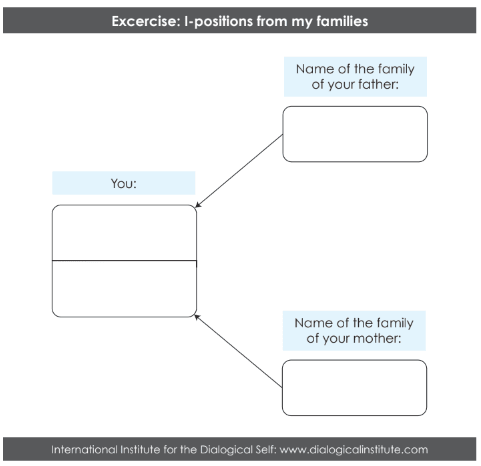
Positions from my families
This exercise introduces clients to the central dialogical concept of a multiplicity of selves in probably the most accessible way—that of the formative influence of the cultures of our families on our definitions of self. While this might sound old hat to object relations thinkers and those of a psychodynamic or attachment-based persuasion, Hermans is more interested in how we narrate that sense of our self and in the way they are involved in internal dialogues than he is in the objective impact of the relationships of the formative years.
Using the sheet, below, Hermans invites clients to enter some of the core qualities of their father’s family and mother’s family in the respective boxes on the right of the page. These tend to be notes on how each family is/was experienced relationally or personologically by the client. He then invites one to look at how one has been influenced by these key figures by entering in the top and bottom half of the left-hand box the qualities and characteristics that one has developed as a result of relationships with the two families, respectively, including their dialogical relationships as part of the client’s self. When used in group settings, this proves a valuable way of allowing clients to begin easing up their ideas of self identity and to consider other impacts on how they view themselves and loosens up the stories they are inclined to tell about who they are.
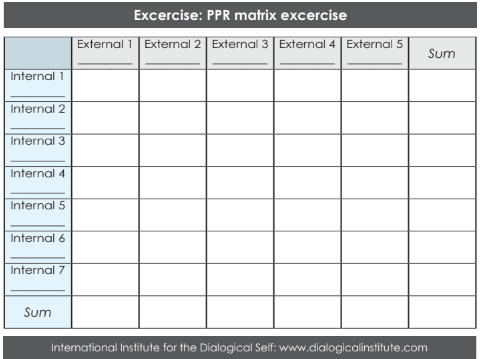
Personal Position Repertoire (PPR) Matrix
To extend the ideas introduced in the family positions exercise, Hermans uses what he calls the Personal Position Repertoire (PPR) Method, which invites clients to consider other influences on their internal and external positions. This exercise concerns the qualitative and quantitative organisation and reorganisation of a person’s position repertoire with attention to the personal meanings that are associated with the different positions. Clients are encouraged to identify, say, seven internal positions that are prominent for themselves (see list below for examples of internal and external positions which may be used as prompts in the event that the client is struggling to generate their own internal and external positions).
The client then thinks of, say, five external positions that she feels that are also of a high level of prominence in her daily life, such as “My daughter”, “My colleague”, “My adversary”, etc. She then completes the matrix with a list of internal positions on the y axis, the external positions on the x axis and a rating of the prominence that each external position has for each of the listed internal positions.
For example, I as a quiet introverted person (internal position) will be rated for the extent to which this internal position is felt as prominent in the relationship with “My father” on a scale of 0 to 5 (where 0 is represents no prominence and 5 indicates a high prominence). When all of the internal and external positions have been completed, they are tallied in rows and columns, yielding a map of the significance of each internal position for each external position identified and allowing a comparison of all self positions identified. The resulting quantification of self positions allows for a more explicit identification of how one prejudices or favours various I-positions in particular contexts.
Hermans recommends much discussion of the matrix, as this is where the understanding and reorganisation of self-positions is accomplished. The differences that emerge between the relationships between internal and external positions shows the contextualized nature of the process of positioning: a particular internal position is more or less prominent in relation to a particular external position, highlighting the influence that external positions have on our internal positions and vice versa.
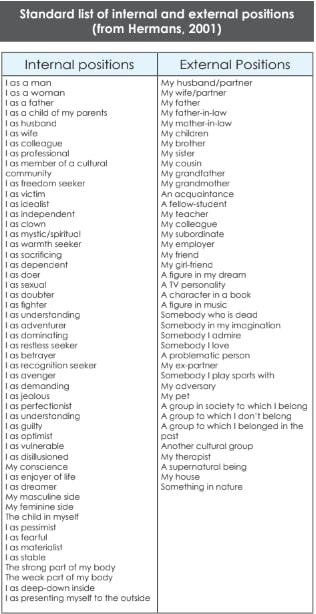
* Note: The internal positions ‘I as deep-down inside’ and ‘I as presenting myself to the outside are provided in every investigation because they reflect some basic aspects of the relationship between the internal and external world. At the end of the investigation, the participants may add those positions that they want to include in the repertoire so that their own words may be studied in the context of the words provided by the standard list. The participant may also add positions that are imagined or longed for, although not part of their actual world.
On the basis of knowledge of the specific personal history of the participant, the psychologist may propose to the participants to add extra positions that are not in the standard list and not proposed by the participants themselves.
This article was first published in New Therapist.
Further reading
Hermans, H. J. M. (2001) The construction of a personal position repertoire: Method and practice. Culture Psychology, 7, 323. Available at http://huberthermans.com/articles/64-the-construction-of-a-personal-position-repertoire-method-and-practice.html
Hermans, H. J. M., & Hermans- Konopka, A. (2010). Dialogical Self Theory; Positioning and counter- positioning in a globalizing society. Cambridge, UK: Cambridge University Press.
http://www.cambridge.org/aus/catalogue/catalogue.asp?isbn=9780521765268
Hermans, H. J. M., Kempen, H. J. G. and Van Loon, R. J. P. (1992) The dialogical self: Beyond individualism and rationalism. American Psychologist, 47, 1, 23-33.
Important: TherapyRoute does not provide medical advice. All content is for informational purposes and cannot replace consulting a healthcare professional. If you face an emergency, please contact a local emergency service. For immediate emotional support, consider contacting a local helpline.
Find Therapists
Must Read
Creating Space for Growth: How Boundaries Strengthen Relationships
Setting healthy boundaries fosters respect, protects emotional well-being, and strengthens relationships by defining personal limits and maintaining self-care.
International Mutual Recognition Agreements for Mental Health Professionals
Mutual recognition agreements for mental health professions are rare and uneven, with major gaps in counselling, social work, and allied therapies. Read on to understand ...
Suicide statistics worldwide
Where to find help, what the evidence says about preventing suicide, and what the World Health Organization's latest estimates show worldwide, by region and by country, p...
Bullying and cyberbullying statistics worldwide
How many young people are bullied at school and online worldwide and in countries on every continent, how bullying is linked to depression and anxiety, and how common bul...
Self-harm statistics worldwide
How many young people and adults self-harm worldwide and in different countries, how reported self-harm has changed over time, and what trials show about therapy that hel...
About The Author

New Therapist Magazine
Pietermaritzburg, South Africa
“An independent, subscription-based magazine for mental health therapists, produced by journalists and therapists on five continents.”
New Therapist Magazine is based in Clarendon, Pietermaritzburg, South Africa.