
Debunking a Few Common Myths About Anger

❝Anger, though natural, is often misunderstood. Contrary to common beliefs, anger is learned, and you can manage it by expressing it assertively. Expressing anger through destruction only reinforces it, and suppressing anger doesn’t make you weak.❞
Anger is a faithful companion in our daily life frustrations. It’s not only an emotion but an alarm system that blares when our boundaries are crossed, or we experience unfair treatment. It’s a natural phenomenon, like laughter at a joke or tears while watching a heartbreaking movie. But unlike other emotions, anger often gets a negative reputation when mishandled.
Considering the tackling of anger with finesse, some misconceptions need to be discussed. Let's look at the truth behind anger and discuss a few common myths about anger that transform this righteous force into a villain in the public eye. Here are some of them.
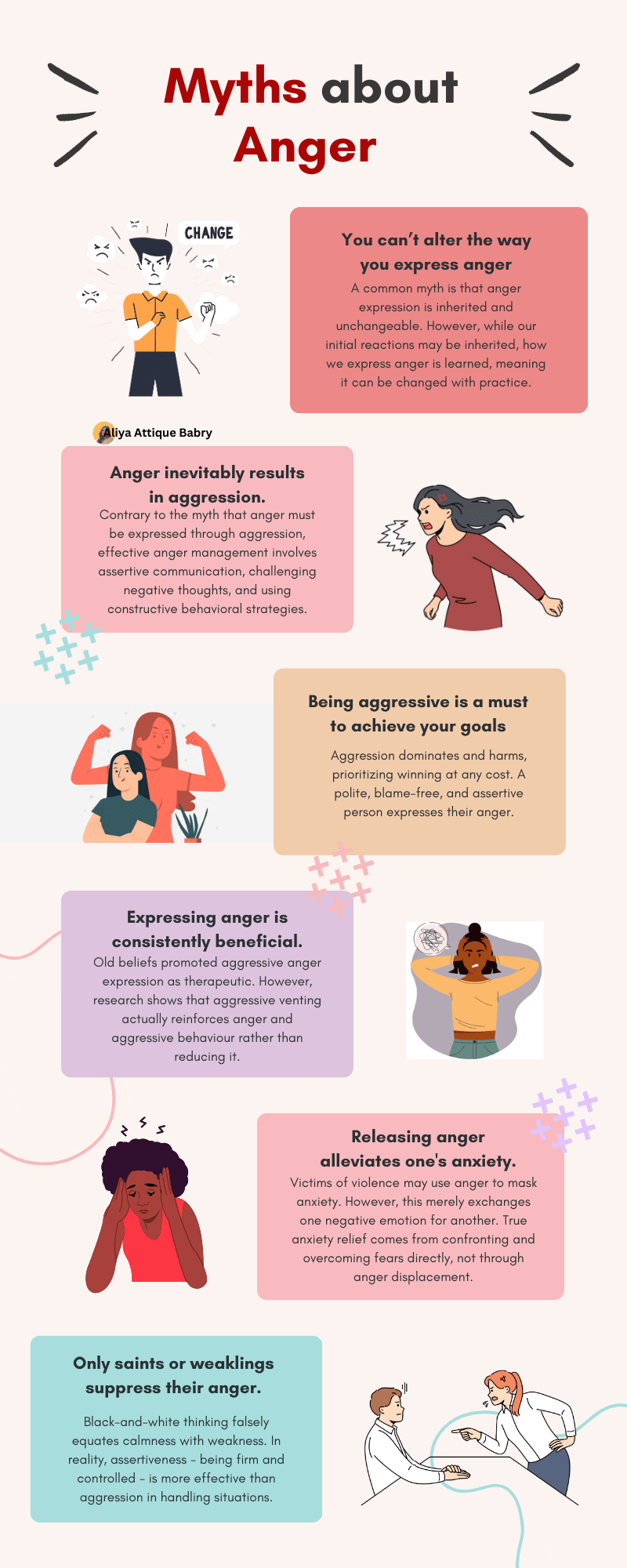
Myth #1: You can’t alter the way you express anger.
A common myth is that anger expression is inherited and unchangeable. However, our facial expressions and nervous response are inherited, but the response (behaviour) is learned, and unhealthy behaviours can be unlearned and replaced with healthy behaviours. Persistent practice to stay calm is required.
Myth #2: Anger inevitably results in aggression.
Aggression is not the only way to express anger; assertiveness is the ultimate key. One can constructively control anger's spiraling by learning assertiveness skills, challenging irrational thinking, and developing “positive self-talk.”
Sometimes you just need someone qualified to talk to. Find a counsellor near you — independent, professional, and ready to listen.
Find a CounsellorMyth #3: Being aggressive is a must to achieve your goals.
People often mislead aggression with assertiveness. Aggression includes dominating, blaming, and harming others emotionally and physically, while assertiveness aims to win the situation while keeping the environment hostile and blame-free.
Myth #4: Expressing anger is consistently beneficial.
For many years, it has been a popular opinion that channelling anger through screaming, hitting a pillow, or throwing/breaking things safely is desirable. Recent research demonstrates that expressing anger through aggressive behaviours will strengthen anger instead of diminish it.
Myth #5: Releasing anger alleviates one's anxiety.
Those who are victims of violence often trade anxiety with anger as a coping mechanism. It does reduce anxiety but in a destructive way. Anxiety or fear can only be overcome by facing it.
Myth #6: Only saints or weaklings suppress their anger.
This myth arises from a black-and-white thinking error. People often believe that only those who are weak, hopeless, or have a glorified soul can suppress their anger, but in reality, in order to deal with situations, one must be firm and in control, or, in other words, assertive.
References
Maunder, D. L., Cameron, L., & Charlton, F. (2023). Controlling anger. Tyne and Wear NHS Foundation Trust.
Reilly, P. M., Shopshire, M. S., Durazzo, T. C., & Campbell, T. A. (2019). Anger Management for Substance Use Disorder and Mental Health Clients: Participant Workbook. Substance Abuse and Mental Health Services Administration.
Important: TherapyRoute does not provide medical advice. All content is for informational purposes and cannot replace consulting a healthcare professional. If you face an emergency, please contact a local emergency service. For immediate emotional support, consider contacting a local helpline.
Find Therapists
Must Read
Creating Space for Growth: How Boundaries Strengthen Relationships
Setting healthy boundaries fosters respect, protects emotional well-being, and strengthens relationships by defining personal limits and maintaining self-care.
International Mutual Recognition Agreements for Mental Health Professionals
Mutual recognition agreements for mental health professions are rare and uneven, with major gaps in counselling, social work, and allied therapies. Read on to understand ...
Mental Health Licensing & Regulation in New York State: 2026 Guide
Mental Health Licensing & Regulation in Singapore: 2026 Guide
Jumping to Conclusions
Jumping to conclusions is a thinking habit where we assume the worst or make judgments without enough evidence. By recognising this pattern, therapy can help you slow dow...
About The Author

“As an internationally trained Clinical Psychologist and Psychotherapist in Lahore, I provide a safe, confidential space to help you navigate anxiety, depression, and trauma. Whether you are looking for online therapy or in-person sessions, I offer a compassionate, integrative approach to help you heal and thrive. Book your first session today."”
Aliya Attique is a qualified Clinical Psychologist, based in Bahria Town, Lahore, Pakistan. With a commitment to mental health, Aliya provides Individual Therapy, Stress Management, Imago Relationship Therapy, Integrative Psychotherapy, Trauma Counselling and Somatic Psychotherapy.
