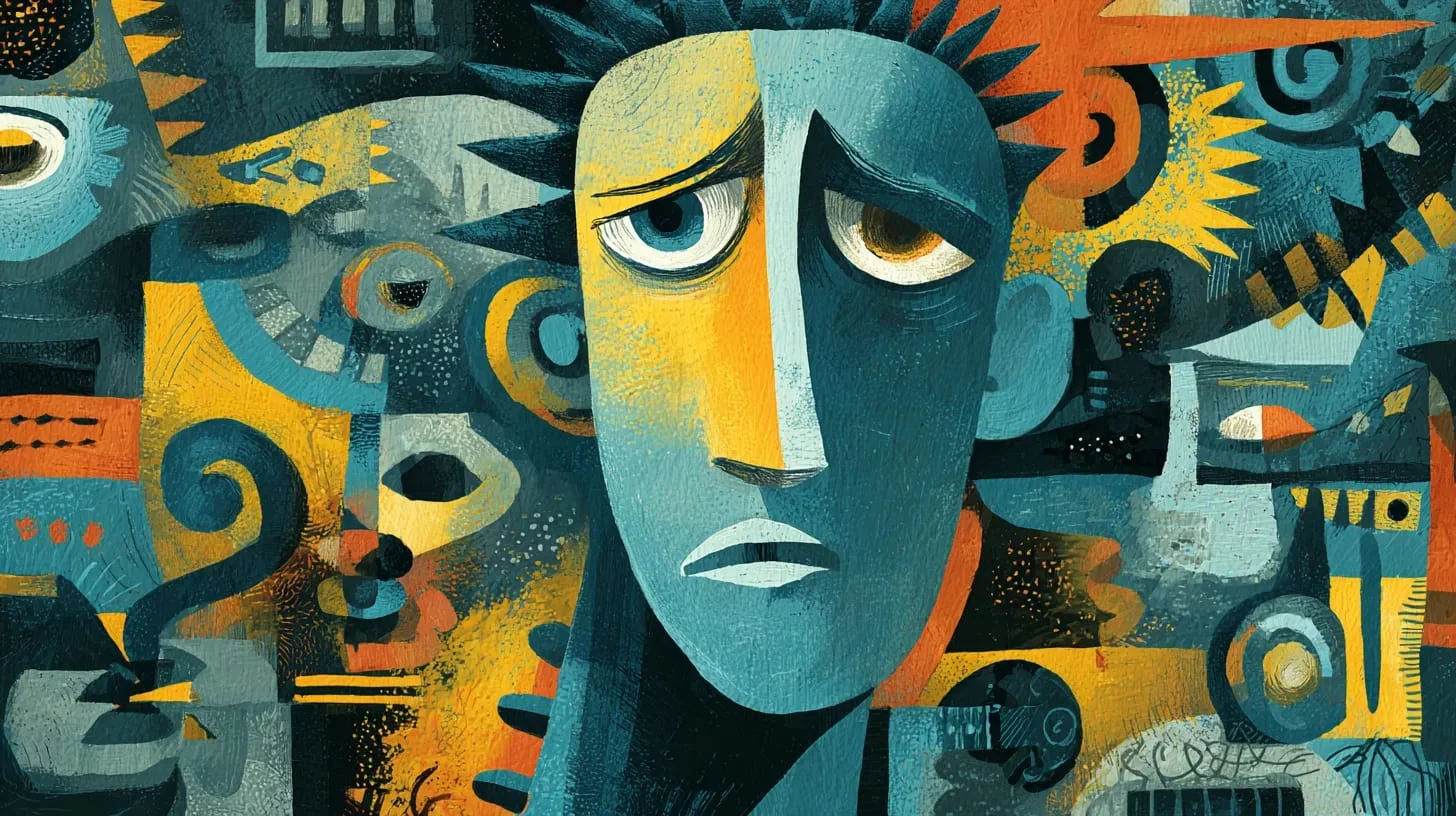
Agoraphobia


❝Agoraphobia is more than a fear of open spaces. It is an anxiety disorder marked by intense fear of situations where escape feels difficult or help may seem unavailable, often leading people to avoid everyday places, routines, and social life altogether.❞
IF YOU ARE IN CRISIS, PLEASE READ THIS FIRST. If you are in danger, please seek help immediately. Visit a nearby emergency service, hospital, or mental health clinic immediately. If you are in crisis, consider these helplines and suicide hotlines worldwide.
Show Crisis Numbers
- United States: 988 Suicide & Crisis Lifeline | Text 988
- United Kingdom: 111 (NHS Urgent Care) | Samaritans 116 123 | Text SHOUT to 85258
- Canada: 9-8-8 Suicide Crisis Helpline | Call or Text 988
- Australia: Lifeline 13 11 14 | Beyond Blue 1300 22 4636
- New Zealand: Call or Text 1737
- South Africa: SADAG 0800 567 567 | Lifeline 0861 322 322
- Ireland: Samaritans 116 123
- India: AASRA 022 2754 6669
- Singapore: Samaritans of Singapore 1767
- Germany: TelefonSeelsorge 0800 111 0 111
Agoraphobia is usually described as a fear of open spaces, but that description is too narrow, and it leaves many people who live with it not recognising themselves in the word at all.
What sits underneath it is a fear of being somewhere that escape might be difficult, or where help might not reach you, if something goes wrong. That is why it can attach to a crowded shop, a bus, a queue, or being at home on your own.
In this Article
What agoraphobia is
The World Health Organization lists agoraphobia among the anxiety and fear-related disorders, under the code 6B02. Its definition turns on fear or anxiety that is marked and excessive,1 and on where that fear shows up.
The trigger is not one place but a class of places: situations where escape might be difficult or help might not be available.1 Public transport, crowds, shops, theatres, queues and being outside the home alone are the everyday examples given.
Managing anxiety is easier with the right support. TherapyRoute connects you with qualified therapists who specialise in anxiety and stress.
Find an anxiety therapistThe fear is rarely about the place itself. A person living with agoraphobia is anxious in those settings because of what they expect to happen to them there, whether a panic attack or some other incapacitating or embarrassing physical symptom.1
What follows is avoidance. Those settings get avoided outright, or they are entered only on particular terms, most often with a trusted companion present,1 or else endured while badly frightened.
A diagnosis asks for more than a difficult few weeks. The pattern has to run for several months at least,1 and it has to bite hard enough to cause real distress or to interfere with family life, work, study, friendships or anything else that matters.
Agoraphobia is a diagnosis in its own right, and while it often travels with panic, it does not require a diagnosis of panic disorder to be real or to deserve treatment.
What it looks like from the inside
Severity varies a great deal between one person and the next.2
At the severe end, a person may not be able to leave the house at all, while at the milder end short and familiar journeys may pass without much trouble.
The symptoms fall into three groups: physical, cognitive and behavioural.
The physical side can be frightening. It runs to a racing heart, fast breathing, sweating, chest pain, trembling, dizziness and feeling faint.2 In agoraphobia this is an alarm system firing rather than a sign of physical danger, though new or unexplained physical symptoms are always worth having checked by a doctor rather than assumed to be anxiety.
The thoughts are as much part of the condition as the body's response. People commonly fear that a panic attack will be life threatening,2 that they will not be able to get out of a place, that they are losing their sanity, or that they will lose control in front of others.
Many people living with agoraphobia seldom feel the physical symptoms at all, precisely because they steer clear of anything that might set them off.2 The fear can be severe and still be almost invisible, because life has been quietly arranged so that it never gets triggered.
That arrangement is what the behavioural symptoms describe: avoiding crowded places, public transport and queues,2 long stretches of not leaving home, needing a trusted person alongside, and staying close to home.
Alongside this sit what clinicians call safety behaviours. Requiring a companion is the common one. Others go out only at certain hours, or carry particular items with them in case the feared thing happens.1 They make the day possible, and they also keep the fear intact.
Short-lived avoidance turns up in ordinary development and in stressful periods,1 and that is not agoraphobia, because it passes and it does not derail how a person functions.
Why it takes hold
One common route in is panic. Agoraphobia can develop as a complication of panic disorder,3 when someone has a panic attack in a particular setting, then worries so much about a repeat that the symptoms return in similar places, until that setting gets avoided altogether.
Panic sits close to the fight or flight reaction, the system that exists to get you through danger,3 releasing adrenaline and pushing up breathing and heart rate. In panic disorder that reaction is thought to fire harder than it needs to.
The pounding heart and the dread are a false alarm rather than a warning. Cognitive behavioural therapy works on exactly this point: many people hold the unrealistic thought that a panic attack will kill them, and therapy replaces it with something more accurate, that the experience is unpleasant but not fatal, and that it passes.4
Panic is not the only way in. Risk also rises after a traumatic childhood experience, after a stressful life event such as a bereavement, a divorce or the loss of a job, with an earlier history of mental illness, with alcohol-use disorder or drug misuse, and in an unhappy or controlling relationship. It can also develop in someone who has never had panic disorder or a panic attack.3
Avoidance is what keeps the whole thing running. Most people who develop agoraphobia have a history of panic attacks, yet many would not currently meet the criteria for panic disorder,1 and some are not having attacks at all, for the plain reason that they no longer go anywhere that might produce one.
Each act of avoidance brings genuine relief, and each one also teaches the fear that it was right. Over time the safe zone contracts.
How common it is, and how much it affects people
Symptom pattern, intensity and degree of avoidance all vary, and even so the WHO places agoraphobia among the most impairing conditions in its anxiety and fear-related group.1
Some people end up completely housebound.1 The cost shows up in work, in getting to medical care, and in the ability to build and hold on to relationships.
Over a lifetime it is about twice as common in women as in men. It also tends to start early: onset is typically in late adolescence, and most people who develop it do so before the age of 35.1 Starting in childhood is considered rare.
The prevalence figures most often quoted come from United States household surveys, and they are best read as US data rather than world rates. In those surveys, an estimated 0.9% of US adults had agoraphobia in the past year, and an estimated 1.3% of US adults experience agoraphobia at some time in their lives.5 Both estimates were assessed against the older DSM-IV criteria, in fieldwork carried out between 2001 and 2003.
Among US adults who had it in the past year, an estimated 40.6% were seriously impaired by it,5 with a further 30.7% moderately and 28.7% mildly affected. Whatever the true rate where you live, this is a condition that seriously disrupts a large share of the lives it touches, which is an argument for treating it rather than waiting it out.
The WHO asks that assessment take cultural and gender norms into account.1 Where violence is common, being afraid to leave home is not by itself a disorder, and the diagnosis belongs only where the fear runs beyond what is normal for that setting. Reasonable caution about a genuinely unsafe environment is not an illness.
How agoraphobia is diagnosed
Assessment is a conversation, not a test. A doctor will ask what the symptoms are, how often they come, which situations bring them on, and what they have cost you day to day.
Clinicians specifically ask whether someone has adopted avoidance strategies, such as relying on others to shop for them,6 because those workarounds map the shape of the problem.
Physical causes are usually excluded first. That may mean an examination and sometimes blood tests, since an overactive thyroid can throw up sensations that closely resemble a panic attack.6
In the United Kingdom's NHS, the diagnosis rests on three things: anxiety about places where escape or help may be difficult, avoidance of those places or getting through them with extreme anxiety or a companion, and no other condition that better explains it. Where the picture stays unclear, a referral on to a psychiatrist for fuller assessment may follow.6
The international criteria add two useful clauses. The symptoms must not be better accounted for by another mental disorder, and functioning that is only being held together through significant additional effort still counts as impairment.1 Coping at great personal cost is not the same as being well.
Who carries out the assessment differs by country: in some health systems a family doctor diagnoses and refers on; in others you may consult a psychologist or psychiatrist directly.
What helps
Agoraphobia is treatable, and the treatments are well described. The NHS in the United Kingdom sets out a stepped approach covering agoraphobia and any panic disorder underneath it: first learning about the condition and using self-help, then a guided self-help programme, then more intensive treatment such as cognitive behavioural therapy, or medication.4
Talking therapy is the centre of it. CBT starts from the premise that unrealistic and unhelpful thinking drives unhelpful behaviour, and for agoraphobia it is normally paired with exposure work.4
Exposure is graded, and it begins smaller than people fear. Early targets are deliberately modest, and the NHS example is a trip to the local corner shop.4 As confidence grows the targets get harder, up to a large supermarket or a meal somewhere busy.
A typical NHS course runs to between 12 and 15 weekly sessions, each lasting about an hour.4
Guided self-help means working through a CBT workbook or computer course with a therapist supporting you. Applied relaxation teaches you to notice the signs of tension,4 to release it, and to use those skills in ordinary situations, over a similar run of weekly sessions.
Gradual Exposure:
- Start with least feared situations
- Bring a trusted friend or family member
- Use coping techniques learned in therapy
- Celebrate small victories
Practical Coping Strategies:
- Plan outings during less busy times
- Identify "safe" people and places
- Carry comfort items (water, phone, medication)
- Practice relaxation techniques regularly
- Set realistic, achievable goals
Medication has a supporting role. Where medicine is recommended an SSRI is usual, and sertraline is the one commonly recommended for agoraphobia,4 with another SSRI, an SNRI or pregabalin used where the first choice does not suit. These decisions belong with a doctor who knows your history, prescribing rules differ between countries, and a prescribed medicine should never be stopped without medical advice.
The WHO describes agoraphobia as generally chronic and persistent,1 which is to say it does not usually tend to clear up on its own. That is an argument for getting help sooner, not a reason to lose heart. Avoidance shrinks a person's world, and with the right support that shrinking can be reversed, though how much changes, and how quickly, differs from person to person and cannot be promised in advance.
Getting help when leaving home is the problem
The standard advice is to go and see someone, and going to see someone is the feared act.
Begin with what needs no journey. NHS guidance is that where attending in person is not possible, a telephone consultation should be arrangeable,6 and it is worth asking whether the same is offered where you live. That conversation is a legitimate first step rather than a lesser one.
In some health systems you can go straight to therapy. In the United Kingdom a person can self-refer for talking therapies, CBT included, without going through their GP first.4 Elsewhere a referral, or a direct enquiry to a practitioner in private practice, may be the route, so it is worth checking how access works where you live.
Guided self-help suits this situation, since the work is done through a workbook or computer course with a therapist alongside. Many practitioners also offer sessions by video or telephone, so it is worth asking about that when you first make contact.
Taking a trusted person to a first appointment is a reasonable accommodation at the start. The aim over time is to need it less, and a therapist will work with you on that rather than against you.
Above all, apply the exposure principle to help-seeking itself. Make the first goal small enough to be achievable, in the same way that treatment opens at the corner shop rather than the crowded supermarket.
Supporting someone living with agoraphobia
Living alongside agoraphobia is demanding, and most people helping are doing their best with very little guidance.
The most useful distinction to hold is between support and accommodation. Clinicians assessing agoraphobia ask specifically about workarounds such as having someone else do the shopping, and that question is telling: practical help which removes the need to face a feared situation can quietly become part of what keeps the pattern in place.
This is not an argument for withdrawing help, and it is certainly not grounds for blame. It is an argument for aiming help in a particular direction, towards the feared situation in manageable steps rather than permanently around it.
Do not improvise exposure. Facing feared situations works when it is graded and guided, so the useful role for someone close is to encourage and accompany a person towards treatment, not to design a programme or push anyone into something they have not agreed to.
Take the fear seriously as fear. A person living with agoraphobia is not being dramatic or difficult, and being told to just get on with it tends to add shame to a condition that already carries plenty.
Finding a therapist
If any of this describes you, or someone close to you, the next step is a conversation with a professional who works with anxiety and can assess properly what is going on.
If you are not sure what to look for in a practitioner, or how to tell whether someone is a good fit, our guide on how to find the right therapist covers the practical questions worth asking before you commit to a first session.
Recovery from agoraphobia is rarely a straight line, and setbacks belong to the ordinary course of treatment rather than being evidence of failure.
This article is for general information and is not a substitute for professional assessment or care. If this is affecting your life, consider reaching out to a qualified mental health professional.
References
- [1] World Health Organization. ICD-11 for Mortality and Morbidity Statistics (2025-01), 6B02 Agoraphobia. icd.who.int/browse/2025-01/mms/en.
- [2] NHS. Symptoms - Agoraphobia. nhs.uk (United Kingdom). nhs.uk.
- [3] NHS. Causes - Agoraphobia. nhs.uk (United Kingdom). nhs.uk.
- [4] NHS. Treatment - Agoraphobia. nhs.uk (United Kingdom). nhs.uk.
- [5] National Institute of Mental Health. Agoraphobia (statistics). NIMH, United States. nimh.nih.gov/health/statistics/agoraphobia.
- [6] NHS. Diagnosis - Agoraphobia. nhs.uk (United Kingdom). nhs.uk.
Important: TherapyRoute does not provide medical advice. All content is for informational purposes and cannot replace consulting a healthcare professional. If you face an emergency, please contact a local emergency service. For immediate emotional support, consider contacting a local helpline.
Find Therapists
Must Read
Creating Space for Growth: How Boundaries Strengthen Relationships
Setting healthy boundaries fosters respect, protects emotional well-being, and strengthens relationships by defining personal limits and maintaining self-care.
International Mutual Recognition Agreements for Mental Health Professionals
Mutual recognition agreements for mental health professions are rare and uneven, with major gaps in counselling, social work, and allied therapies. Read on to understand ...
Sexual violence statistics worldwide
How many people experience sexual violence worldwide and in countries on most continents, how often it begins in childhood, how men and boys are affected, how many surviv...
Phobia statistics worldwide
How many people have a specific phobia, social anxiety disorder or agoraphobia, which fears are most common, when phobias start, how many people get treatment, and which ...
Autism statistics worldwide
How many people are autistic worldwide and in countries on every continent, how diagnosis differs between boys and girls and across ages, which conditions often occur alo...
About The Author

TherapyRoute
Cape Town, South Africa
“Our in-house team, including world-class mental health professionals, publishes high-quality articles to raise awareness, guide your therapeutic journey, and help you find the right therapy and therapists. All articles are reviewed and written by or under the supervision of licensed mental health professionals.”
TherapyRoute is a mental health resource platform connecting individuals with qualified therapists. Our team curates valuable mental health information and provides resources to help you find the right professional support for your needs.