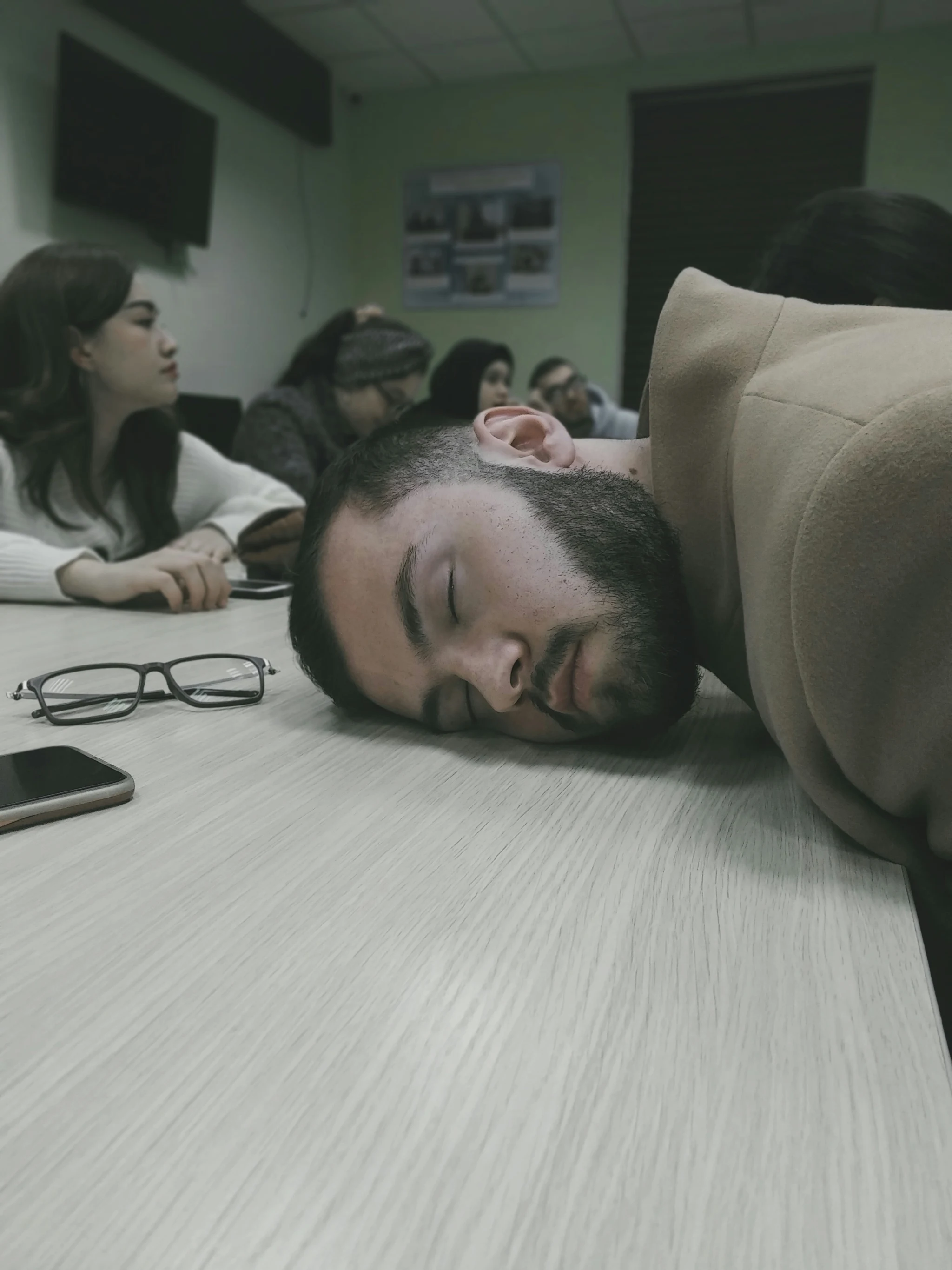
Achieving a Healthier Work Life Balance

❝If you’ve ever felt like you’re missing out on life outside the office or struggling to prioritize self-care, it might be time to reassess your work-life balance (WLB).❞
Work-life balance is usually written about as a set of personal habits: plan better, say no more often, put the phone down. The measured harms of overwork are not mainly about habits. They track the hours worked, the security of the job, and the ordinary daily strain of it. This page sets out what sustained overload does over time, how to tell ordinary strain from a state that needs assessment, and what a therapist does with work stress when someone brings it.
In this article
What work-life balance means
Work-life balance describes the fit between what a job demands and what the rest of a life needs: sleep, relationships, care of children or parents, health, and rest. It is a fit, not a character trait. Two people working the same hours can sit in very different positions, depending on control over the schedule, travel time, pay, and who else depends on them.
Balance rarely means equal halves. For most people it means the job stops at a point that leaves enough of the day, the week and the year for everything else. It also means that this holds most of the time, rather than in one good month.
Managing anxiety is easier with the right support. TherapyRoute connects you with qualified therapists who specialise in anxiety and stress.
Find an Anxiety TherapistWhat sustained overload does over time
Long hours have measurable health effects at population level. In 2016 long working hours led to 745 000 deaths from stroke and ischemic heart disease, according to the World Health Organization and the International Labour Organization, 29 per cent more than in 2000.[1] The World Health Organization and International Labour Organization attribute those 2016 deaths to working at least 55 hours a week.[1] These are population estimates. They say nothing about any one person's risk.
The physical mechanism is worth setting out. Chronic stress can interfere with the body's ability to keep the sympathetic and parasympathetic systems balanced, and low heart rate variability is one marker of that.[2] Epidemiological studies use brief validated questionnaires to assess chronic psychological distress and its contribution to cardiometabolic risk.[3] Heart rate variability is simply the small variation in time between heartbeats, which drops when the system stays braced.
Workload is not the only exposure. Ferrie and colleagues, combining 19 cohort studies, found high job insecurity associated with an increased risk of diabetes compared with low job insecurity.[4] An insecure contract carries health consequences of its own, and changes to an evening routine do not affect it.
Ordinary daily strain is worth taking seriously. Lazarus and Folkman found that daily hassles appear to be better predictors of health outcomes than major life events.[5] That matters if your job holds no single crisis and you still feel worn down. The small repeated frictions are what the evidence points at, so a job with nothing dramatic in it can still be the thing making you ill.
Ordinary strain, or something that needs attention
Most tiredness after a hard stretch is ordinary strain, and it lifts with rest. Clinicians pay closer attention when three things appear together and hold for weeks. The first is exhaustion that rest does not repair. The other two are growing detachment from the work and the people in it, and a fall in what a person can get done. That pattern is what burnout looks like in the consulting room. It describes a work-related state rather than a diagnosis.
The same pattern is also how depression and anxiety often present, and both are treatable. Changes in sleep, appetite, concentration or interest that persist for weeks belong with a doctor or a therapist, whatever the cause turns out to be. People usually come late, after months of pushing on, which is the part worth changing.
| Common signs | Likely picture | Next step |
|---|---|---|
| Tired after a heavy stretch, and a weekend or a week of leave restores you | Ordinary strain | Trial one or two of the changes below |
| The strain returns within days; the hours, workload or job insecurity are constant | A job problem | Aim at the conditions, not your habits |
| Sleep changed for weeks, dread most mornings, little interest at home, work slipping | Worth assessing | Speak to a doctor or a therapist |
| Hopelessness, or thoughts of harming yourself | Urgent | Get help today: helplines worldwide |
Changes worth trialling
None of what follows repairs a workload that is simply too large, and none of it is a treatment. Pick one or two and give them a few weeks, rather than attempting the set.
- A marked end to the working day. A walk, a change of clothes, cooking, the trip home if you still make one. The repeated signal is what does the work, not the particular activity.
- One protected block. An evening, a morning, or part of a weekend that work does not enter. One block you keep is worth more than a rule you break most nights.
- Fewer commitments, chosen deliberately. Declining depends on your standing at work, and it is not equally available to everyone. Where refusing is not safe, negotiating the timing or the scope of a task often is.
- Contact with people, deliberately kept. A 2024 study describes social support as reducing perceived stress and, through that, improving mental health outcomes.[6] Contact is usually the first thing dropped when work expands.
- Sleep and movement at a level you can actually sustain. Our page on self-care covers the ordinary version of this without the performance.
Shift workers, people on call, carers, and anyone holding more than one job cannot apply several of these. If that is your position, work with the one or two that survive your roster and treat the rest as unavailable rather than as a personal failure.
When the problem is the job, not you
Work-related stress is common enough to be counted at national scale. In a 2021 American Psychological Association survey, 59% of workers reported negative impacts of work-related stress in the previous month.[7]
The bodies that study this do not treat it as a private matter of self-discipline. The World Health Organization and the International Labour Organization published a policy brief on mental health at work setting out what governments and employers can do.[8] The WHO guidelines on mental health at work recommend organisational interventions, manager training and worker training alongside individual interventions.[8] Workers put it in the same place: in the same 2021 survey of work-related stress, 87% of employees said actions from their employer would help their mental health.[7]
A common belief is that the remedy is the setup around the work: better desks, a quiet room, an app. One study of office environments found that satisfaction with the organisation matters more to perceived productivity support than the office layout itself.[9] Something similar happens with training. Hick observes that many employers of mental health professionals see mindfulness as a way of reducing worker turnover or burnout.[10] Teaching staff to cope better is cheaper than changing what they are coping with, and the two are not the same intervention.
What an employer is required to do differs by country, and this page does not give legal advice. In the United States, the Occupational Safety and Health Administration points workers and employers to a resource from the National Institute for Occupational Safety and Health. Its Healthy Work Design and Well-Being Program covers how work affects overall health and well-being.[11] Elsewhere the duty sits with occupational health and safety regulators, labour inspectorates or working-time law, and leave entitlements differ sharply between countries. Check the regulator that covers your own country before assuming any of it applies to you.
What therapy for work stress involves
Therapy for work stress is not a productivity intervention. The American Psychological Association describes psychotherapy as a collaborative treatment grounded in dialogue, in which you and your psychologist work together to identify and change thought and behaviour patterns.[12] A first session usually maps the actual week: hours, how much control you have, how secure the job is, sleep, and what has quietly been dropped.
The approaches differ. The Australian Psychological Society describes cognitive behaviour therapy as based on the premise that thoughts influence feelings and behaviours.[13] In acceptance and commitment therapy, people increase their acceptance of distressing thoughts, beliefs, sensations and feelings while moving toward valued goals.[13] Psychodynamic work asks a different question, about what the overwork does for the person and what it costs them.
No therapy can promise that a job becomes bearable, and a therapist cannot change your employer. What treatment can address is the low mood, the anxiety, the broken sleep, and the habit of pushing on well past the point of coping. If your own reading points that way, our guide on how to find the right therapist sets out what to look for, and the TherapyRoute directory lists clinicians by country.
Team TherapyRoute
References
- [1] World Health Organization and International Labour Organization (2021). Long working hours increasing deaths from heart disease and stroke. who.int/news.
- [2] Review article on relationship stress and physical health. PubMed Central. pmc.ncbi.nlm.nih.gov/articles/PMC8474672.
- [3] Review article on chronic psychological stress and cardiometabolic risk. PubMed Central. pmc.ncbi.nlm.nih.gov/articles/PMC12924779.
- [4] Review article on work as a determinant of health. PubMed Central. pmc.ncbi.nlm.nih.gov/articles/PMC10454804.
- [5] Lazarus & Folkman - Stress, Appraisal, and Coping (1984), Summary (pt 1) (pp 340-347).
- [6] Study on social support, perceived stress and mental health outcomes (2024). Frontiers in Psychology. frontiersin.org/journals/psychology.
- [7] American Psychological Association (2021). News release on work-related stress and worker well-being. apa.org/news/press/releases.
- [8] World Health Organization. Mental health at work (fact sheet). who.int/news-room/fact-sheets.
- [9] Haynes, B. Paper on the physical work environment and productivity. Sheffield Hallam University research archive. shura.shu.ac.uk/22473.
- [10] Hick, S. F. Cultivating Therapeutic Relationships: The Role of Mindfulness, in Mindfulness and the Therapeutic Relationship, Chapter 1 (pt 1) (pp 20-27).
- [11] Occupational Safety and Health Administration, United States. Workplace stress: understanding the problem. osha.gov/workplace-stress.
- [12] American Psychological Association. Understanding psychotherapy and how it works. apa.org/topics/psychotherapy.
- [13] Australian Psychological Society. Evidence-based psychological interventions. psychology.org.au.
Important: TherapyRoute does not provide medical advice. All content is for informational purposes and cannot replace consulting a healthcare professional. If you face an emergency, please contact a local emergency service. For immediate emotional support, consider contacting a local helpline.
Find Therapists
Must Read
Creating Space for Growth: How Boundaries Strengthen Relationships
Setting healthy boundaries fosters respect, protects emotional well-being, and strengthens relationships by defining personal limits and maintaining self-care.
International Mutual Recognition Agreements for Mental Health Professionals
Mutual recognition agreements for mental health professions are rare and uneven, with major gaps in counselling, social work, and allied therapies. Read on to understand ...
Mental Health Licensing & Regulation in New York State: 2026 Guide
Mental Health Licensing & Regulation in Singapore: 2026 Guide
Jumping to Conclusions
Jumping to conclusions is a thinking habit where we assume the worst or make judgments without enough evidence. By recognising this pattern, therapy can help you slow dow...
About The Author

“I specialize in weight loss and weight management therapist, as well as treating eating disorders, insomnia,body image issues, & self-esteem”
Candice Seti is a qualified Licensed Psychologist, based in San Diego, United States. With a commitment to mental health, Candice provides Coaching, Counseling, Mindfulness, Online Therapy, Psych & Diagnostic Assessment, Individual Therapy and Therapy.
