Who was Otto Gross?

Bernd Nitzschke
Mental Health Resource
Cape Town, South Africa
❝Book Review of Gottfried M. Heuer: Freud’s ‘Outstanding’ Colleague/Jung’s ‘Twin Brother’. The Suppressed Psychoanalytic and Political Significance of Otto Gross. Routledge, London/New York 2017❞
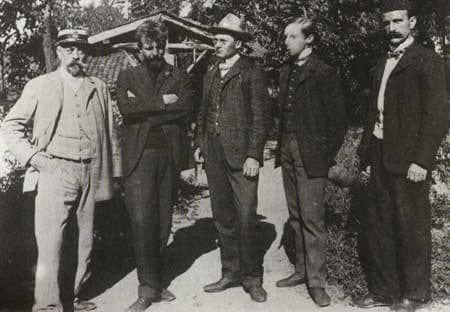
Who was Otto Gross? If this question had been asked in the middle of the 20th century, only a few specialists would have been able to give an answer.
Students of the early history of psychoanalysis might have cited the second volume of Ernest Jones’s Freud biography, published in 1955, where we learn that on 26th April 1908, Otto Gross and his wife Frieda participated in the ‘Gathering to discuss Freudian Psychology’ in Salzburg, a meeting today known as the First International Psychoanalytical Congress. Those who knew the bohemian scenes in Schwabing (an artistic quarter in Munich) and Ascona (a town popular with artists in the Swiss canton of Ticino) could have added that Gross had conducted psychoanalytic sessions in the local cafés. Historians of anarchism would have mentioned Erich Mühsam and Franz Jung who were friends of Gross. And literary scholars would have deciphered fictional characters in order to discover a picture of Otto Gross, as is indicated in the following quotations:
Looking for evidence-based support? Find a qualified psychologist near you through TherapyRoute.
Find a psychologist
- Dr. Askonas, alias Dr. Gross: ‘He appears as a pale, slender high school student, who is just beginning to sprout a little black beard.’ (Max Brod, Das große Wagnis, 1919, p 19).
- Dr. Kreuz, alias Dr. Gross: ‘Once you had seen that fanatical bird face which appeared to be made of lightly tinted porcelain, you never forgot it.’ (Leonhard Frank, Links wo das Herz ist, 1952, p 17).
- Dr. Hoch, alias Dr. Gross: ‘Striving to walk like a normal person, he performed the individual stages of each step so precisely that his gait resembled a ghostly dance. It was as if his body were connected inside with wires that someone, maybe up there on the rooftops, controlled to create this strange hesitant motion.’ (Johannes R. Becher, Abschied, 1975, p 350f.).
- Mr. Noon, alias Dr. Gross: ‘He never let you sleep. He talked and talked. Oh he was so marvellous. I once went with him to a zoo place. And you know, he could work up the animals by merely looking at them till they nearly went mad.’ (D.H. Lawrence, Mr. Noon, 1984).
In each of these four descriptions, the reader is reminded of another characteristic of Otto Gross. Max Brod recognised Gross’s arrested development for which he compensated by decades of drug use. In 1913, when he was once again in a mental hospital,2 he stated: ‘By the way, almost everything I publish3 I have written under the influence of a double intoxication induced by cocaine and morphine. This was so intense that I no longer recognised the ceiling and had an illusion of a golden vault instead.’ Leonard Frank emphasized the associated fanaticism with which Gross tackled the world around him, while Johannes R. Becher gave the impression that Gross acted as if he were controlled by sinister powers. D.H. Lawrence used a metaphor to describe the hypnotic power with which Gross aroused the animal desire of those he adopted, promising to free them from inhibitions, fears and restraints.
For Otto Gross, polyamory was no foreign word. He practised the ‘sexually immoral’ principles he established without inhibition. Gross generously offered his wife to Ernst Frick and Erich Mühsam, as well as to Ernest Jones, whom he had introduced to psychoanalysis by letting him listen in to sessions. At such times he was usually satisfied with the position of participating observer, but he would also become engaged on occasions. Else von Richthofen, whose married name was Jaffé, bore him a son in the same year (1907) as his wife did so. The two women had been close friends since their youth, and both mothers called their sons Peter. Otto Gross also initiated Frieda von Richthofen, Else’s sister, who was then still married to Ernest Weekley (later she became the muse of D. H. Lawrence and thus the model for Lady Chatterley), into ‘free love.’ And when it came to curing patients, Gross also recommended sexual activities with the therapist.
Even after Lotte Hattemer, in 1906, and then Sophie Benz, in 1911, found the only way to liberate themselves from the arms of their ‘psychoanalyst’ was suicide , Otto Gross still regarded himself as a humane doctor. As a qualified psychiatrist in the field of psychopathology (he had graduated in 1905), he diagnosed the two women as suffering from incurable mental illness (dementia praecox). Accordingly, he left the ‘poison’ with which Lotte Hattemer killed herself lying within her reach. ‘I declare my support for euthanasia,’ commented Gross. ‘A beautiful death is better than a low probability of cure.’ And in the case of Sophie Benz, he informed the psychiatrists who examined him after his admission to the Tulln asylum in 1913: ‘When I could no longer intervene analytically, I had a duty to poison her.’4
The law saw matters differently from Otto Gross, who maintained he had done his lovers a parting service. In 1912 Gross was being sought for murder and assisting suicide. His father, Professor Hans Gross, considered the founder of criminology, now moved heaven and earth to protect his son from conviction. He had him tracked down in Berlin, where Otto had found refuge with Franz Jung, and arranged for him to be committed to the Tulln lunatic asylum. Otto’s friends accused Professor Gross of abduction and started a press campaign calling for his (Otto’s) release. His father would have liked nothing better than to banish to penal colonies these revolutionaries and other ‘degenerates’ who had glorified Otto as an avant-gardist. In this context it is curious to note that Franz Kafka had attended Professor Hans Gross’s lectures at the University of Prague in 1903. Fifteen years later the author of In der Strafkolonie [In the Penal Colony, 1919] discussed with Otto the launch of a publication to be called Blätter zur Bekämpfung des Machtwillens [Journal for Resistance Against the Will to Power].
In 1914 Otto Gross was declared of unsound mind, and as a consequence incapable of being prosecuted. His father, who had always supported his son financially and was thereby co-dependent in his drug use, was appointed guardian. When Hans Gross died a year later, Otto was left empty-handed. He had also lost his grip over his father which he achieved by fighting him. He could now no longer focus his struggle with an inner adversary by representing this in the form of his father. Franz Jung wrote that from now on Gross’s ‘behavior has a strong infantile character. He is doomed.’ In February 1920 matters came to a head when Gross, still addicted, was found half frozen and starving in a Berlin street. A few days later, shortly before his 43rd birthday, he died of pneumonia. In the lunatic asylum in Tulln Gross is recorded as saying: ‘My whole life was focused on overthrowing authority, for example that of the father. In my view there is only the maternal right, the right of the horde. [...] So when I’ve finished my work, let come what may. Actually, I would like to live to the age of forty-five, and then go under, [...] preferably participating in an anarchist assassination [...]. That would be the most beautiful way.’5 This is how the rebel against paternal authority fantasized his heroic departure from the stage; by contrast his actual death in hospital was pitiful.
What did Otto Gross leave to the world? He achieved a limited output of around three dozen titles, including five monographs published between 1901 and 1920. Starting out in psychiatry, he turned to psychoanalysis, which he wanted to enrich with anarchist concepts and which he understood as a manual to the ‘sexually immoral’ liberation of mankind. The posthumously published Drei Aufsätze über den inneren Konflikt (1920) [Three Essays on the Inner Conflict] can be considered as representative of his whole work. It combines a critique of patriarchal society (political economy) with criticism of the nuclear family (sociology) where the conflict between children and parents takes place (family dynamics). This conflict is internalized as a struggle between self and the other (psychodynamics), but is later turned outwards again in the sex life of adults through the obsessional contest between the desire to sadistically dominate the love object and the desire to subjugate the same masochistically (relationship dynamics).
With this contribution Otto Gross stands at the head of a line of psychoanalysts, and following them the authors of the Frankfurt Institute for Social Research, who described the mind of those socialized in an authoritarian way as a place where the inner struggle between submission and rebellion takes place. In the best possible outcome, this can lead to liberation from obedience to authority, that is to autonomy (individuation).6 Gross championed the release from patriarchy, or ‘the reversing of every single effect of mis-development,’ such patriarchy and mis-development being said to have led society from the original ‘matriarchal-communism’ to the present social order.7 Franz Jung recognized the similarity of this liberation theology to the later sexual revolution preached by Wilhelm Reich and described the latter as ‘a copy’ of Otto Gross’s teaching.
Gross wanted regression – Freud demanded progression. The contrast could not have been greater. In Freud’s conception remembering, repeating and working through conflicts associated with infantile desires should lead the patient to the insight that such desires, particularly where they related to incest, were not retroactive and could no longer be fulfilled. For Freud, remembering meant reliving, but not in the sense of acting out infantile wishes.
The ability to renounce the fulfilment of such desires was for Freud a sign of psychological health. He recognized in this renunciation the precondition for love freed from infantile restraints. Otto Gross, on the other hand, idealised the acting out of childish desire. ‘Dr. Gross tells me that he puts a quick stop to the transference by turning people into sexual immoralists,’8 wrote C. G. Jung to Freud on 25th September 1907 after meeting Gross for the first time at the Neuro-Psychiatry Congress in Amsterdam. Freud may have recalled this when, years later, he declared emphatically: ‘To believe that psychoanalysis seeks a cure for neurotic disorders by giving a free rein to sexuality is a serious misunderstanding which can only be excused by ignorance.’9
During his lifetime Otto Gross was well known, and indeed infamous, as an anti-bourgeois avant-gardist, but no sooner had he died than he was forgotten. It was not until the correspondence between Sigmund Freud and C. G. Jung was published in 1974 that he re-entered public consciousness. Gross was treated for drug addiction twice at the Burghölzli psychiatric clinic, the first time in 1902 and then again in 1908. It is for this reason that Gross plays such an important role in the correspondence between the two men. After Jung’s initial enthusiasm, during which he wrote to Freud that he had spent all his ‘available time, day and night’ on his patient,10 this second treatment ended, like the first, in relapse. After six weeks of treatment, Gross jumped over the hospital wall and withdrew from any further therapy. In retrospect, Jung told Freud: ‘There is no development, no psychological yesterday for him; the events of early childhood remain eternally new and operative, so that notwithstanding all the time and all the analysis he reacts to today’s events like a six-year-old boy, for whom the wife is always the mother [...].’ Further on in the same letter, Jung writes: ‘[...] in Gross I discovered many aspects of my own nature, so that he often seemed like my twin brother – but for the Dementia praecox.’11 Freud replied that ‘[…] Dem. pr. still has no precise meaning for me; […],’ but he acknowledged that ‘in paranoia I recognize a psycho-clinical type.’12
In an earlier letter, which again sought to clarify the problem of ‘paranoia (dementia praecox),’ Freud wrote to Jung: ‘You really are the only one capable of making an original contribution; except perhaps for O. Gross, but unfortunately his health is poor.’13 In his biography of Freud Ernest Jones represented this remark as ‘[…] he expressed the opinion that Jung and Otto Gross were the only truly original minds among his followers.’14 Although incorrect, this version has often been repeated uncritically in the literature on Otto Gross. Freud had merely remarked that Jung, and perhaps even Gross, could contribute ‘something of [their] own’ to clarifying the problem of paranoia. Freud’s choice of words was, however, ambiguous, as it implied a comment on Jung’s own psychological make-up in addition to the open reference to Gross’s mental problems. Had Freud already divined the spiritual kinship of Gross and Jung before Jung came to see Gross as his twin brother, albeit emphasizing that he, Jung, did not suffer from dementia praecox?
Gottfried M. Heuer is an established expert on Gross literature, and is the author of numerous articles about his subject. On his initiative, in collaboration with Raimund Dehmlow, the International Otto Gross Society was founded 1999, and for many years he was its chair. 2017 Heuer has published a book about Otto Gross entitled Freud’s ‘Outstanding’ Colleague / Jung’s ‘Twin Brother,’ a bringing together of two quotes from the Freud-Jung correspondence. On the one hand Heuer picks up on the formulation ‘twin brother,’ which C.G. Jung had used in his letter to Freud, while decidedly rejecting Jung’s ‘Dementia praecox’ diagnosis of Gross which Freud, as well as Eugen Bleuler, Jung’s superior at Burghölzli, had doubted from the beginning. On the other hand, Heuer’s title describes Gross as Freud’s ‘outstanding colleague.’ He uses these two quotes to highlight the stature of his hero, as if he wanted finally to realize the ‘golden vault’ which Gross saw spanned above him in his drug-induced high.
The truth is Freud never recognized Gross as an ‘outstanding colleague.’ Nor did he, as Heuer claims in the preface, describe the work of Gross as ‘outstanding.’ In the Standard Edition of Freud’s works Gross is cited only once, which for Heuer is proof that the founder of psychoanalysis wanted to destroy the memory of Gross’s outstanding contribution to the movement. In the chapter ‘Psychoanalysis politicized and sacralized,’ where he extols Gross as a prophet, Heuer finally introduces the statement that inspired him to formulate the phrase ‘outstanding colleague.’ On 3rd June 1909 Freud wrote to Jung, referring adroitly to Gross’s book, Über psychopathische Minderwertigkeiten (1909) [On Psychopathic Inferiority],15 and indirectly including an earlier work as well: ‘I haven’t studied it yet, but obviously it’s another outstanding work, full of bold syntheses and overflowing with ideas. And again two different ways of indicating emphases (bold type and letter spacing), which makes an exquisitely paranoid impression. Too bad, the man has a good mind!’ Heuer quotes this passage in the letter but falsifies Freud’s statement by omitting the part about those bold-printed passages giving a ‘paranoid impression.’ He also mutilates the subsequent sentence by removing ‘Too bad,’ before the phrase ‘the man has a good mind!’ With this trick Heuer succeeds in turning Freud’s statement about ‘a good mind’ on its head.
Immediately following this tendentious citation, Heuer attacks Zvi Lothane for contradicting the often stated view in the Spielrein-Gross-Jung literature, shared by himself, that Sabina Spielrein and C. G. Jung had explicit sex, that is sexual intercourse, during (or after?) their therapeutic relationship. As his advocate, Heuer praises Gross’s ‘ethical and sacral dimensions,’ and in the role of examining magistrate rebukes Lothane with these words: ‘Lothane states with an authority as if he had been present, that they [Spielrein/Jung] did not have sex [...].’ When he was at the Burghölzli in 1908, Gross prompted Jung to try out the sexual immoral treatment at least once. Shortly thereafter Jung, following this advice, acknowledged his attraction to Sabina Spielrein. There were stormy expressions of love on both sides.
Well, it is true that Lothane was not an eyewitness, but he clearly read the letters written by Jung and Sabina Spielrein more thoroughly than Heuer. In a letter to Sabina Spielrein in 1919 Jung says: ‘The love of S. for J. has made the latter aware of something he had previously only vaguely suspected, that is of a power in the unconscious that shapes one’s destiny, a power which later led him to things of greater importance. The relationship had to be “sublimated” because otherwise it would have led him to delusion and madness [...].’16 The same message appeared in a letter from Sabina Spielrein to her mother a decade earlier where she wrote: ‘So far we have remained at the level of poetry that is not dangerous,17 and we shall remain at that level, perhaps until the time I will become a doctor, unless circumstances will change.’18
This criticism of Lothane is, however, only the overture to a much wider ranging charge that Heuer brings against ‘the founding fathers of psychoanalysis.’ Heuer claims that Freud and Jung falsified the history of psychoanalysis ‘actively and intentionally’ and appropriated important insights from Gross without mentioning his name. Accordingly he accuses them of ‘character assassination,’ and furthermore Gross becomes in Heuer’s eyes the victim of a damnatio memoriae.19 As proof of this assertion, Heuer claims that while Jung had named Gross in the first version of his treatise on Die Bedeutung des Vaters für das Schicksal des Einzelnen (1909) [The importance of the father for the fate of the individual], in the third and revised edition of 1949 he deleted him. This criticism may be justified, but Heuer’s more general point that Jung had erased the memory of Gross is simply wrong. Gross is mentioned several times in the third volume of Jung’s Collected Works, published in German in 1968, at the point where he deals with the contribution of Otto Gross to the understanding of dementia praecox.
Heuer then turns his attention to the present and asks: ‘How does psychoanalysis stand today? How does it deal with dissidents and how does it implement its program?’ Heuer has taken these questions (translated by him) from the headline of an article published in the Süddeutsche Zeitung in 2014.20 What he fails to mention, however, is that this was a report on a symposium organized by two psychoanalytic institutions in Düsseldorf, in which Goetz von Olenhusen, Chair of the International Otto Gross Society,21 gave a lecture on Gross. Instead of properly informing his readers of this highly relevant context, his allegations rise in a crescendo: ‘The continuing exclusion from the contemporary psychoanalytic discourse of all those analysts who – like Gross – have been purged from the analytic community is reminiscent of keeping alive the old hatred [ ...].’ Heuer maintains that the perpetrators of yesteryear needed to uphold and justify this old hatred because otherwise they could not live quietly. Claude Lanzmann had indicated a similar defence mechanism among the inhabitants of a Polish village, who in retrospect had justified their hatred of the Jews who fell victim on their account to the Shoah as ‘otherwise they could not live.’ The tastelessness of this analogy is highlighted when one recalls that four of Freud’s five sisters were victims of the Shoah, which Freud himself only narrowly escaped.
Heuer sees his task as the rehabilitation Otto Gross. The title of his first chapter, ‘Healing wounded history,’ sets the agenda. Heuer wants to achieve the goal of releasing ‘Otto Gross from the trauma of damnatio memoriae’ using his own ‘intersubjective, psychoanalytic and sacral-political methodology.’ In contrast to traditional historiography, which Heuer calls ‘pseudo-objective,’ the subjectivity of the author plays an important role in this approach. The reader will thereby be exposed not only to the life and work of Otto Gross, but also to aspects of Heuer’s family and emotional life. In this way a peculiar double portrait emerges, comprising features of both Otto Gross’s and Gottfried ‘M.’ Heuer’s lives. The ‘M.’ stands for Maria, a middle name which Heuer had added only a few years earlier. Heuer tells his readers that this was intended to recall the girl that his parents had wanted in his place, but did not receive. In addition, ‘M.’ was intended ‘to explicitly honor the feminine.’
Otto Gross saw the worship of the female differently from others. He concealed his sexual addictive behaviour behind an avowed sacred service to women, who therefore felt able to participate in his Ascona orgies, invoking the Near-Eastern mother goddess Astarte, or to submit to treatment with Gross by means of the ‘sexual-immoral’ variant of psychoanalysis. In this connection, Heuer admits somewhat reluctantly: ‘However, Gross’s psychoanalysis-without-boundaries, as one might call it, did have negative repercussions.’ For Lotte Hattemer and Sophie Benz, the effects of this ‘psychoanalysis-without-boundaries’ were particularly negative.
In the final phase of writing his book, Heuer dreamed that he had prepared an omelette for Freud, who had thanked him for it. In this way, Freud (or rather the author himself with the help of a dream) fulfilled a wish: ‘I feel I have passed the test by receiving affirmation from the founder of psychoanalysis.’ Whether Freud would have praised the omelette if it had been presented to him in the form of the book we are discussing here is questionable. For he wrote of Gross: ‘He is addicted and can only do great harm to our cause.’22 a judgement which differs considerably from the image which Heuer draws of Gross, whose intellectual genealogy he traces back to Zenon, the founder of Stoic philosophy.
Heuer, however, praises not only the predecessors of Otto Gross, including the anarchist Pyotr Alexeyevich Kropotkin, who attended the Congress of the Anti-authoritarian International in 1877, but also Gross himself as an intellectual pioneer. Accordingly, he repeats what Franz Jung said, namely that Wilhelm Reich had appropriated the term ‘sexual revolution’ without naming Gross, who originally coined this term. Gross's also stood, according to Heuer, at the very outset of research into the authoritarian personality.23 In addition, Heuer claims, Gross was the inspiration behind many ideas that Freud and Jung worked on further. Freud, for example, should have used Gross’s ideas in his book Triebe und Triebschicksale [Instincts and their Vicissitudes] (1915), without making their origin clear. Heuer also believes Gross is the progenitor of the psychoanalytic object relations theories of Fairbairn and Winnicott. The foundations of intersubjective psychoanalysis were, moreover, laid out in Gross’s work, Heuer says. And finally, Otto Gross was the first psychoanalyst to recognize the great importance of the mother-child relationship and accordingly forcefully stressed the consequences of deprivation of maternal love. As evidence of this claim Heuer quotes a passage from Gross’s essay Drei Aufsätze über den inneren Konflikt [Three Essays on the Inner Conflict] (1920) in which Gross explains hospitalism24 empathically: ‘Lack of love! The children perish [...] from starvation of the soul, the child’s instinct to find mother-love remains unsatisfied and the little soul dies.’ Heuer’s omission in this paragraph is significant, for in the original the complete passage reads: ‘Lack of love! The children, as one of the leading researchers of hospitalism expresses it, perish from mental starvation, the childish instinct for maternal love remains unsatisfied and the soul dies.’
In Heuer’s book ‘the leading investigator of hospitalism’ falls victim to censorship. Had he mentioned this expert, the image of explorer Gross would not have appeared so wonderful. And if Heuer had then also communicated what Gross expressly pointed out, the readers of Heuer’s book would have known that the passage quoted does not even come from Otto Gross. In the introduction Gross writes: ‘In the following [sic] a popular Kosmos lecture, currently available to me, is reproduced; it refers to the research findings of a paediatrician, Prof. Ibrahim [...].’ This indicates that when Gross wrote the paper quoted by Heuer, the importance of maternal love and the consequences of its deficiency were already so well known that it could be reported in a popular journal.
Heuer has expressed his reverence for Otto Gross many times in the past, without having to resort to supporting quotations. He has earned a reputation for exploring the life and work of his idol by finding buried paths and opening up forgotten sources. Furthermore Heuer’s book contains interesting illustrations from the Otto Gross Archive in London, of which he is the curator. In particular the chapter on Otto Gross’s wildlife and his resulting offspring contains pictures of the sons Peter and Peter, and the daughters Sophie (mother: Marianne Kuh) and Camilla (mother: Regina Ullmann). Finally, the appendix presents a medical file from Mendrisio which Heuer has discovered. Otto Gross had found refuge in this clinic following his mental breakdown brought on by the suicide of his lover, Sophie Benz.
In March 1911 Gross was transferred to the Steinhof Psychiatric Hospital in Vienna, and on 7th April 1911 Freud wrote to Jung that he had received a ‘most respectful letter’ from him containing ‘an urgent request that I publish an enclosed communication as soon as possible. It is scribbled in pencil and entitled: “In Self-Defence …”’ In this paper Gross attacked Eugen Bleuler and C. G. Jung who, he said, had used someone else’s property, namely the thoughts of Otto Gross, without sufficiently stating this. However, in the next letter from Freud to C.G. Jung we read: ‘Gross has written me a furious letter demanding that I return his article “In Self-Defence.” Which I have done.’ Jung replied briefly, after which there is no further mention of Gross in the Freud-Jung correspondence.
The document ‘In eigener Sache’ (‘In Self-Defence’) has to this day not been found. But its subject matter was the topic which occupied Otto Gross throughout his life, that is the conflict between the self and the stranger. The ‘self’ should be the unadulterated ‘nature’ of man, the ‘stranger’ was for Gross the ruling patriarchal society, embodied in the form of parents, which takes possession of the body (read the sexual desire) of the child. Gross ‘promoted the overthrow of this original “Fall” and a return to a society organized on the principle of “mother law” where the “free” self-regulation of human relations should again become possible. In his time he was highly influential among anarchist reformers and in expressionist circles, but was quickly forgotten after his death.’ Heuer quotes this contribution to the Personenlexikon der Sexualforschung [Lexicon of Sexual Research], 25 maintaining that it was written by ‘the renowned German scholar Volkmar Sigusch.’ This he sees as evidence of the attention that Otto Gross is attracting today. I am sure that Sigusch, with whom I have enjoyed friendly relations for half a century (that is, since the late 1960s when I took over the editorial team of the ‘rororo-sexologie’ book series published by Hans Giese), will forgive me for revealing that the contribution praised to the skies by Heuer is not from Volkmar Sigusch, but from Bernd Nitzschke, the author of this book review.
Translated from German by Francis Clark-Lowes, author of
Freud’s Apostle: Wilhelm Stekel and the Early History of Psychoanalysis,
Authors OnLine (now New Generation Publishing), 2010.
----
Notes:
1 The following text represents a combination and expansion of two articles which appeared in a German journal: (a) Bernd Nitzschke (2017). Otto Gross (1877–1920), Psychiater, Psychoanalytiker, Anarchist, Drogensüchtiger – ein Paradiessucher, der seiner inneren Hölle nicht entkommen konnte. Sexuologie 24 (3–4) 2017 pp 173–176; (b) Bernd Nitzschke (2017). Book Review of ‘Gottfried M. Heuer: Freud’s “Outstanding” Colleague/Jung’s ”Twin Brother.” The Suppressed Psychoanalytic and Political Significance of Otto Gross. London/New York 2017.’ Sexuologie 24 (3–4) 2017, pp 192-194.
2 See: Berze, J., & Stelzer, K.D., ‚Befund und Gutachten über den Geisteszustand des am 15. Dezember 1913 über Auftrag des k. k. Bezirksgerichtes Tulln untersuchten Dr. Gross (geboren 1877, zuständig nach Czernowitz, katholisch, verh. Derzeit im Sanatorium Dr. Bonvicini [Findings and evaluation of the mental state of Dr. Gross (born 1877, resident of Czernowitz, Catholic, married, at present in Dr Bonvicini’s Clinic), investigated on 15th December 1913 by order of the imperial royal district court in Tulln.] Gegner, 1999–2000, No 3, pp 24-36. It is unknown why Gross was described as a resident of Czernowitz, rather than Graz, at this time. Gegner was a literary journal which appeared irregularly in Berlin between 1999 and 2013; it took its name from an earlier journal, called Der Gegner, published by Franz Jung between 1931 and 1933.
3 Contributions to psychiatry, psychoanalysis and the theory of society, including the so-called sexual revolution.
4 Berze & Stelzer, op cit.
5 Berze & Stelzer, op cit.
6 For a fuller exploration of this subject see Nitzschke B., ‘Gross Reich Fromm, Der Wille zur Macht. Die Sehnsucht nach Liebe [Gross, Reich, Fromm: The Will to Power. The Longing for Love],’ in Felber W. et al., Otto Gross, Psychoanalyse und Expressionismus [Otto Gross, Psychoanalysis and Expressionism], Marburg, 2010, pp. 32-61.
7 Gross, O., Die kommunistische Grundidee in der Paradiessymbolik [The Fundamental Communism in Paradise Symbolism], 1919.
8 Freud, S., Jung, C., The Freud/Jung letters: The Correspondence between Sigmund Freud and C.G. Jung, ed. McGuire, W., London, The Hogarth Press and Routledge & Kegan Paul, 1974. Letter Jung to Freud dated 25th September 1907.
9 Freud, S., ‘Psychoanalyse.’ Standard Edition, Vol. 18. This was an entry for Max Marcuse’s Handwörterbuch der Sexualwissenschaften which appeared in 1923.
10 Freud/Jung, Jung to Freud dated 25th May 1908.
11 Freud/Jung, Jung to Freud dated 19th June 1908.
12 Freud/Jung, Freud to Jung dated 21st June 1908.
13 Freud/Jung, Freud to June dated 25th February 1908.
14 Jones, E., Sigmund Freud: Life and Work, Vol 2, London, Hogarth Press, 1955, p 37.
15 This work appears in English as a chapter entitled ‘On the Inferiority Complexes’ in Gross, O., Selected Works 1901-1920, Berlin, Mindpiece, 2012, pp 173-256.
16 Letter from Jung to Sabina Spielrein in 1919 quoted in Kerr, J., A Most Dangerous Method: The Story of Jung, Freud, and Sabina Spielrein, London, Sinclair-Stevenson, 1994, p 491.
17 In other words, you cannot get pregnant that way.
18 Translated from the Russian by Zvi Lothane, and included in his essay ‘Tender love and transference: Unpublished letters of C. G. Jung and Sabina Spielrein,’ which was in turn included in Covington, C. and Wharton, B., eds., Sabina Spielrein: Forgotten Pioneer of Psychoanalysis, Hove, Brunner-Routledge, 2003, p 221.
19 That is ‘damnation of memory’ in Latin, referring to the way in which the names of people who were unpopular were removed from portraits and writings in the Roman Empire.
20 Breidecker, V., ‚Eine gewisse Grundverrücktheit. Wie geht es eigentlich der Psychoanalyse? Und wie geht sie mit Dissidenten und ihrem politischen Schweigeprogramm um? Ein aufschlussreiches Treffen zum 70. Geburtstag von Bernd Nitzschke’ [A degree of basic craziness. How is psychoanalysis faring today? And how is it dealing with dissidents and its history of political silence? A fruitful gathering on the occasion of Bernd Nitzschke’s 70th birthday.], Süddeutsche Zeitung, 17th June 2014, p 11.
21 Heuer was the first Chair, followed by Goetz von Olenhusen.
22 Freud/Jung, Freud to Jung dated 30th June 1908.
23 See Nitzschke, B., 2010 op cit.
24 A pediatric diagnosis used in the 1930s to describe infants who wasted away while in hospital.
25 Sigusch V. & Grau G., Personenlexikon der Sexualforschung, 2009.
MORE POSTS
Important: TherapyRoute does not provide medical advice. All content is for informational purposes and cannot replace consulting a healthcare professional. If you face an emergency, please contact a local emergency service. For immediate emotional support, consider contacting a local helpline.
Find Therapists
Must Read
Creating Space for Growth: How Boundaries Strengthen Relationships
Setting healthy boundaries fosters respect, protects emotional well-being, and strengthens relationships by defining personal limits and maintaining self-care.
International Mutual Recognition Agreements for Mental Health Professionals
Mutual recognition agreements for mental health professions are rare and uneven, with major gaps in counselling, social work, and allied therapies. Read on to understand ...
Suicide statistics worldwide
Where to find help, what the evidence says about preventing suicide, and what the World Health Organization's latest estimates show worldwide, by region and by country, p...
Bullying and cyberbullying statistics worldwide
How many young people are bullied at school and online worldwide and in countries on every continent, how bullying is linked to depression and anxiety, and how common bul...
Self-harm statistics worldwide
How many young people and adults self-harm worldwide and in different countries, how reported self-harm has changed over time, and what trials show about therapy that hel...
About The Author

TherapyRoute
Mental Health Resource
Cape Town, South Africa
“Our mission is to help people access mental healthcare when they need it most.”
TherapyRoute is a mental health resource platform connecting individuals with qualified therapists. Our team curates valuable mental health information and provides resources to help you find the right professional support for your needs.