When “Just Do It” Is the Wrong Advice: How I Distinguish Avoidance From Depletion


❝Why avoidance, depletion and low motivation can look alike, and how understanding the difference changes what helps.❞
You can know exactly what needs to be done and still find yourself unable to do it.
In this Article
- What is wrong with me?
- Hard things carry more than one cost
- Familiar does not always mean comfortable
- Not every form of stuckness is avoidance
- You are functioning, but avoiding one consequential action
- Everything feels mentally complicated
- You can still perform, but you are depleted
- Nothing feels worth beginning
- Why reassurance is sometimes not enough
- From prediction to proof
- 1. Name the action
- 2. Name the prediction
- 3. Choose the smallest action that still tests it
- 4. Review what actually happened
- When motivation has almost disappeared
- Knowing when to push and when to reduce
- Effort is not the enemy
In counselling and performance-focused work, I have become increasingly cautious about what people mean when they say, “I just can’t make myself do it.” On the surface, the problem can look straightforward: there is something important to do, and it is not getting done.
Clinically, however, that sentence can describe very different experiences.
One person may have spent the day answering emails, exercising, organising files and researching every possible angle of a decision. They are functioning, sometimes exceptionally well, but the application remains unfinished, the proposal stays unsent or the difficult conversation is postponed again.
Another person may be struggling to prepare food, respond to messages or engage with activities they would normally enjoy. Tasks that once felt manageable now seem strangely remote or effortful.
Both may eventually reach the same conclusion:
What is wrong with me?
They may describe themselves as lazy, weak or undisciplined. Other people may encourage them to stop overthinking and “just do it”. Online advice often offers another routine, stricter discipline or a more elaborate system for becoming productive.
But these two people may not be experiencing the same problem at all.
Managing anxiety is easier with the right support. TherapyRoute connects you with qualified therapists who specialise in anxiety and stress.
Find an anxiety therapistThe first may be avoiding uncertainty, exposure, possible rejection or failure while remaining capable elsewhere. The second may be depleted, depressed, grieving, physically unwell or experiencing anhedonia, where the capacity to anticipate or experience interest and pleasure has become reduced.
Both are stuck. The route forward is not necessarily the same.
This distinction has changed how I think about motivation. I no longer assume that someone who is not acting simply needs more pressure. Sometimes the useful intervention is helping a person move towards something they are avoiding. At other times, greater pressure adds demand to a system that is already depleted.
The behaviour may look similar from the outside. The formulation changes what I do next.
Hard things carry more than one cost
Before an important action, the mind is not only assessing whether the eventual outcome would be worthwhile. It is also, in effect, estimating what the process will cost now.
That cost may involve several things.
Effort: This will require concentration, energy or sustained attention.
Uncertainty: I cannot know whether this will work or what will happen afterwards.
Exposure: Other people may see me trying, wanting something, failing, changing or asking for help.
Delay: I have to invest effort now, while the reward may not arrive for weeks, months or perhaps at all.
This helps explain an apparent contradiction I frequently see: people can care deeply about something while persistently avoiding it.
You may genuinely want a new position, while the application carries uncertainty and the possibility of rejection. You may want more closeness in a relationship, while the necessary conversation involves emotional exposure. You may care enormously about building a business, improving your health or producing meaningful work, while the payoff remains delayed and uncertain.
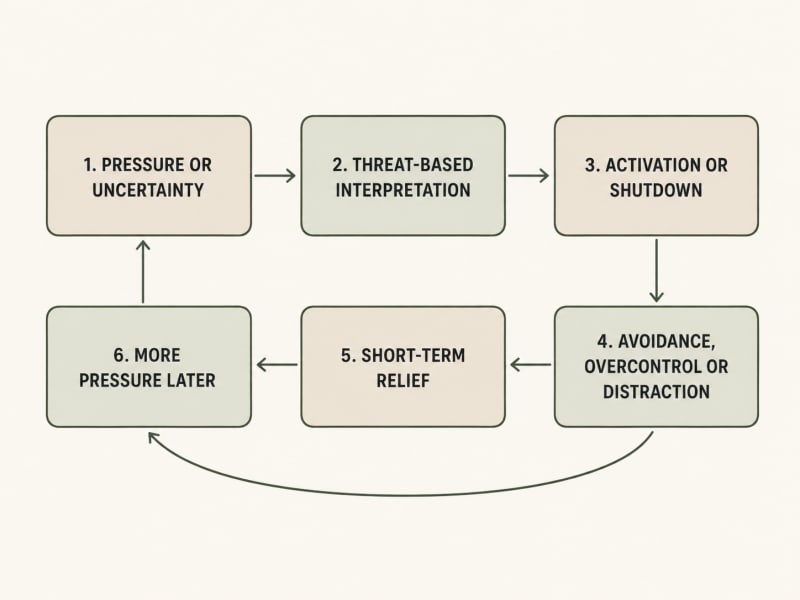
Avoidance offers something these actions do not: immediate relief.
The moment you decide not to send the email, make the call or start the task, some of the discomfort falls away. The long-term problem remains exactly where it was, but something important has happened in the short term: not acting made me feel better for a moment.
That relief is part of what makes avoidance so easy to repeat.
There is also evidence that mental effort itself often has an emotional cost. David and colleagues (2024), in a meta-analysis of 170 studies, found a strong association between reported mental effort and negative affect, including frustration, stress and irritation.
That does not mean difficult thinking is harmful or that worthwhile work should always feel easy. It means that the sensation of effort is not reliable evidence that you lack ability, have chosen the wrong goal or should stop.
The problem is often not that effort feels difficult.
It is what we conclude from that feeling.
“This is difficult” can become:
“I am not ready.”
“I must be doing the wrong thing.”
“I should wait until I feel more confident.”
The first statement may simply describe reality. The others are interpretations.
Familiar does not always mean comfortable
I find the phrase “comfort zone” somewhat misleading.
Many familiar situations are not comfortable at all.
A familiar job may be draining. A familiar relationship dynamic may repeatedly hurt. A familiar routine may leave someone flat, dissatisfied or disconnected.
What familiarity often provides is not comfort.
It provides predictability.
You know the script. You know what disappointment usually looks like. You know how you tend to respond and what parts of yourself you may have to suppress to keep things stable.
Change introduces variables.
You could succeed. You could fail. You could be misunderstood. You could discover that you want more from your life than you previously allowed yourself to admit.
Contemporary models of anxiety increasingly consider difficulties with learning and decision-making under uncertainty, rather than assuming anxiety always involves a firm belief that catastrophe will occur. Brown, Price and Dombrovski (2023), for example, discuss the role of uncertainty in maladaptive anxiety and anxious avoidance.
This offers another way of understanding why an unsatisfying but known situation can sometimes feel easier to tolerate than a potentially better but unpredictable one.
You may not be protecting a comfort zone.
You may be protecting a prediction zone.
The nervous system is involved here, but I am cautious about reducing complex behaviour to the idea that the nervous system is simply “trying to keep you safe”. Physiological activation can reflect many things: demand, uncertainty, previous learning, excitement, effort or perceived threat.
Unfortunately, the body does not provide a neat label explaining which one it is.
A racing heart before a presentation can be interpreted as “I cannot cope” or as “my body is preparing me to perform.” Research on stress reappraisal suggests that changing how physiological arousal is interpreted can produce modest improvements in performance, although this is not a cure-all and cannot transform an unsafe situation into a safe one 2.
Sometimes a more useful response is simply:
My system is activated. I do not have to treat that activation as a command to stop.
Not every form of stuckness is avoidance
Before trying to become more motivated, I think it is worth asking a different question:
What is actually interfering with action?
There are several patterns I distinguish.
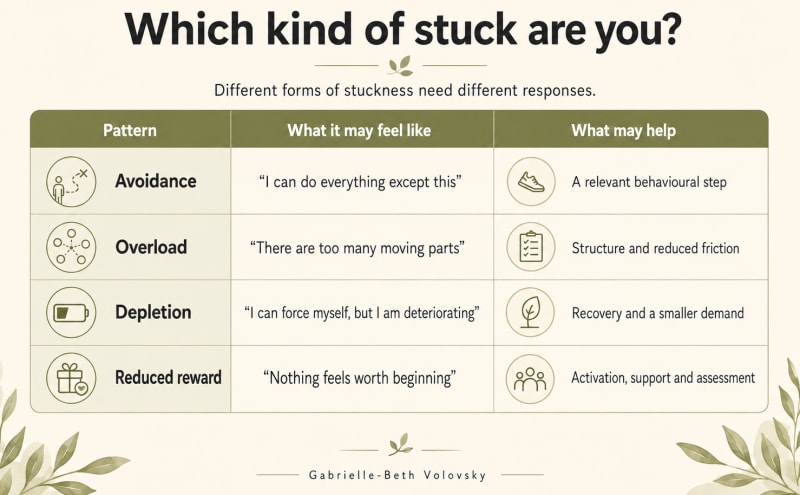
You are functioning, but avoiding one consequential action
You may be capable and productive across most of your life while repeatedly circling one task involving uncertainty, visibility or rejection.
The avoidance can be surprisingly industrious.
You research. Prepare. Rewrite. Gather more information. Improve something that is already usable. Wait for greater certainty. Find another small task that suddenly feels strangely urgent.
In this situation, more planning may simply give avoidance better furniture.
What is often more useful is a specific behavioural step towards the discomfort itself.
Everything feels mentally complicated
A different pattern appears when someone is carrying too many decisions, interruptions and unfinished loops.
They move between tasks, repeatedly reorganise what needs to be done and become disproportionately irritated by decisions that would ordinarily be straightforward.
Here, I am much less interested in demanding courage and much more interested in reducing friction.
Externalising decisions, determining in advance when and where a task will begin, removing unnecessary choices and placing demanding work earlier in the day can all reduce the amount of cognitive negotiation required.
Wiehler and colleagues (2022) found that following a day of demanding cognitive work, participants became more likely to select lower-effort options with more immediate rewards. The researchers also observed glutamate-related changes in a prefrontal region involved in cognitive control.
This finding is sometimes distorted online into claims that thinking fills the brain with “toxins”. That is not what the study established.
The more useful point is that prolonged cognitive demand can alter what subsequently feels worth the effort.
You can still perform, but you are depleted
Some people continue functioning long after their capacity has begun to deteriorate.
Responsibility, fear of disappointing others, habit or sheer pressure can keep behaviour going even while concentration, judgement and patience progressively worsen.
This is where “push through” can become particularly misleading.
The more useful intervention may be to reduce the task, change its timing or restore basic capacity through sleep, nutrition, movement, medical care or support before demanding another major effort.
The fact that someone can force themselves to continue does not necessarily mean continuing is the best choice.
Nothing feels worth beginning
This is different again.
Here, the problem may not primarily involve fear of the process. The reward itself may feel inaccessible.
Apathy, fatigue, anhedonia and avoidance can overlap, but they are not interchangeable.
Research on effort-based decision-making in depression suggests that motivational difficulties may involve a reduced general willingness to accept effortful options, rather than simply insufficient discipline 8.
This helps explain why advice such as “imagine how good you’ll feel afterwards” sometimes lands nowhere.
The person may currently have difficulty accessing that anticipated sense of reward.
They do not necessarily need a harsher lecture.
They need a different starting point.
Why reassurance is sometimes not enough
Suppose someone avoids public speaking because they predict:
If I lose my words, everyone will realise I am incompetent.
They can challenge the thought intellectually. They can visualise success, remind themselves that mistakes are normal and repeat more balanced statements.
All of that may be useful.
But one problem remains.
The original prediction has not yet been tested.
Then they speak.
They lose their place.
They look at their notes, recover and continue.
The experience may still be uncomfortable, but psychologically something important has become available that reassurance alone could not provide: evidence.
They now know they can become anxious, make an error and still respond.
Research on exposure-based learning examines this process of encountering information that differs from what was expected. Gromer, Hildebrandt and Stegmann (2023), for example, examined the role of expectancy violation in extinction learning.
The science is more complicated than the popular claim that one positive experience simply “rewires the brain”. Still, the underlying principle is useful.
Avoidance prevents us from encountering some of the very information that could update our expectations.
This is why I do not always view confidence as a prerequisite for action.
Confidence is not always the fuel required before action. Sometimes it is the evidence gathered afterwards.
From prediction to proof
When avoidance appears to be the primary problem, I often find it more useful to make the prediction testable rather than simply telling someone to be brave.
1. Name the action
Keep it observable.
Not:
Fix my career.
But:
Send the application.
Not:
Become more confident.
But:
State my view in tomorrow’s meeting.
Not:
Repair the relationship.
But:
Ask for ten uninterrupted minutes to explain what has been bothering me.
2. Name the prediction
Complete the sentence:
If I do this, I predict…
Perhaps:
“I will be ignored.”
“I will become overwhelmed and stop.”
“They will think I am difficult.”
“I will publish the work and feel ashamed if it performs badly.”
A vague fear is extremely difficult to test and remarkably easy to preserve.
3. Choose the smallest action that still tests it
The step needs to be manageable enough to complete, but relevant enough to produce new information.
If visibility is the problem, practising privately forever will not test it.
If rejection is the fear, another hour of preparation will not tell you what happens when you actually make the request.
The action needs to contain at least some of the uncertainty you have been avoiding.
Send one pitch.
Make one request.
Film one usable take.
Have the first five minutes of the conversation.
Release a version that is good enough to be evaluated rather than endlessly protected.
4. Review what actually happened
Afterwards, ask:
What did I predict?
What actually occurred?
What was difficult?
What did I handle?
What would I adjust next time?
The important part is not only whether you obtained the outcome you wanted.
A rejected proposal may still teach you that you can tolerate exposure.
An awkward conversation may show that you remained present rather than disappearing into silence or people-pleasing.
An article that performs poorly may still demonstrate that you were able to publish without spending another month protecting it from judgement.
Curiosity can be useful here.
Spitzer and colleagues (2025) found that when people genuinely wanted information and effort was required to obtain it, curiosity could outweigh tendencies to avoid cognitively demanding options.
Instead of treating every action as a referendum on your worth, there is another possible stance:
What will this teach me?
When motivation has almost disappeared
When someone’s capacity is very low, I think less about generating motivation and more about restoring behavioural contact.
The first action may be extremely small.
Sit upright.
Open the curtain.
Drink water.
Place food within reach.
Send one honest sentence to someone safe.
These actions may look insignificant from the outside. They are not insignificant if they interrupt immobility.
Behavioural activation is based partly on this principle. Rather than requiring someone to wait until motivation returns, it gradually reconnects them with routine, relationships, competence, pleasure and personally meaningful activity.
A 2023 meta-analysis by Alber and colleagues found that internet-delivered behavioural activation reduced depressive symptoms and increased activation compared with inactive control conditions, although longer-term findings and comparisons with other active treatments were less conclusive.
The point is not to remain constantly busy.
Compulsive productivity can itself become another form of avoidance.
Instead, activity can restore contact with something useful:
Maintenance: eating, showering, taking prescribed medication or attending an appointment.
Connection: replying to one person, sitting with somebody or saying honestly that you have been struggling.
Mastery: paying one bill, preparing one meal or completing five minutes of work.
Sensory contact: sunlight, music, movement, a warm drink or time with an animal.
I would also avoid demanding an immediate mood transformation from these actions.
After one walk, meal or conversation, someone may still feel low.
A more useful question can be:
Am I slightly more connected, oriented or able to make the next choice?
Persistent or worsening loss of motivation, loss of interest, social withdrawal or difficulty managing basic self-care warrants appropriate professional and medical assessment. Thoughts of suicide or self-harm require urgent support rather than another productivity strategy - see helplines and suicide hotlines worldwide.
Knowing when to push and when to reduce
There is no perfect formula for deciding whether discomfort should be approached or demand should be reduced.
But the quality of the experience gives us information.
Useful discomfort may involve reluctance, uncertainty, self-consciousness or a strong desire to delay. You remain oriented. You are able to think and choose. You may dislike the experience while still retaining meaningful capacity to engage with it.
That may be an appropriate place for a contained step forward.
Depletion tends to look different.
You repeatedly lose your place. Your judgement worsens. You make errors that are unusual for you. You become unusually impulsive or irritable. You can no longer meaningfully engage with the task.
There, reducing demand or recovering before returning may be the more intelligent form of persistence.
And some experiences belong in neither category.
Significant physical symptoms, dissociation, substance withdrawal, inability to manage basic care or feeling unable to keep yourself safe are not performance challenges. They require appropriate professional support.
Doing hard things requires discernment. Otherwise, persistence can become self-neglect with better branding.
Effort is not the enemy
None of this means that effort should be avoided.
Campbell, Wang and Inzlicht (2025) found experimental evidence that exerting effort can increase the meaning people attribute to an activity.
But difficulty does not automatically make an activity worthwhile.
Suffering is not proof that you are growing.
A damaging workplace does not become healthy because you worked hard to survive it.
A relationship does not become safe because leaving would be painful.
Exhaustion is not evidence of commitment.
The objective is not to choose the most difficult path available.
It is to become more accurate about which difficulty you are facing.
You may not need complete confidence before beginning.
You may need to know whether you are avoiding something important, cognitively overloaded, depleted or struggling to access motivation and reward at all.
Once that distinction is clearer, the next step becomes more precise.
Challenge the prediction.
Reduce the friction.
Restore capacity.
Or seek appropriate support.
Change often becomes more believable once it has been experienced.
References
- [1] Alber, C. S., Krämer, L. V., Rosar, S. M., & Mueller-Weinitschke, C. (2023). Internet-based behavioral activation for depression: Systematic review and meta-analysis. Journal of Medical Internet Research, 25, e41643.
- [2] Bosshard, M., & Gomez, P. (2024). Effectiveness of stress arousal reappraisal and stress-is-enhancing mindset interventions on task performance outcomes: A meta-analysis of randomised controlled trials. Scientific Reports, 14, 7923.
- [3] Brown, V. M., Price, R., & Dombrovski, A. Y. (2023). Anxiety as a disorder of uncertainty: Implications for understanding maladaptive anxiety, anxious avoidance, and exposure therapy. Cognitive, Affective, & Behavioral Neuroscience, 23, 844–868.
- [4] Campbell, A. V., Wang, Y., & Inzlicht, M. (2025). Experimental evidence that exerting effort increases meaning. Cognition, 257, 106065.
- [5] David, L., Vassena, E., & Bijleveld, E. (2024). The unpleasantness of thinking: A meta-analytic review of the association between mental effort and negative affect. Psychological Bulletin, 150(9), 1070–1093.
- [6] Gromer, D., Hildebrandt, L. K., & Stegmann, Y. (2023). The role of expectancy violation in extinction learning: A two-day online fear-conditioning study. Clinical Psychology in Europe, 5, e9627.
- [7] Spitzer, M. W. H., Strittmatter, Y., Marti, M., Schumacher, A., & Bardach, L. (2025). Curiosity overpowers cognitive effort avoidance tendencies. Cognition, 262, 106167.
- [8] Valton, V., et al. (2025). A computational approach to understanding effort-based decision-making in depression. Psychological Medicine, 55, e302.
- [9] Wiehler, A., Branzoli, F., Adanyeguh, I., Mochel, F., & Pessiglione, M. (2022). A neuro-metabolic account of why daylong cognitive work alters the control of economic decisions. Current Biology, 32(16), 3564–3575.e5.
Important: TherapyRoute does not provide medical advice. All content is for informational purposes and cannot replace consulting a healthcare professional. If you face an emergency, please contact a local emergency service. For immediate emotional support, consider contacting a local helpline.
Find Therapists
Must Read
Creating Space for Growth: How Boundaries Strengthen Relationships
Setting healthy boundaries fosters respect, protects emotional well-being, and strengthens relationships by defining personal limits and maintaining self-care.
International Mutual Recognition Agreements for Mental Health Professionals
Mutual recognition agreements for mental health professions are rare and uneven, with major gaps in counselling, social work, and allied therapies. Read on to understand ...
Bullying and cyberbullying statistics worldwide
How many young people are bullied at school and online worldwide and in countries on every continent, how bullying is linked to depression and anxiety, and how common bul...
Self-harm statistics worldwide
How many young people and adults self-harm worldwide and in different countries, how reported self-harm has changed over time, and what trials show about therapy that hel...
Prison mental health statistics worldwide
How common depression, psychosis, post-traumatic stress and substance use are among people in prison worldwide and in countries on every continent, how women and young pe...
About The Author

“PACFA Certified Practising Counsellor offering online counselling and performance coaching for adults experiencing anxiety, overwhelm, burnout, overthinking, relationship difficulties, low self-confidence, emotional or behavioural patterns, and more complex mental health concerns. I work collaboratively and practically, helping you understand what is happening beneath the surface and create meaningful changes that translate into everyday life.”
Gabrielle-Beth Volovsky is a qualified Certified Counselor, based in Singapore. With a commitment to mental health, Gabrielle-Beth provides CBT, MBCT (Mindfulness-Based CBT), Trauma Counselling, Addiction Services, Coaching, DBT (Dialectical Behavior Therapy), Group Therapy, Individual Psychotherapy, Online Counselling and Internal Family Systems.