Part 2 - Creating your Mini-Site

TherapyRoute
Mental Health Resource
Cape Town, South Africa
❝Expand your basic listing into a detailed mini-site❞
In "Part 1 - Your Basic Listing" (click here to read it), we explored the creation of a personalized basic listing that caters to your needs, encompassing elements such as your professional statement, profile photo, identity, and more. In Part 2, our focus shifts towards crafting a comprehensive listing that distinguishes itself and equips potential clients with the essential information required to make well-informed decisions.
This step is currently only available to PRO-Members, if you’d like to make use of the below features, which we highly recommend, please consider upgrading your basic membership.
For those who are PRO-Members, let’s carry on!
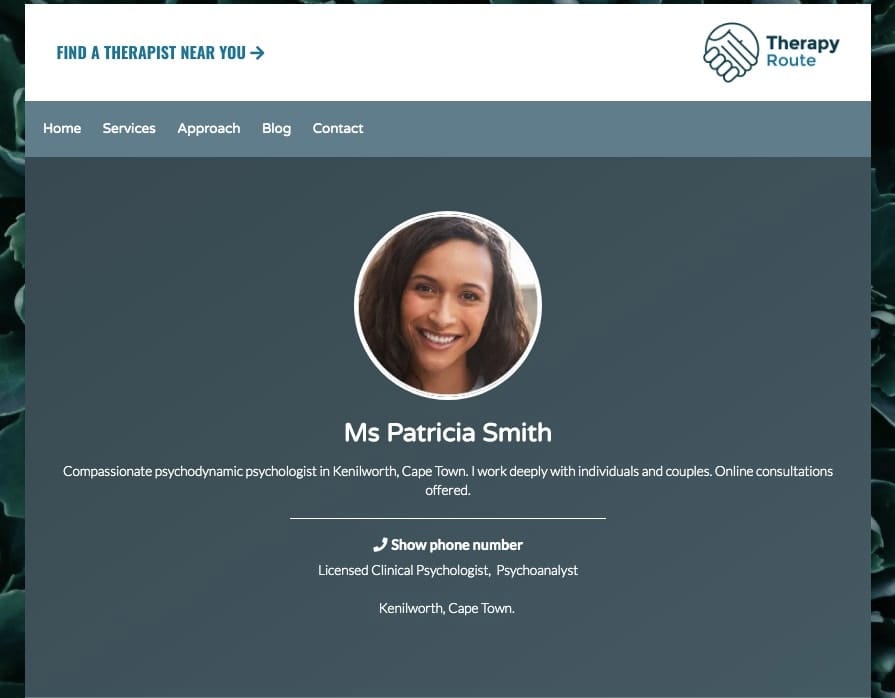
The exciting part is that you're already halfway through building your mini-site! TherapyRoute seamlessly transfers the information from your basic listing, populating the corresponding fields in your profile. This means you won't have to start from scratch when creating your mini-site. Essentially, it is an extension of your listing.
- • It looks more compelling.
- • It offers more information.
- • It has a higher likelihood of attracting visitors.
- • It gives people more reason to return to your listing.
Moreover, the mini-site offers enough flexibility for you to utilize it as your very own personal practice website if you wish!
If your practice becomes too busy and you’d prefer fewer inquiries, or if you prefer not to use the mini-site, you have the option to deactivate it. Simply navigate to the “Account Settings” section and untick the boxes you feel would best suit your situation.
Services
The Services page is where you are given the opportunity to connect with your visitors, make them feel safe, and invite them to contact you.
The top paragraph is very important. It gives you the space to elaborate on your professional statement with some compelling detail about what you offer and how this will help potential clients. The below can be a useful guide for what to include:
Therapy should be personal. Therapists listed on TherapyRoute are qualified, independent, and free to answer to you – no scripts, algorithms, or company policies.
Find Your Therapist
- • Elaborate on your services.
- • List some of the emotions and challenges your clients might be experiencing.
- • Communicate how your services might help.
- • Include a call to action.
An example might be: “As a psychodynamic psychotherapist, my focus is to help you get to the root of your problems. I deal with a broad range of issues. You may be asking why your relationships regularly break down or why you swing from feeling superior to inferior. My aim is to work with you to understand the root of your problems and to use this understanding to help you make positive changes. Should this be what you are looking for, please contact me to set up an initial consultation.”
Tip: We suggest keeping this paragraph to 4-5 lines and using plain language (avoiding therapy jargon).
All other fields in Services will have been populated when you set up your profile but you can change and refine them here.
The services page is automatically activated. If you don't want to include it in your mini-site, de-select the 'activate services page' block at the top of the page and click 'Save'.
Approach
When it comes to the "Approach" section, it's your opportunity to provide potential clients with the information they need to evaluate whether you could be the right therapist for them. This section allows them to envision the collaborative journey toward the emotional well-being they aspire to achieve through therapy.
Your Description
The opening paragraph provides you with an opportunity to introduce your unique approach using your own words. It offers potential clients a brief glimpse into what they can expect and entices them to explore further.
This section is particularly valuable in reassuring clients who may feel anxious about the therapeutic process, as it provides them with a clearer understanding of what to anticipate. By emphasizing the key aspects of your approach that you deem significant, you can also attract clients who align well with your therapeutic style.
Outlined below are a few suggestions and guidelines to consider when crafting your introduction:
- • What do you do in the first session?
- • A description of the kind of therapy you do or techniques you employ, i.e. what is psychodynamic psychotherapy, how long is long-term therapy, and what is EMDR.
- • A description of your philosophy.
- • Elaborate on your training and extra courses you have completed and explain how your specific experience can help your client.
An example might be: “Deciding to start therapy is an important decision. When we first meet, I'll ask about your life and find out more about you and what you expect from therapy. This will help me determine if I am a good therapist for you and will allow you to decide if you want to work with me. I work psychodynamically and most of my therapy is long-term. A client may visit me once a week for only 2-3 months but others choose to commit to more sessions for a number of months or even years. In therapy, we'll spend a lot of time talking and reflecting on what you say in ways that help you come to a deep understanding of where you are, the emotions you are experiencing, and how to move forward. Apart from my initial training as a clinical psychologist (MA clin psych) I have completed specialized training as a psychoanalyst and am registered with the IPA (International Psychoanalytic Association).”
Custom Questions and Answers
In the second part of the Approach page, TherapyRoute provides a list of heading options or questions. Select up to five and write your paragraphs accordingly.
We have structured our headings to help you answer common questions from potential clients and provide them with the information they need to make an informed decision. A good fit between client and therapist plays an important role in determining the success of therapy so use this opportunity to communicate your ideas and professional approach clearly.
Tip: The Approach section is by far the most time-consuming aspect of your mini-site. We suggest tackling it when you have time. If you don't do it right now, deactivate the page (untick the checkbox and click 'Save') and return to it later (it is deactivated by default).
Contents of the Series
Introduction - Create the Ideal Therapist Profile
Setting the scene, communicating how you help clients, and being mindful of keywords and search phrases in your writing.
Part 1 - Making Your Basic Listing Work for You
The first step in creating an online profile is to create your listing. We take you through the various elements involved, from your professional statement to your profile photo and identity.
Part 2 - Creating your Mini-Site | This page :)
Consider your mini-site as an enhanced version of your basic listing, offering more detailed information and allowing for customization to create a truly unique digital presence. In fact, it can even serve as your personal website! By completing your listing, you've already laid the foundation for your mini-site. The information you've provided will automatically populate your Home and Services page. We'll assist you in expanding on your Services section and filling the Approach page with comprehensive details, ensuring potential clients gain a clear understanding of your offerings and how you can support them.
Your Blog posts can be shared on your mini-site or submitted for inclusion on TherapyRoute. Here we explore a Blog to bring more visitors to your profile, through sharing your own unique and creative writing.
We look at the importance of your profile's look and feel and discuss mundane but vital factors, such as formatting and editing.
Part 5 - Help your Mini-Site Get Found
Once you have created a mini-site, one of the most important tasks you can do is to ensure it gets found. We discuss how you can share your profile link and include relevant keywords to boost your site’s findability. Finally, you have completed creating your online profile. Now you can sit back and let it work for you!
Important: TherapyRoute does not provide medical advice. All content is for informational purposes and cannot replace consulting a healthcare professional. If you face an emergency, please contact a local emergency service. For immediate emotional support, consider contacting a local helpline.
Find Therapists
Must Read
Creating Space for Growth: How Boundaries Strengthen Relationships
Setting healthy boundaries fosters respect, protects emotional well-being, and strengthens relationships by defining personal limits and maintaining self-care.
International Mutual Recognition Agreements for Mental Health Professionals
Mutual recognition agreements for mental health professions are rare and uneven, with major gaps in counselling, social work, and allied therapies. Read on to understand ...
Jumping to Conclusions
Jumping to conclusions is a thinking habit where we assume the worst or make judgments without enough evidence. By recognising this pattern, therapy can help you slow dow...
Case Conceptualisation
Case conceptualisation is how a therapist thoughtfully pulls together your concerns, experiences, and strengths into a clear understanding of what’s going on. This shared...
Guided Discovery
Guided discovery invites clients to arrive at their own insights through collaborative questioning and reflection. Instead of being told what to think, individuals learn ...
About The Author

TherapyRoute
Mental Health Resource
Cape Town, South Africa
“Our mission is to help people access mental healthcare when they need it most.”
TherapyRoute is a mental health resource platform connecting individuals with qualified therapists. Our team curates valuable mental health information and provides resources to help you find the right professional support for your needs.