
How Not to Niche for Therapists in Private Practice

❝There is often pressure on therapists in private practice to find a niche. This article says that it's OK not to niche. Find out why.❞
Can you be a generalised private practice without finding your niche? Absolutely.
Whether you have decided not to market directly to a niche clientele or just haven’t found what that is for you yet, have a look at how to build your practice as a generalist one.
How do clients find you?
Some clients don’t know why they feel the way they do. They don’t know whether they need to see someone who specialises in depression or if they are ‘just a bit down’. They don’t know whether they have generalised anxiety disorder, a social phobia or are just reacting to an individual trauma in their life.
Traditionally a large part of the population has shied away from labelling themselves due to the stigma that surrounds words like ‘depressed’ or ‘traumatised’. They may not want to feel too much like a victim, or they may not be aware of what these terms mean. Conversely, others who have ready access to ‘Dr Google’ may take great pleasure in self-diagnosing their behaviours to come up with labels such as ‘suffering from depression’ or ‘living with post-traumatic stress disorder’. So, clients come with different understandings about why they need therapy.
Therapy should be personal. Therapists listed on TherapyRoute are qualified, independent, and free to answer to you – no scripts, algorithms, or company policies.
Find your therapistThere are three types of clients:
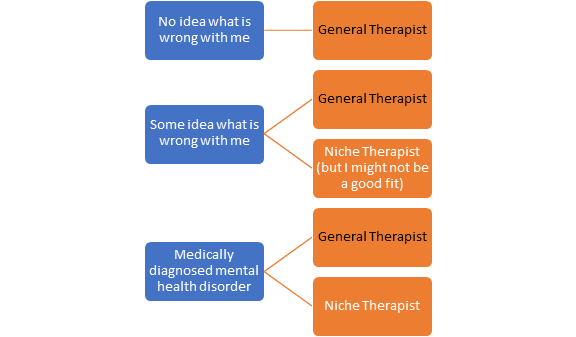
Ultimately all 3 client types can see you, the general therapist. Only one client type knows without a doubt whether they are a good fit for the niche therapist.
The other catch is that even if the client is a good fit for the therapist the therapist may not be a good fit for the client. Ultimately the success of therapy is determined on a good therapeutic relationship more than any other factor.
Common fears
There are common fears for not having a niche, below are the top 4 and what to do about them.
1. What if I get a client presentation that I don’t know how to work with?
Whether you are just starting out or have been employed in the industry for a long time you have the basic ability of holding space for others. You can use active listening, minimal encouragers and paraphrasing to allow your clients to feel safe enough to tell their stories to you. Sometimes that is therapeutic in itself. We need to remember that if this is all we do, that is sometimes enough.
The best way to deal with any client is to keep it simple. There is often a self-imposed pressure to use a new technique or intervention or a belief that if you just took that next course or jumped onboard the newest therapeutic fad you could deal with a particular type of client better. This may be true or may not be true. Every client is unique even those with the same diagnosis. Trauma isn’t just trauma; anxiety isn’t just anxiety. There are a million variances between one person with depression and another. The search to have ‘all the answers’ is unattainable. You have enough skills now, you are enough. Clients benefit from unconditional positive regard, respect, honesty and a good therapeutic relationship. Get that stuff right and you can deal with any presentation. How do you get better? By doing more of it. Practice working with a wide variety of clients and you get better at working with a wide variety of clients. Plus, it’s always interesting!
2. How do I market generalised therapy?
ONLINE: Being a generalist practice gives you the breadth to work with whoever and whatever comes through your door. But how do you market everybody? Having an open market is easier than niching a market. Because really your target is EVERYONE.
Google Ads are a great easy way to market your business to people locally or ones further afield. It works by having you choose search criteria that people search for on Google and include these terms in your advertising. Instead of being limited when advertising niche markets, a generalist practice can choose a variety of presentations that clients may search for. Google trends is a great source for finding search term trends. It gives you a graphical representation of how popular a certain search term is such as anxiety, depression, trauma, marriage problems, mental health, OCD, PTSD, gender issues or infidelity. Try adding popular search terms to your Google Ad to boost client enquiries.
IN PERSON: As a general therapist, you can have a generic business card/ brochure/ flyer that you can put on local notice boards or give to local medical clinics, non- government or not-for-profit centres. You can also make variations on these that highlight specific clientele and give them to more relevant organisations. You can have a flyer that markets to clients with anxiety that you drop into a yoga centre as well as a flyer that promotes your services for helping those with PTSD that you drop off at a returned servicemen’s group. Remember that clients can ask whether you deal with their issues before they decide to see you.
When you are a general therapist you are marketing yourself not a speciality. Take more time to get your bio spot on. In my experience, more people have told me that they chose me because of my photo and my bio, not on what type of client I see. Your bio should say something about your personality, your interests and why you think clients should come to see you.
3. Will people think me less of an expert if I don’t have a niche?
Who are you talking about when you ask this? More times than not we worry more about what our peers think of us than what our clients think of us. I feel there is a still an environment of one-upmanship and superiority in therapy circles. That those who have more degrees or who have more clients or specialise in more traumatic presentations ARE more, better or have their shit together. This is what adds to the common feeling of imposter syndrome amongst therapists. When we have an unrealistic standard in which to adhere to, we can feel like imposters. This is due to comparing ourselves against others and coming up short. Let your clients determine who is best for them. Other therapists can choose to have a niche or purport themselves as an expert but that doesn’t have to mean you are any less because of that. Clients will not think less of you. If you have a client who forms a great therapeutic relationship with you and is making progress, they will not care if you are not a so-called expert.
4. What if I don’t want to see EVERYBODY, will I be forced to take clients I don’t want?
Of course not. Those with niche markets subliminally say to the world “I ONLY deal with (insert niche here) and I won’t/can’t/am unable to see anyone else. Being generalist doesn’t mean you have to see EVERYBODY; you are not an expert of everybody. You have a choice. In the client’s initial contact with you ask what their presenting problem is and take a moment to check in with yourself as to whether you want to work with them. It is OK to have boundaries and work within your abilities and comfort zone. Remember that if they have a specific presentation that you don’t want to work with there will be specialist/niche therapists to which you can refer to.
In conclusion, I want to reiterate that having a niche for some can be great, it can narrow their focus and allow them to work with those that they want to, but it is not the answer for everyone. Those that say it should be is only adding to the pressure on therapists to be just like other therapists when in reality we are all individuals who need to chart our own course of action. I don’t want to say that being generalist is the way forward for everyone, but I do know that it has worked for me in generating a diverse range of clients in my private practice that keeps me engaged and enthused every day about going to work.
If you are interested in seeing what my generalist website looks like please click on
my profile
image and then see the link to my website in the contact section.
Important: TherapyRoute does not provide medical advice. All content is for informational purposes and cannot replace consulting a healthcare professional. If you face an emergency, please contact a local emergency service. For immediate emotional support, consider contacting a local helpline.
Find Therapists
Must Read
Creating Space for Growth: How Boundaries Strengthen Relationships
Setting healthy boundaries fosters respect, protects emotional well-being, and strengthens relationships by defining personal limits and maintaining self-care.
International Mutual Recognition Agreements for Mental Health Professionals
Mutual recognition agreements for mental health professions are rare and uneven, with major gaps in counselling, social work, and allied therapies. Read on to understand ...
Suicide statistics worldwide
Where to find help, what the evidence says about preventing suicide, and what the World Health Organization's latest estimates show worldwide, by region and by country, p...
Bullying and cyberbullying statistics worldwide
How many young people are bullied at school and online worldwide and in countries on every continent, how bullying is linked to depression and anxiety, and how common bul...
Self-harm statistics worldwide
How many young people and adults self-harm worldwide and in different countries, how reported self-harm has changed over time, and what trials show about therapy that hel...
About The Author

“Providing warm professional support to individuals, couples and groups on the Sunshine Coast. Affordable and inclusive.”
Adrienne Finck is a qualified Counselor, based in Birtinya, Australia. With a commitment to mental health, Adrienne provides Counseling.