
Hitting the Notes, or The Varieties of Authentic Experience

❝“To lie is not only to say what isn't true. It is also and above all, to say more than is true, and, as far as the human heart is concerned, to express more than one feels."❞
“There is no sun without shadow,” writes Camus in “The Myth of Sisyphus,” “and it is essential to know the night.” Camus, often mistakenly identified with the protagonist of the early novel that catapulted him to fame in his 20’s, once observed that what he, in fact, admired in Meursault was his refusal to lie: “To lie is not only to say what isn't true. It is also and above all, to say more than is true, and, as far as the human heart is concerned, to express more than one feels." Here, stated succinctly, we encounter an ethos far surpassing conventional expectations and mores. Camus invokes what humanists call “authenticity”—not merely the word, which is easy, but the thing itself, which, decidedly, is not: in Hannah Arendt’s words, “unswerving fidelity to the real.” Upon meeting Camus, Arendt wrote to her husband: “He is, undoubtedly, the best man now in France . . . head and shoulders above other intellectuals.” Arendt knew Heidegger as a mentor and lover, Jaspers as her mentor and friend, and Sartre an unacceptable prophet of righteous violence.
Raised in poverty and significantly in silence, Camus relished the place of solitude. “His room was his sanctuary,” observes Patti Smith, the American singer, poet, and, most recently, touching memoirist. “It was here that he labored over his unfinished masterwork The First Man, unearthing his ancestors, reclaiming his personal genesis.” In Paris for interviews arranged by her publisher, Smith is invited by Camus’s daughter, Catherine, to the family home in the Provençal village of Lourmarin, which Camus had purchased upon winning the Nobel Prize. After lunch, the two woman visit Camus’s gravesite—a simple stone inscribed with his name and the years of his birth and death. Upon their return, Catherine presents Smith with her father’s uncompleted masterpiece, the manuscript found in the car in which Camus perished along with his closest friend. After a ritual washing of hands, Smith reverently examines the manuscript: “I turned each page carefully, marveling at the aesthetic beauty of each leaf. The first hundred watermarked sheets had Albert Camus engraved on the left-hand side; the remaining were not personalized, as though he had wearied of seeing his own name.” A modesty that led the Nobel laureate to proclaim that the prize should have gone to André Malraux.
Therapy should be personal. Therapists listed on TherapyRoute are qualified, independent, and free to answer to you – no scripts, algorithms, or company policies.
Find Your Therapist
In Devotion, a book about writing, Smith also pays homage to the sanctity of solitude in returning to her own work:
Why is one compelled to write? To set oneself apart, cocooned, rapt in solitude, despite the wants of others. Virginia Woolf had her room. Proust his shuttered windows. Marguerite Duras her muted house. Dylan Thomas his modest shed. All seeking an emptiness to imbue with words. The words that will penetrate virgin territory, crack unclaimed combinations, articulate the infinite.
Vanity, artists on these taoist planes seem instinctively to know, easily becomes mediocrity and impediment.
Camus was raised amid simple people and gestures: “Whatever I know about morality,” he opined, “I’ve leant on the football pitch and the theatre stage.” He learned also from astute mentors about the life of the mind and books written by extraordinary human beings evolved in the conjoined arts of rarified thought and comportment: St. Augustine and the Ancient Greeks, Simone Weil and Hannah Arendt were among Camus’s philosophical and moral compatriots. Members of the local soccer team, a squad on which Camus also played, bore his casket at the funeral. Bells pealed not from the local cathedral but from the village square—just as Camus imagined it.
Evanescence
Folk music in the States has a long tradition of just the sort of bedrock demeanor and decency I attempt to convey in this briefest of reveries. Leadbelly rambled and played with Woody Guthrie from an early point. Dylan, after visiting Guthrie regularly upon his arrival in NYC as the older troubadour lay dying of Huntington’s illness in a New Jersey hospital, realized at a certain point that he had his own vision to pursue and wouldn’t be returning to visit; the two men never met again. Dylan did not, he would later recall, think of himself as any kind of songwriter. Still, he felt a sense of gratitude, one in sympathy with Arendt’s “frailty of human affairs” no less than bona fide friendship and fellow feeling along the way of legitimate ethical and aesthetic pursuit. “Song to Woody,” one of two original compositions on Dylan’s first album, expresses this sentiment with a simplicity coupled to the most poignant of lines:
Here’s to Cisco and Sonny and Leadbelly too
An’ to all the good people that traveled with you
Here’s to the heart and hands of the men
That come with the dust and are gone with the wind
“We must write,” observes Smith, “engaging in a myriad of struggles, as if breaking in a willful foal.”
Sonny Terry and Lead Belly (the rendering of the name that Ledbetter preferred) were black men steeped in folk traditions and the blues. “We come with the dust and we go with the wind”—words from Guthrie’s “Pastures of Plenty” intimating a Zen-like awareness of evanescence while evoking, too, the sufferings and displacements endured by myriad lives turned topsy-turvy by the draughts and windstorms that ravaged the western states during the Great Depression. Songs like “Oxford Town,” “Only a Pawn in Their Game,” “The Lonesome Death of Hattie Carroll,” and “Blind Willie McTell” reflect the manner in which an ever-observant Dylan learned quickly from his guides, tapping into a deep-seated violence that has underwritten the American story, along with its more principle aspects, from the start. Dylan’s 1967 album, John Wesley Harding, spare and mesmerizing, recalls an infamous Texan outlaw, his name oddly misspelled. On the album cover, Dylan is flanked by itinerant Bengali musicians; a local Nashville stonemason and carpenter stands directly behind. The poet, it is clear, has been hitting all the notes for a very long while; his has been an astonishingly expansive mind from very early on.
Fallenness
Like all noble spirits, Camus never placed himself above the fray. Despite having captured the hearts and minds of innumerable readers, he remained steadfastly self-critical. Accepting his prize in Stockholm, he spoke of “limits and debts."The Fall is arguably Camus’s most confessional work. Here we encounter Jean-Baptiste Clamence, a wildly emotive, self-anointed/confessed “judge-penitent”—a lawyer who is chased by conscience and inner Furies out of a privileged Parisian existence to an Amsterdam dive called Mexico City. The city’s concentric canals bring to Clamence’s disordered mind Dante’s circles of hell. At the bar, he holds court with an unseen interlocutor, sometimes confessing, at others waxing philosophic, even prophetic, all the while judging both self and the world and, by extension, us literary eavesdroppers as well.
The Fall ends with Amsterdam bathed in fresh snow. (“Amsterdam asleep in the white night, the dark jade canals under the little snow-covered bridges, my muffled steps—it will be purity, even if fleeting, before tomorrow’s mud.”) Clamence imagines the snowflakes to be doves. Harsh valuations of self and others notwithstanding, he suddenly feels compelled to return to the fallen world and start anew. (Beckett, fellow résistance fighter and Nobel laureate—who also didn’t especially covet the prize—expresses the matter starkly: “Ever tried. Ever failed. No matter. Try again. Fail again. Fail better.”) In the end, it is what we can do. Encountering our personal daemons forthrightly, the outcomes of our efforts might become richer than they tend too often to be. Camus’s nature was deeply spiritual and, by his own admission, deeply flawed. Rollo May, in certain respects our stateside Camus, as Bob Abzug’s stirring biography suggests, embodied radical contradictions as well.
Amsterdam
Dylan dons the odd pseudonym Robert Milkwood Thomas likely insofar as he was flying beneath the radar while recording, unofficially, for a label not his own. He can be heard playing keyboards and on the chorus on folk artist Steve Goodman’s “Somebody Else’s Troubles” on an album bearing the name of the song. The folk tradition is one is which gestures of understated grace and generosity (“handing one another along,” as child psychoanalyst Robert Coles puts it) are everyday occurrences. Goodman, diagnosed with leukemia at the age of 20 and dead at 36, knew early on his life would be brief.
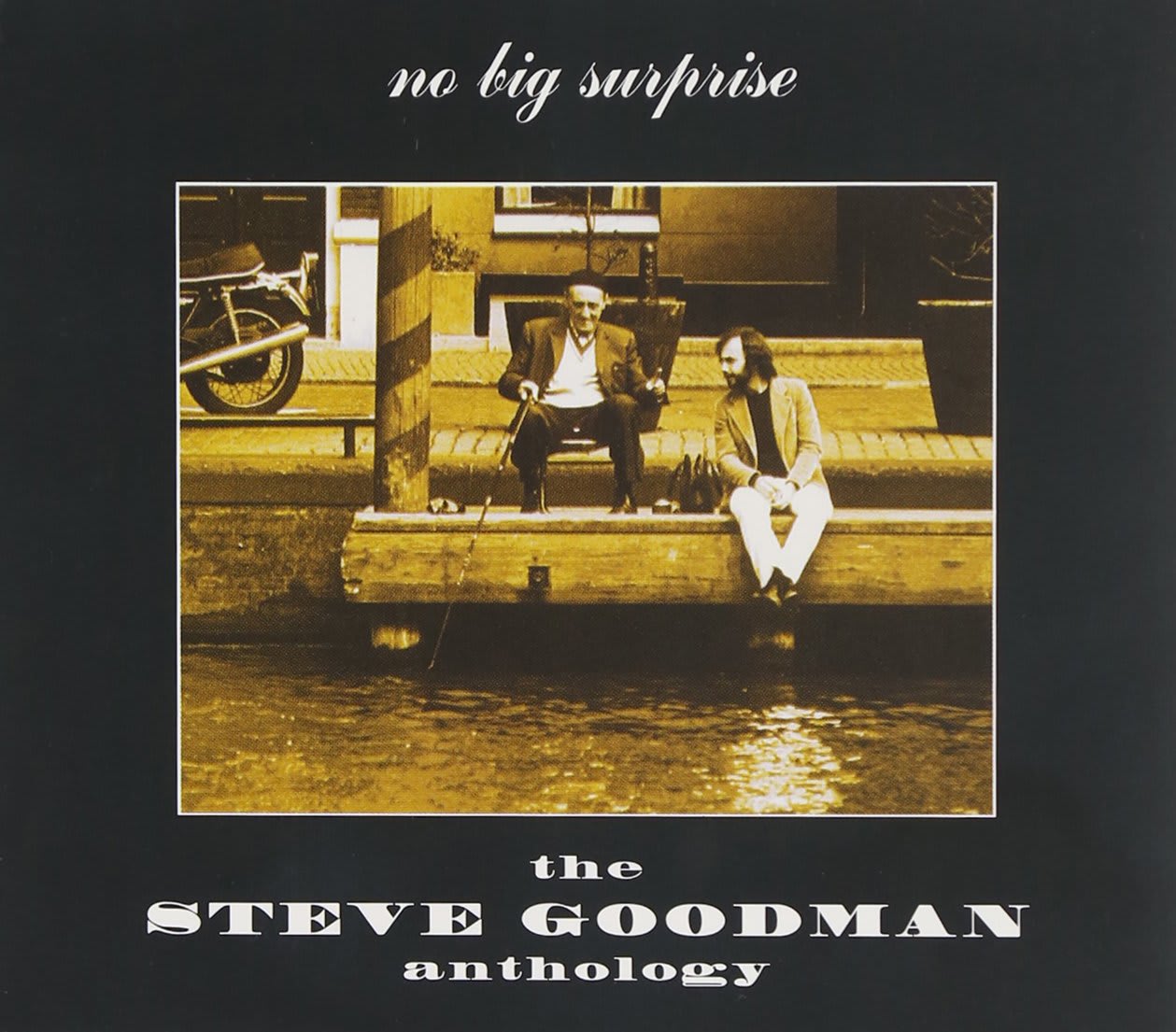
It is fitting, perhaps, that we draw to our close by returning to a place already visited—Amsterdam in winter. And to the prospects for collective renewal; graceful sentiments, acts, and connections amid fragile, fretful existences and lives. Fuller embrace of the agony of existence, no less than its attendant mysteries, beauties, and joys. Ultimately, for a Camusean vision of “human community” co-inhabited by modestly enlightened, ever-attentive bodies, spirits, and minds. On the posthumously released No Big Surprise, we find Goodman’s cover of Michael Smith’s “The Dutchman,” a song I heard Goodman perform at myriad venues on both coasts during my youth. Immaculately rendered, it is a song about an elderly couple, childless and alone, as they approach the ends of their respective lives together. The Dutchman, often confused, imagines Holland tulips blooming beneath the Amsterdam snow and is wholly at a loss without Margaret’s quiet devotion and enduring love. That is Steve himself lounging on the pier on the album cover. And surely it is the Dutchman beside him, wielding a fishing pole while dreaming about God knows what, slightly cracked like the rest of us.
Afterword
John Prine, in his youth a hard-drinking, chain-smoking man who seemed to make a hobby of dabbling in chemically-induced states of mind, hailed from a wholly different planet from Goodman, though both men grew up around Chicago. Goodman and Prine became the closest of friends, a relationship Prine honored until his own death at the outbreak of the Covid pandemic at the age of 73. Prine’s guitar playing paled in comparison with Goodman’s finely-honed technique. Still, the nuance and human core he was able regularly to evoke with a capo and a handful of chords found their way into hearts and minds throughout the world, the States and Ireland especially. “Souvenirs” is a song found on Prine’s second recording, Diamonds in the Rough, an album I discovered a few years after its 1972 release. Prine and Goodman play seamlessly together, as they would continue to do in live performances that followed, Prine later recalling that Goodman’s selfless guitar work always made it sound like Prine was playing the good parts. After Goodman’s death, the song remained a staple of Prine’s playlist, dedicated always to his late friend. Folk artists doing their things—hitting the notes while passing along humble, albeit simultaneously cosmic messages and codes before slipping quietly away and returning to the ether. This performance took place at Sessions on West 54th Street in 2001, six months before 9/11.

References
Abzug, R. (2021). Psyche and Soul in America: The spiritual odyssey of Rollo May. Oxford University Press.
Arendt, H. (1978). The life of the mind, vols.1 and 2. Harcourt Brace Jovanovich.
Beckett, S. (1984). Worstward ho. Grove Press.
Camus. A. (1968). Lyrical and critical essays. Alfred A. Knopf.
Camus, A. (2004). The plague, the fall, exile and the kingdom, and selected essays. Alfred A. Knopf.
Camus, A. (1995). The first man. Alfred A. Knopf.
Coles, R. (2010 Handing one another along: Literature and social reflection. Random House.
Dylan, B. (1962) Bob Dylan [CD]. Columbia Records.
Dylan, B. (1967). John Wesley Harding [CD]. Columbia Records.
Goodman, S. (1972). Someone else’s troubles [CD]. Buddha Records.
Goodman, S. (2006). No big surprise: The Steve Goodman anthology [CD]. Red Pajamas Records.
James, W. (1908) The varieties of religious experience: A study in human nature. Longmans, Green, and Co.
Meagher, R. E. (2021). Albert Camus and the human crisis. Pegasus Books.
Prine, J. (1972). Diamonds in the rough [CD]. Atlantic Records.
Smith, P. (2017). Devotion. Yale University Press.
Dedicated to Steve Goodman (1948-1984)
and John Prine (1946-2020)
In memory of
Georgia May
(1926-2021)
Soundtrack: Clark, S. (1958]. Blues in the night [CD]. Blue Note.
Note: I am indebted to Robert Abzug for the James-infused subtitle as well as several other editorial suggestions rendering this latest installment of “Humanitas” a more coherent piece.
Important: TherapyRoute does not provide medical advice. All content is for informational purposes and cannot replace consulting a healthcare professional. If you face an emergency, please contact a local emergency service. For immediate emotional support, consider contacting a local helpline.
Find Therapists
Must Read
Creating Space for Growth: How Boundaries Strengthen Relationships
Setting healthy boundaries fosters respect, protects emotional well-being, and strengthens relationships by defining personal limits and maintaining self-care.
International Mutual Recognition Agreements for Mental Health Professionals
Mutual recognition agreements for mental health professions are rare and uneven, with major gaps in counselling, social work, and allied therapies. Read on to understand ...
Mental Health Licensing & Regulation in New York State: 2026 Guide
Mental Health Licensing & Regulation in Singapore: 2026 Guide
Jumping to Conclusions
Jumping to conclusions is a thinking habit where we assume the worst or make judgments without enough evidence. By recognising this pattern, therapy can help you slow dow...
About The Author

“Ed Mendelowitz received his doctorate from the California School of Professional Psychology in Berkeley where he worked closely with the preeminent psychotherapist and author Rollo May. Dr. Mendelowitz is author of the Rollo May Consortium on Substack: https://rollomayconsortium.substack.com.”
Edward Mendelowitz is a qualified Mental Health Blogger, based in Roxbury, Boston, United States. With a commitment to mental health, Edward provides Consultation, Counseling, Supervision and Philosophy.



