DREAMDANCING®

❝Building on C. G. Jung's early understanding of dance as a form of active imagination, Dreamdancing (Stromsted 1984) brings together the inner world of body sensation, feelings, dreams and images; moving through dreams can help us experience the body/psyche connection.❞
The symbols of the self arise in the depths of the body. C.G. Jung
Therapy should be personal. Therapists listed on TherapyRoute are qualified, independent, and free to answer to you – no scripts, algorithms, or company policies.
Find Your TherapistIn the deepest sense, we all dream not of ourselves, but out of what lies between us and the other. C.G. Jung
Abstract
Building on C. G. Jung's early understanding of dance as a form of active imagination, Dreamdancing (Stromsted 1984) brings together the inner world of body sensation, feelings, dreams and images; moving through dreams can help us experience the body/psyche connection. Just as the sensing body provides immediate access to all of life's experiences, our dreams, in turn, reflect the vitality of the body and the condition of our psychic, spiritual life. Analysis involves attuning to these messages, in the other, and within ourselves, hearing the soul's call and working with obstacles to its fulfillment. Elements from this practice may enhance your clinical practice by providing an increased sense of comfort with and appreciation for your own bodily wisdom and feeling responses. Expanded ways of seeing and enhanced awareness of the somatic foundations of the intersubjective relationship can deepen empathy and effectiveness in working with others, while providing avenues for self care and renewal.
* * *
Our bodies and dreams may be our closest links to the unconscious, expressing the soul’s longing through image, breath, gesture, the rhythm of our step, and the music of our speech. Unresolved physical and emotional wounding is often held in the body, in stasis, until it can be brought to consciousness. Once contact is made, the flow of unconscious material can find expression through the body, so we can come to terms with it. Movement that emerges from a genuine source within us, when made conscious and integrated into lived experience, is by its very nature transformative.
From our earliest beginnings, empathic relating with the other is an essential component in the formation of the self. Affective mirroring and embodied presence provide a foundation for the development of consciousness in the cells, and a sense of well-being and belonging in the world. Recent advances in developmental neuroscience underscore this, pointing to the right brain’s receptivity to non-verbal elements such as facial expression, voice tone, movement, affect, music, imagery and the play of symbols in dreams and poetry (Schore 2003; Wilkinson 2006).
Just as the sensing body is our immediate access to all of life's experiences, our dreams, in turn, reflect the vitality of the body and the condition of our psychic, spiritual life. Dreamwork through Dreamdancing can provide a vehicle for working with dreams, whose landscapes, says somatics pioneer, Stanley Keleman, reflect the body's tissue states at the time of the dream. Dreams can also be understood as rehearsals for action—the ‘body speaking its mind’ (Keleman 1975, 1999). Early shamans and traditional peoples from many cultures respected dreams as oracles. Ancient Greeks made pilgrimages to the Aesclepian temples where dreams were incubated to assist in the diagnosis and treatment of physical and soul illnesses (Meier 1989). Today, body-sensitive psychotherapy and analysis can provide a temenos where dreams may be further explored through movement that springs from an inner source (Stromsted 1984, 1998, 2010).
Dreamdancing integrates verbal analysis with embodied methods to engage the energies, feelings and action of the dream, helping to bring it to consciousness. Clients can be encouraged, for example, to describe the landscape, feelings, and action of the dream in sensory-grounded detail. As witness, I may then reflect back their gestures, representing the emotional essence of each dream scene as they shared it. Gestures amplify the feeling and action, and can then be strung together like beads on a necklace in a dance that speaks directly from the non-verbal, emotional midbrain, in concert with the image-producing brain networks that map our interactions with the world and the embodied self (Damasio 2010, p. 64).
Crystallizing a sequence of movement that gradually engages more of the body allows the dreamer to commit him/herself more fully to the action - for it is within the dialogue of gestures that the conflict or message of the dream is embedded. Clients can further deepen a relationship with the images through stepping into a dream character and then dreaming the dream onward through an active imagination process, attending to and engaging the movement impulses, feelings and images that emerge. As I witness my client’s dream exploration, I also note its impact on my body and feelings (somatic countertransference). It is the attitude and experience of the witness/analyst that invites the body of the client into the room, where potentials held in the dream may touch and awaken us both.
Dreamdancing can also nourish a sense of community, providing a meaningful, depth exploration in which each individual’s experience plays a vital role. When practiced in group settings, themes and stories often emerge from the ‘collective body’ (Adler 1994), seeking insight and integration into daily life. Our experience of, and attitude toward our individual body also echoes our relationship with the Earth’s Body: the microcosm of the macrocosm. How we attune to and support, deny, ignore or desecrate one is inevitably reflected in the other. Analysis involves attuning to these messages, in the other and within ourselves, hearing the soul’s call and working with the obstacles to its fulfillment. Sensitivity to the body can allow us to attend to this language as it arises in our analysands, and to be guided by it in our own lives. My childhood dream journals were soul friends, a temenos for my evolving inner truth. Dance tapped body wisdom, and provided a pathway to the divine. Embodying our dreams can open us to the mysteries, and offer guidance in living a richer, soulful life.
At the conclusion of our pre-congress day, analyst colleagues came together to integrate the experiences of the day and to engage in a Dreamdancing process. After stretching, centering, and warming up our bodies to music, participants explored essential elements in their dreams through a safe, inner-directed movement process, in the presence of a witness. Through respectful listening, moving, witnessing, drawing and writing we supported the unfolding of psyche’s deep gestures as they bloomed in the body, engaging a source that informs the self, relationship, and the world. No experience in dance was necessary—only curiosity, respect and a bit of courage to open to the unknown.
References:
Adler, J. (1994). The Collective Body. In Authentic Movement: Essays by Mary Starks Whitehouse, Janet Adler, and Joan Chodorow , ed. P. Pallaro. Philadelphia: Jessica Kingsley, 1999, 190-204.
Damasio, A. (2010). Self Comes to Mind: Constructing the Conscious Brain. New York: Pantheon Books.
Keleman, S. (1975). Your Body Speaks Its Mind. New York: Simon and Schuster.
Stromsted, T. (1999). Myth & the Body: A Colloquy with Joseph Campbell. Berkeley, CA: Center Press.
Meier, C. A. (1989). Healing Dream and Ritual. Einsiedeln, Switzerland: Daimon Verlag.
Schore, A. (2003). Affect Regulation and the Origin of the Self & Affect Dysregulation and Disorders of the Self. (2 Volume Set). NY: W.W. Norton & Company.
Stromsted, T. (1984). Dreamdancing: The use of dance/movement therapy in dreamwork. Unpublished master’s thesis. John F. Kennedy University, Orinda, CA.
Stromsted, T. (1998). The dance and the body in psychotherapy: Reflections and clinical examples. In D. H. Johnson & I. J. Grand (Eds.) The Body in Psychotherapy, eds. D. H. Johnson & I. J. Grand. Berkeley & SF: North Atlantic Press & California Institute of Integral Studies.
Stromsted, T. (2009). ‘Authentic Movement: a dance with the divine’. Body Movement and Dance in Psychotherapy Journal, 1–13.
Wilkinson, M. (2006). Coming into Mind: The Mind-Brain Relationship: A Jungian Clinical Perspective. East Sussex, England & NY: Routledge Press.
~ ~ ~
*Stromsted, T. (2010). ‘Dreamdancing’ In P. Bennett (Ed.), Facing Multiplicity – Psyche, Nature, Culture , Proceedings of the 18th International IAAP Congress for Analytical Psychology. Montreal, Canada. Einsiedeln, Switzerland: Daimon Verlag.
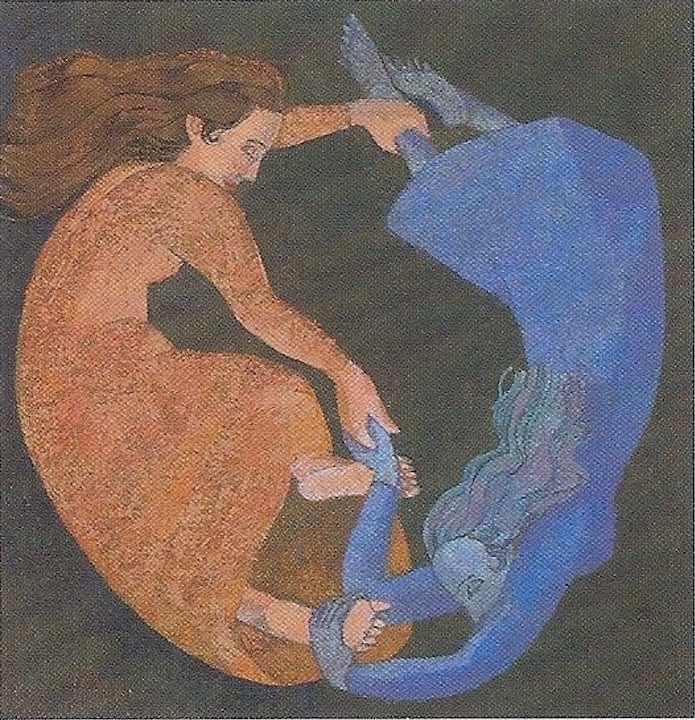
Image extract from Peter Malone's Painting from the book, The Secret Language of Dreams by David Fontana .
Important: TherapyRoute does not provide medical advice. All content is for informational purposes and cannot replace consulting a healthcare professional. If you face an emergency, please contact a local emergency service. For immediate emotional support, consider contacting a local helpline.
Find Therapists
Must Read
Creating Space for Growth: How Boundaries Strengthen Relationships
Setting healthy boundaries fosters respect, protects emotional well-being, and strengthens relationships by defining personal limits and maintaining self-care.
International Mutual Recognition Agreements for Mental Health Professionals
Mutual recognition agreements for mental health professions are rare and uneven, with major gaps in counselling, social work, and allied therapies. Read on to understand ...
Mental Health Licensing & Regulation in New York State: 2026 Guide
Mental Health Licensing & Regulation in Singapore: 2026 Guide
Jumping to Conclusions
Jumping to conclusions is a thinking habit where we assume the worst or make judgments without enough evidence. By recognising this pattern, therapy can help you slow dow...
About The Author

“A warm, interactive Jungian Psychoanalyst, Board Certified Dance therapist, and Somatics educator with 40 years of clinical experience.”
Tina Stromsted is a qualified Jungian Analyst, based in San Francisco, United States. With a commitment to mental health, Tina provides Consultation, Counseling, Dream Analysis, Personal Development, Jungian Analysis, Individual Therapy, Relationship Counseling and Supervision.
