Dialectical Behaviour Therapy: For More Than Borderline Personality Disorder

❝Dialectical Behaviour Therapy (DBT) was developed by Marsha Linehan (1993), as a treatment programme for people diagnosed with Borderline Disorder. It has been proven to reduce impulsive behaviours found across a wide range of emotional difficulties, not just Borderline Personality Disorder.❞
Dialectical Behaviour Therapy (DBT) was developed by Marsha Linehan (1993), as a treatment programme for people with a diagnosis of Borderline Personality Disorder. In particular, the treatment has been proven to reduce impulsive behaviours.
If you're struggling with low mood or depression, talking to a professional can make a real difference. Find a therapist who understands.
Find a Therapist for DepressionImpulsive Behaviours are those that create a discharge from an internal feeling into an outside action. They are actions without thought. Impulsive behaviours include: suicidal actions, other self-harming behaviours, aggression, binge/purging cycles, spending, substance abuse, gambling, promiscuity etc. If you are struggling with those urges now, see helplines and suicide hotlines worldwide.
The DBT approach suggests that this key feature of Borderline Personality Disorder is an attempt at regulating high levels of distress (emotional arousal) resulting from significant impairments in the regulatory systems normally available to do so.
DBT provides patients with a profoundly meaningful understanding of what causes and maintains their impulsive behaviour, and cycles of self-hatred, low self-esteem, and shame. In addition, it offers a skills training programme to slowly develop alternative ways of managing intense emotions, without having to fall back on such self-destructive actions.
Affect Regulation is the ability to use both physiological and psychological techniques to modulate levels of emotional arousal. It acts as an internal thermostat to cool us down when we feel too emotionally stirred up, and warm things up when we feel too emotionally flat.
In addressing the failure of affect regulation in Borderline Personality Disorder, the DBT approach has additionally highlighted ways people manage their internal emotional states, and the effect this has on their ways of managing their problems.
Patients with a much wider range of presenting emotional and behavioural difficulties can benefit from DBT. It offers them the development of a more reliable capacity for affect regulation and effective ways of addressing problems.
Dialectical Behaviour Therapy:
Linehan termed the therapy “Dialectical” in order to focus on the tensions between opposites within recovery. Linehan recognized that a treatment focused on change felt to the Borderline patient as a professional correcting his/her faults, and would quickly break down through a perceived lack of empathy, and criticism.
Alternatively, practitioners focused on acceptance and validation of the patient felt the pressure to go to greater and greater lengths to act in ways that proved to their client how much they cared. This in turn often resulted in the breakdown of the treatment relationship through practitioner burn out, or a breakdown in the professional boundaries required for such difficult work.
Dialectical refers to the integration of two apparently opposite poles of any theme. The core dialectic in DBT is the integration of Acceptance and Change.
In recognition of the frequency of treatment breaking down between Borderline patients and their practitioners, Linehan put as a priority of her treatment addressing the behaviours that prevented the client attending and maintaining treatment. In addition, these behaviours were the impulsive behaviours that maintained destructive cycles in patients’ everyday lives.
Hierarchy of DBT Treatment
1. Life-threatening behaviours
Behavours that could lead to patient’s death inc suicidal and non-suicidal self harm.
2. Therapy-interfering behaviours
Behaviours that stop patients benefitting from treatment inc. attitude towards help.
3. Quality of life behaviours
Features that interfere with clients having a reasonable quality of life inc. anxiety,
Depression, marital conflict, parenting difficulties, work conflict etc.
4. Skills acquisition
Development of new skills that would help patients achieve their goals inc. mindfulness, distress tolerance, emotion regulation, relationship skills.
Addressing the behaviours that interfere with treatment as a priority is necessary in a therapy for Borderline Personality Disorder and is a distinct aspect of DBT. However, addressing behaviours that interfere with clients’ abilities to enjoy a reasonable quality of life, and the development of skills to deal more effectively with the challenges they face, are more widely applicable for the treatment of a huge range of presenting mental health and behavioural problems, even when not related to a psychiatric illness.
Beyond Borderline Personality Disorder:
Underneath a wide range of mental health complaints is the lack of a reliable system to tune up or down the intensity of the client’s feelings. Practitioners are presented with problems of anger outbursts, eating issues, conflicts at work, parenting problems, marital tensions in the absence of a psychiatric diagnosis.
For people with a wide range of presenting problems, “reactive” behaviours are an attempted coping skill to manage painful feelings without an adequate internal regulatory system. However, these reactive ways of behaving often make situations worse. Anxiety and depressive symptoms are a frequent consequence of feeling unable to effectively address problems clients face in their everyday lives.
Both impulsive and reactive behaviours do provide a brief “relief” by discharging inside feelings outwards. However, this brief relief quickly develops into chronic feelings of shame, guilt and low self-esteem. Left with facing the consequences of reactive actions, a vicious cycle of overwhelming feelings build up inside the person, which then in turn maintains the repetition of reactive behaviours.
The “Behavioural” aspect of the DBT approach is the teaching and practicing of techniques to enable clients more effective approaches to addressing these challenges. The first two skill sets are ways of Accepting pain, without making the current situation worse. This is balanced with the second two skill sets that focus on addressing patients’ sense of competency in the world, by teaching and practicing problem solving to create Change.
DBT includes four sets of behavioural skills:
1. Mindfulness skills
Understanding the model of the mind, and practice being present in this moment.
2. Distress Tolerance Skills
How to tolerate pain in difficult situations without attempting to change it.
3. Interpersonal Effectiveness
How to ask for what you want and say no while maintaining self-respect and relationships with others.
4. Emotion Regulation Skills
How to understand emotions and manage their intensity.
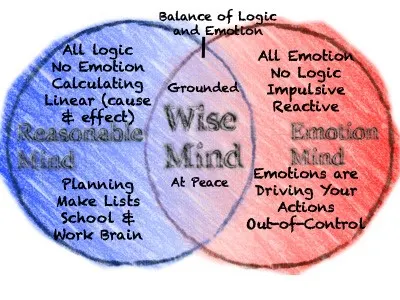
As a foundation for the practice of Mindfulness, DBT presents clients with a Model of the Mind. The “Emotional Mind” is the part that experiences feelings, from intensely pleasurable through to overwhelmingly painful. The “Rational Mind” has the role of problem solving, applying information to new situations, and organizing the demands that we face in life.
Both states are essential for living an engaged and meaningful live. We need an Emotional Mind to feel invested and connected in our relationships, to work, social, and recreational activities. We need a Rational Mind to stay cool headed in response to the problems that we face. To get stuck in either an elevated Emotional State of Mind, or to chronically disengage into a Rational State of mind results in difficulties in navigating our way through life.
Affect regulation requires flexibility across these different States, and at times to integrate both. The overlapping state when one can both think about feelings and have feelings about one’s thoughts is what Linehan refers to as the “Wise Mind.”
Mindfulness is the ability to direct one’s attention in a chosen direction. In DBT it is mainly used to practice being fully aware and present in the moment. Mentalising is a particular form of mindfulness, when the focus of attention is on one’s own or another person’s mental state.
Mentalising is the capacity to think about one’s own mind (both thoughts and feelings) and the minds of others, and understand they are distinct from one another. It is the understanding that one’s own mind or the mind of others can never fully be understood, yet there is a meaningful link between people’s actions and their inside mental states.
In practice, Mindfulness skills are very difficult to achieve! Therefore, a vital additional range of skills is to tolerate pain that for the time being cannot be tuned down. Distress Tolerance is to have a range of tools to help resist urges to act impulsively. These include breathing exercises, a wide range of distraction techniques, and physiological self-soothing activities.
Anxiety and depression can be the consequence of feeling powerless to address difficulties in life. Resisting the urge to act reactively does not imply no action should be taken. The Wise Mind allows for both the feeling, and to think about a useful response. Frequently patients present with limited experience of being assertive without becoming hostile or aggressive, and with limited skills in negotiation without becoming passive or submissive.
The Interpersonal Effectiveness Skills give clear guidelines about working towards getting what you want, and saying no to what you don’t want, while maintaining self-respect and good relationships.
Often patients feel that it is their Emotions that cause all the trouble and that to be “well” they must “feel less.” The Emotion Regulation Skills directly address the dilemmas around what emotions provide for us, but also how to feel able to direct strong feelings in useful ways.
Clearly the skills offered by DBT although developed for the treatment of Borderline Personality Disorder, offer a model of the mind, and techniques to feel more equipped to address a wide range of emotional and behavioural problems.
Dr Ella Brent is a Clinical Psychologist based at The Day Clinic, Johannesburg. The Day Clinic offers out-patient DBT groups for adults and adolescents, and training and consultancy for Practitioners. For more information please visit www.thedayclinic.co.za
References:
Linehan, M (1993) Cognitive-Behavioural treatment of borderline personality disorder. New York:Guilford Press.
Linehan, M (1993) Skills Training Manual for treating borderline personality disorder. New York: Guilford Press
Van Dijk, S (2012) DBT made simple. New Harbinger publications, Inc
Important: TherapyRoute does not provide medical advice. All content is for informational purposes and cannot replace consulting a healthcare professional. If you face an emergency, please contact a local emergency service. For immediate emotional support, consider contacting a local helpline.
Find Therapists
Must Read
Creating Space for Growth: How Boundaries Strengthen Relationships
Setting healthy boundaries fosters respect, protects emotional well-being, and strengthens relationships by defining personal limits and maintaining self-care.
International Mutual Recognition Agreements for Mental Health Professionals
Mutual recognition agreements for mental health professions are rare and uneven, with major gaps in counselling, social work, and allied therapies. Read on to understand ...
Mental Health Licensing & Regulation in New York State: 2026 Guide
Mental Health Licensing & Regulation in Singapore: 2026 Guide
Jumping to Conclusions
Jumping to conclusions is a thinking habit where we assume the worst or make judgments without enough evidence. By recognising this pattern, therapy can help you slow dow...
About The Author

TherapyRoute
Mental Health Resource
Cape Town, South Africa
“Our mission is to help people access mental healthcare when they need it most.”
TherapyRoute is a mental health resource platform connecting individuals with qualified therapists. Our team curates valuable mental health information and provides resources to help you find the right professional support for your needs.
