
Conversations with a Blank Canvas - A chapter excerpt - Decade 6: Belonging (1998 / 2010)

❝From Nowhere to Somewhere Decades of Change and Transformation❞
What follows below is a chapter excerpt from my book, Conversations with a Blank Canvas . Through, what I hope will be received as an honest, detailed and thought-provoking self-assessment of my life journey as a therapist, I invite you, the reader, to engage consciously with your own personal journey. If you enjoy the chapter, do click the link at the bottom and buy a copy of your own.
After the death of my mother, I felt my body come to life viscerally, like a stabbing white light into my heart; a sheet of glass penetrating into an overwhelming space where I felt a torrent of extreme and unprocessed feelings.
Therapy should be personal. Therapists listed on TherapyRoute are qualified, independent, and free to answer to you – no scripts, algorithms, or company policies.
Find Your Therapist
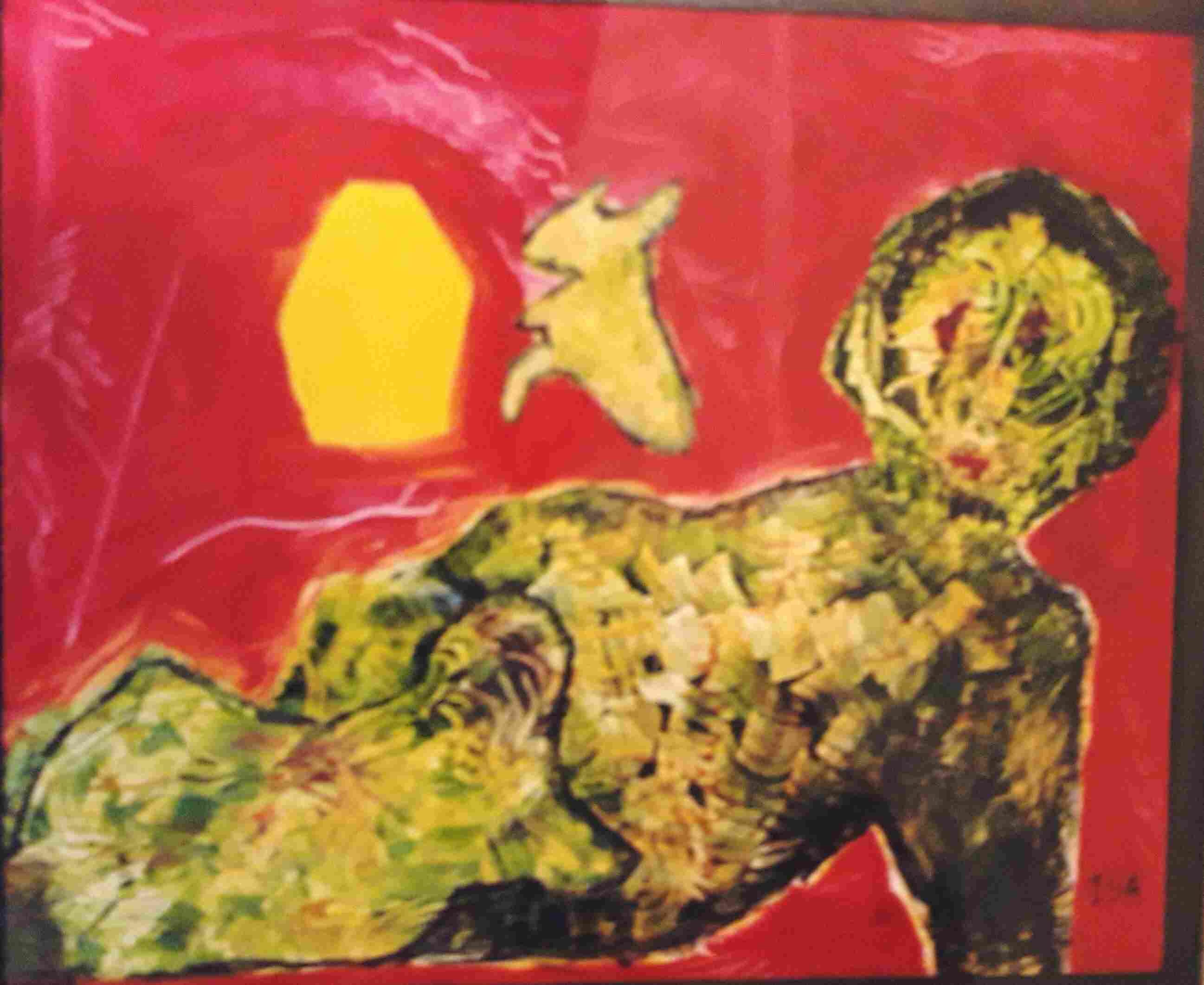
TWO IN ONE
In the painting “Two in One” I wonder now, as the therapist I have become, at the connection of the two female shapes as they blend into each other. Who is who? A shape is escaping into the light … perhaps it was a part of me that had not been killed off.
As a child I had learnt to hide my emotions and tame my individuality in order to fit in which also dismantled any sense of authenticity. Now I was positively motivated to find that authentic part of myself that was painfully missing.
Going into the studio I closed the door on the world and painted and painted my primitive feelings onto canvasses through paint, texture and colour and I found that even the critical and negative voices that were my constant companions could not stop me. I was sitting in my own light at long last.
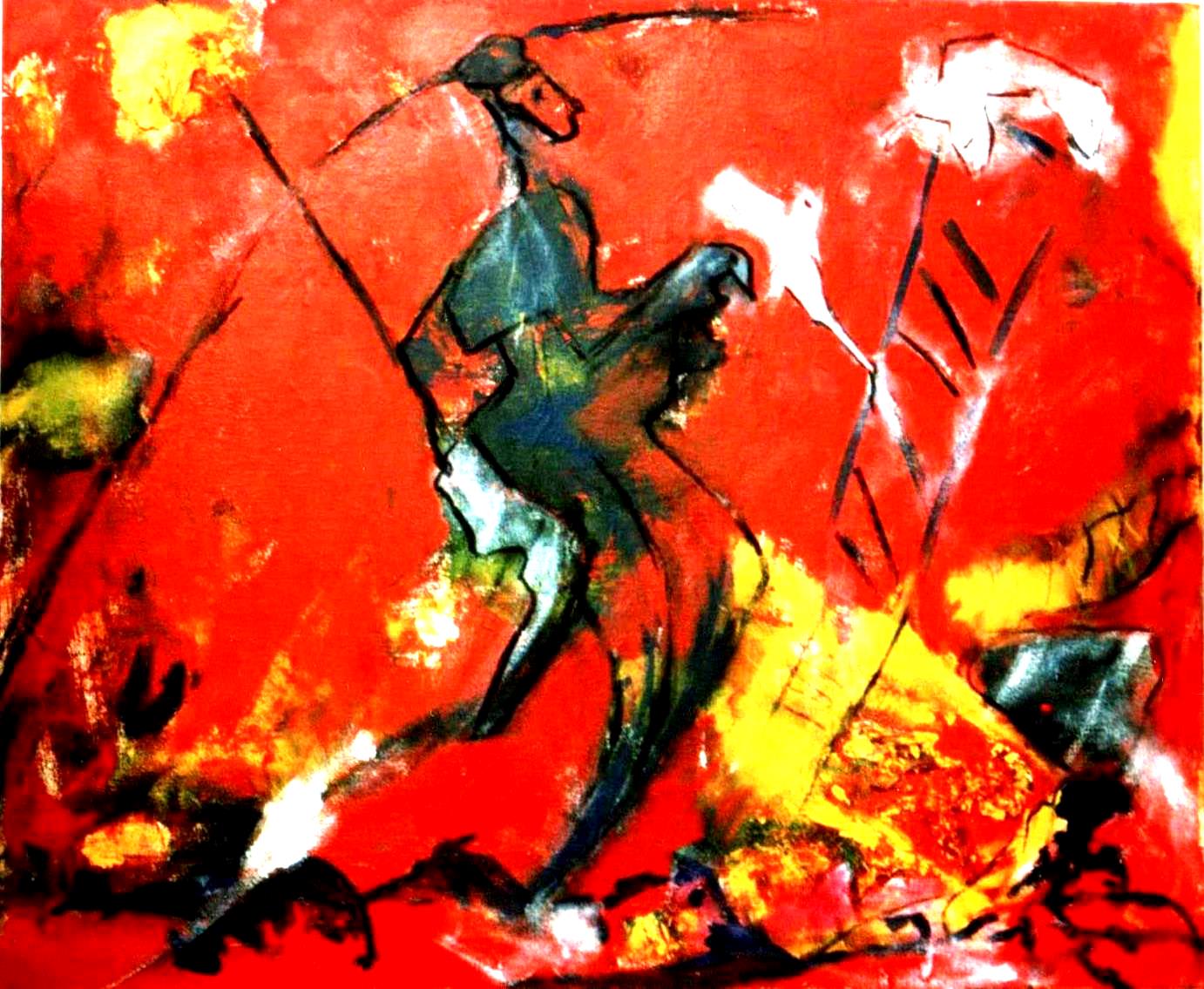
IN MY OWN LIGHT
In this painting the white dove-like bird is calling me to climb the ladder. I now realise that these critical and negative voices were in part what I had inherited from my mother, and I could see it now for what it was for when others spoke positively about my paintings, my mother was still unable to find it within herself to do so; praise was foreign in my world. So while the world was welcoming my paintings, my mother could not. Still critical, she would add her comments, “Too busy” or “Too blue”, “Looks like an old boot” to my abstract vision of a face.
In the wake of her comments I could see why I had such a lack of confidence and I started to change my own critical voice within so that when I felt I had made a mistake on my canvas I just put more energy into my painting and learnt that in that place something more than I could ever have imagined would sometimes develop, creating an interesting dynamic that could alter the whole painting.
I was learning to go with the flow and trust that all was not lost by making a mistake; probably the biggest lesson I have ever learnt. I could now see how my False Self was formulated from the belief that I thought that every part of my True Self was a mistake and everything authentic about me should be changed.
Needless to say, this very painful state of affairs leads to mental distress. In understanding more about recovery from “narcissistic abuse”, or you could say “unconscious toxic parenting”. In my case my parents were always physically present, so there was no explicit evidence of parental abandonment, but emotionally I experienced them as absent.
This emotional absence makes sense now as my parents lacked good role models in their own upbringings. I felt my role in childhood was to meet their needs rather than my own. The child tries to please the parent, as a natural human adaptation, and in my case my True Self disappeared and became invisible through what is sometimes referred to as dissociation, the natural human survival mechanism when there is too much strain and stress for the child and so the child becomes disembodied within the state of dissociation.
My Buddhist practice has helped me accept that negative mind chatter is normal and very much part of our human experience; learning to accept and challenge this part of ourselves with compassion and humour, if possible is at the heart of mindfulness.
I was glad to be part of a Buddhist community at this time and felt privileged to have monks and nuns teaching us to stay present with what is rather than escape into what isn’t.
The monks and nuns radiated a glowing sense of presence in their stillness and compassionate humour for the very nature of the human condition of mindlessness and were a great innovating factor in inspiring me to learn gentleness and compassion in relation to the harsh, critical and judgemental voices within.
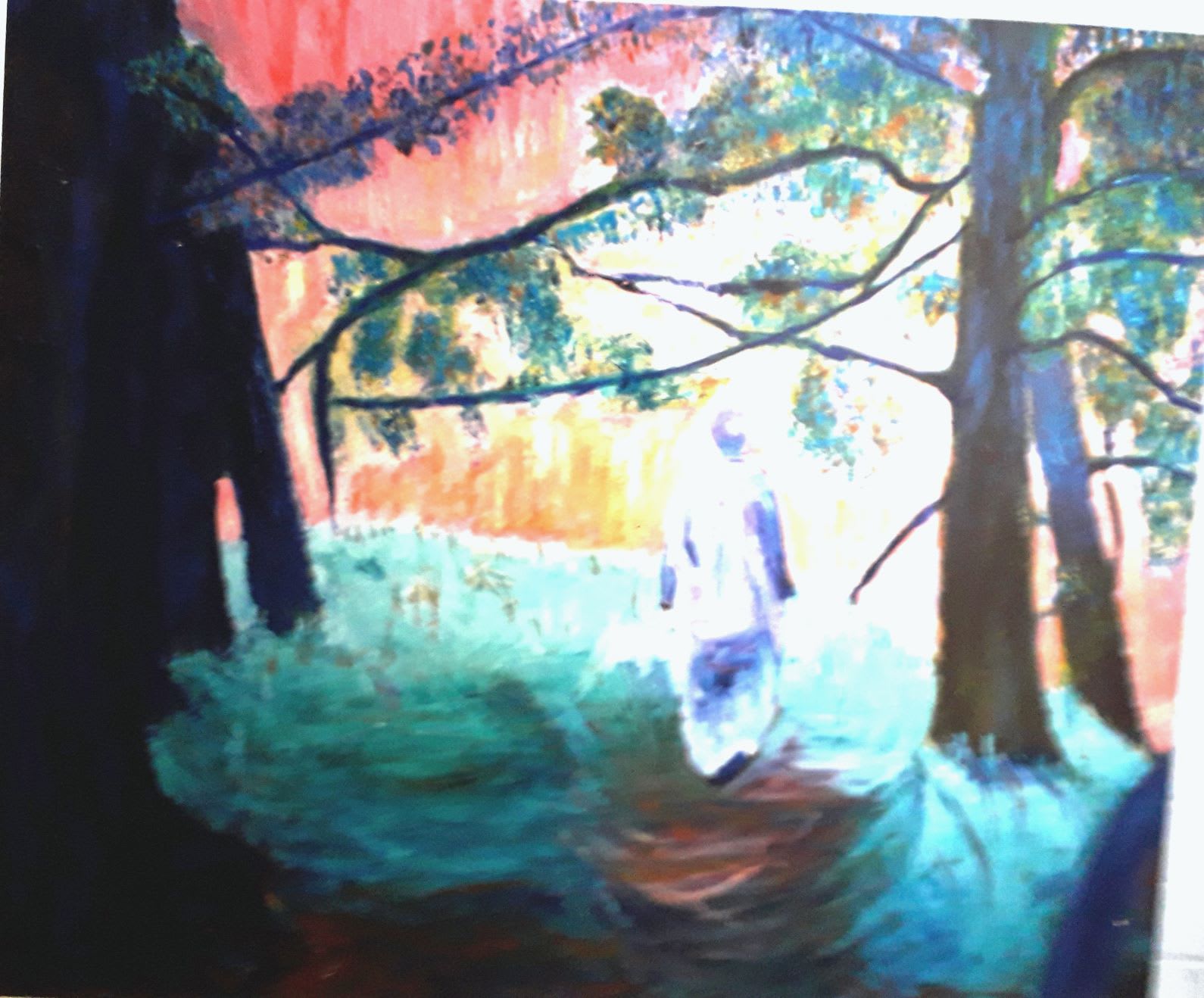
WALKING MEDITATION
It was a relief to know that I was a human being after all, rather than an alien, which I often felt.
During this period I travelled to see art collections in many parts of the world including New Mexico, New York, Venice and practically all the galleries in Paris versing myself with those great artists that inspired me so much in my evolution as a painter - such as the European and Eastern European artists like Nolde, Klimt, Kandinsky and Chagal, Soutine and Schiele to name but a few and some American expressional artists such as De Koening and Jackson Pollock.
Many paintings flowed and I just showed up every day at my studio, sometimes facing the blank canvas or sometimes continuing on a painting that I had started previously, approaching it with new eyes. Sometimes I would learn in classes, but I was opening to my authentic self and allowing the unknown to pour out.
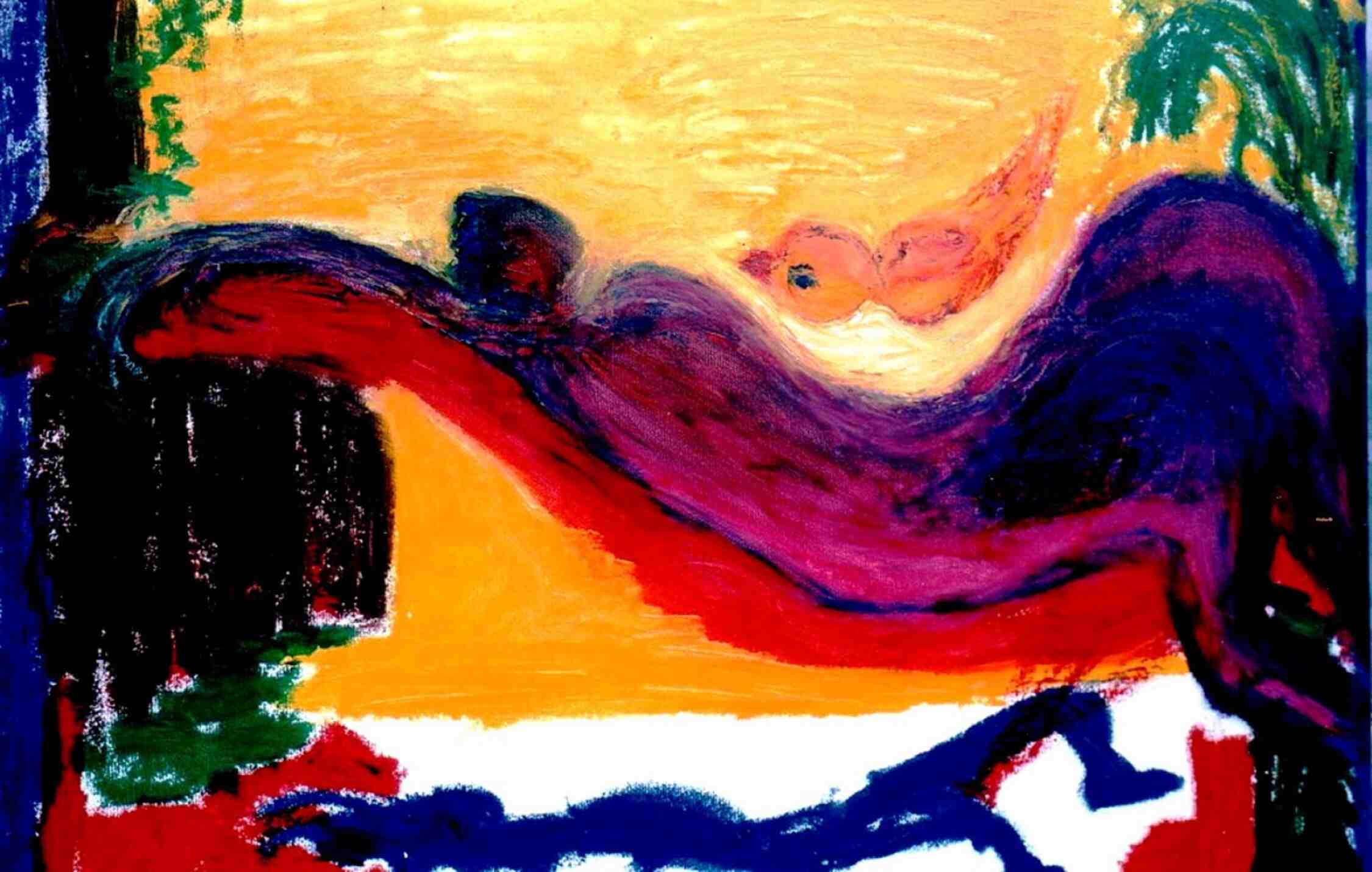
CONCEPTION
I was beginning to sell paintings also, which left me speechless in the wake of creating something that people actually liked before I really knew what I was doing.
They bought and I painted: assortments of flowers, landscapes, portraits, abstracts and I was alive –I was learning just how much energy is trapped within our negative self-judgments as I danced out my paintings into the world about 450 of them.
At this time I had won a prize as Artist of the Month in an art magazine and was awarded a £ 100 of art materials.
During the period I experienced a chance meeting in a local cafe with a man who was quite chatty and before long I was showing him the art magazine with my photo in as “artist of the month”, he asked me where the painting was and I said “in my studio” and he said – “Ok – I’d like to buy it. Let’s go there now”.
So, always up for a potential sale, I said goodbye to my friend and climbed into his car, stunned that anyone would offer to buy a painting without even seeing it in its true glory, or at least haggling over the price. Buying a painting, unlike purchasing a fridge or a washing machine, is normally a process approached very cautiously I’ve noticed.
What will my friends and family think of me? Am I marked for life? A fridge or washing machine can be replaced in five or six years, but what of a painting? What will happen to it after my death?
While we were driving to my studio, he told me that he was a fourth-generation Quaker and a publisher, and if he was to buy my painting I should buy his latest Quaker publication Silence of the Word. I hastily agreed and somehow relaxed knowing he was a Quaker. He was only passing through London for the week end and I never saw him again, but what followed was exciting.
When we got to the studio, I think it’s fair to say that there was bedlam as shelves were ran sacked to see all my wares, and it was a feverish hour or so.
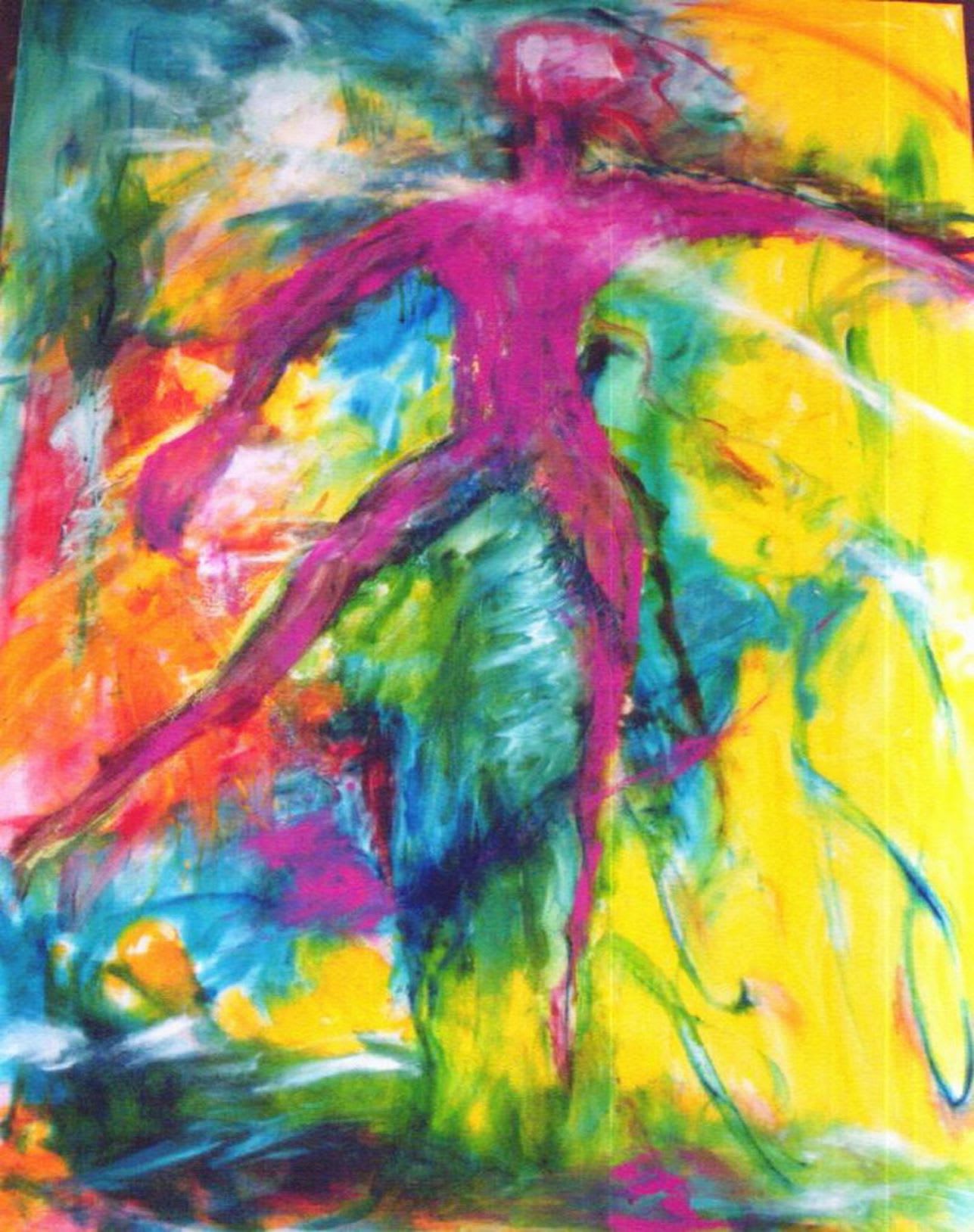
CELEBRATION IN PINK
I felt, somehow, that this man was really living his life spontaneously and going with the flow, as was I, and we all enjoyed an unplanned great evening together in a house where he was staying for the weekend, surrounded by original paintings by Sir Stanley Spencer, a great British artist and I ended up playing my guitar and singing and really sharing from my heart.
Sometime later when I read his pamphlet Silence of the Word it resonated. I had found no words since my mother’s death to express my feelings, as my paintings had been my words. There was a link here somewhere, I believed, but I did not gain this information from my logical mind; more from a deep place within. So I decided to go to my first Quaker meeting in August 1998 after having read my new friend’s pamphlet and I have been going ever since.

IN MY PRISM: A SELF-PORTRAIT
The silent meeting for worship appealed, as did the Quaker principle of “that of God within”. It has, however, taken some years for me to become aware that my “True or Authentic Self” – “that of God within”– is a meeting place for my personal, spiritual, creative and therapeutic self to unite, somewhere deeper than the ego and where, eventually, freedom can be found.
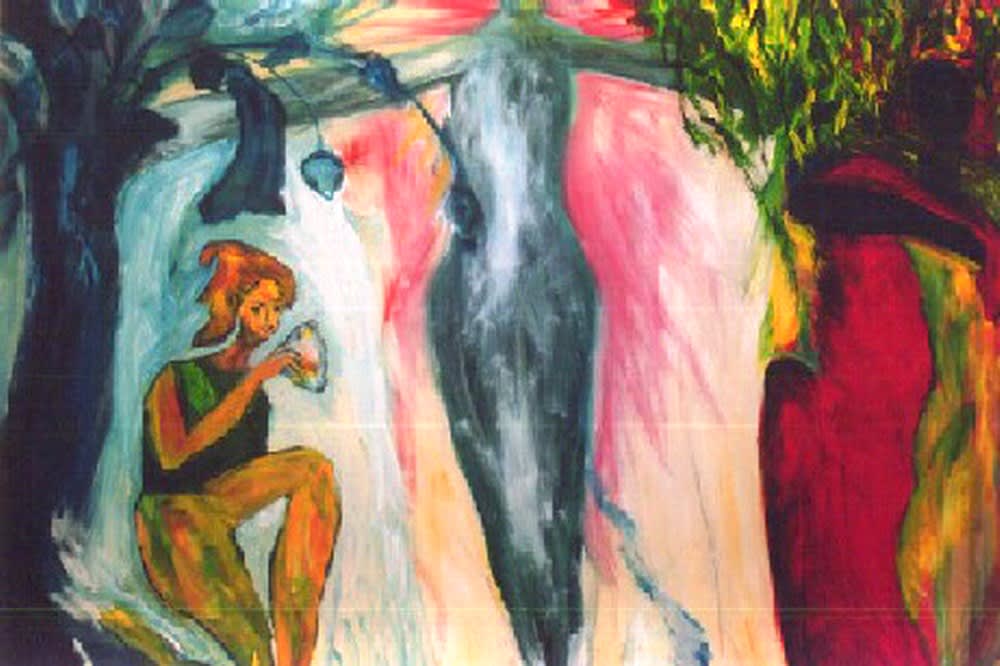
FEMALE RESURRECTION
As I was coming to terms with the death of my mother and four other women also, some of them my own age, I was questioning how one could celebrate life while at the same time experiencing a plethora of females around me dying; maybe a part of me was dying also.
I think I was also marking a spiritual crossover in my life that linked many aspects of my Authentic Self that lay beyond words.
Putting the female figure on the cross created guilt for me as I felt a traitor to my own cultural heritage – and also felt I was being sac religious to put myself, like Jesus, on the cross.
I can see now having researched the meaning of the Celtic cross that the four sides of the cross represented the Self: Divine God / Goddess: Wisdom: Nature and thus made absolute sense to me that this is what I had been searching for all my life – Unity – Connection – Truth.
And so I called the painting the “Female Resurrection”, a transcendent image of suffering and transformation.
The figure on the left, looking into a sort of conch, was the face of reflection and the other, on the right of the painting, a dark figure wearing the crown of thorns, but decidedly dancing into the painting and so I had my answer that within the suffering or the ‘shadow’ is also the celebration and the possibility for transformation.
Isa Levy is a London based psychotherapist.
Her book "Conversations with a blank canvas" can be purchased by
clicking on this link.
Important: TherapyRoute does not provide medical advice. All content is for informational purposes and cannot replace consulting a healthcare professional. If you face an emergency, please contact a local emergency service. For immediate emotional support, consider contacting a local helpline.
Find Therapists
Must Read
Creating Space for Growth: How Boundaries Strengthen Relationships
Setting healthy boundaries fosters respect, protects emotional well-being, and strengthens relationships by defining personal limits and maintaining self-care.
International Mutual Recognition Agreements for Mental Health Professionals
Mutual recognition agreements for mental health professions are rare and uneven, with major gaps in counselling, social work, and allied therapies. Read on to understand ...
Mental Health Licensing & Regulation in New York State: 2026 Guide
Mental Health Licensing & Regulation in Singapore: 2026 Guide
Jumping to Conclusions
Jumping to conclusions is a thinking habit where we assume the worst or make judgments without enough evidence. By recognising this pattern, therapy can help you slow dow...
About The Author

Isa Louise Levy
Brighton and Hove, United Kingdom
“Are you looking to find your authentic path. Find ways to deal with your depression and anxiety and lead a more fulfilling life.”
Isa Louise Levy is based in Brighton and Hove, United Kingdom. With a commitment to mental health, Isa Louise provides Individual Therapy and CBT.
