
Cognitive Behavioural Therapy in Practice

C.B.T. Psychologist and Therapist
Windsor, United Kingdom
❝If you feel lost and can not find the right way forward...… Cognitive Behavioural Therapy can help you find your way out of a difficult situation.❞
What is Cognitive Behavioural Therapy
Cognitive Behavioural Therapy (also called C.B.T.) is one of the effective methods used to treat a host of mental disorders, emotional difficulties and behavioural problems. In the majority of cases this therapy alone is sufficient, although a complement pharmacological treatment e.g. in the treatment of severe depression, schizophrenia or personality disorders - is advisable.
Looking for evidence-based support? Find a qualified psychologist near you through TherapyRoute.
Find a PsychologistThe therapy assumes that it is not our life situations that shape our well-being rather our thoughts and our relationship to them.
Each of us actively creates our own interpretation of situations we encounter and what meaning we give to our thoughts based on learnt behaviour.
C.B.T. is focused on changing the way we see ourselves, the world and other people and the way in which our behaviour is affected by our thoughts and feelings. Accordingly therapy works to change our perception and behaviour thus improving our overall well-being.
What does C.B.T. Therapy actually Involve?
The therapy itself is based on building a close co-operation with a therapist and is focused on solving our current difficulties and specific problems in the "here and now". The therapist does not ignore our past experiences, but focus is maintained on finding ways to improve our situation and emotional well being in the present. It is recognised, however, that it’s often useful for the therapist to ask their client about the past in order to understand its impact now.
Cognitive-behavioural therapy is relatively short-term and usually lasts from a few to several sessions held on average once a week. Together client and therapist work out the optimal length of treatment, which can be adapted to coincide with our progress and success.
What Problems are Treated with Cognitive Behavioural Therapy?
Although initially this therapy was designed for the treatment of depression, it is currently successfully used in the treatment of other disorders:
Anxiety disorders, seizure medications
Depression (bipolar depression)
Agoraphobia and other phobias
Social phobia
Bulimia and other eating disorders
Obsessive-compulsive disorder (OCD)
Post-traumatic stress disorder (P.T.S.D.)
Schizophrenia and other personality disorders
How Effective Is Cognitive Behavioural Therapy?
The efficacy of this therapy in the treatment of various emotional problems, has been confirmed in numerous clinical trials. It is the most effective psychological treatment for the treatment of mild or medium depression.
In the long-term treatment of anxiety, panic attacks and phobias when you can not use sedation therapy is the only option.
How Does Cognitive Behavioural Therapy Work?
Cognitive-Behavioural Therapy is based on the premise that by changing our way of thinking, we can make changes to our mood and behaviour. The link between our thoughts, emotions and behaviours are explored in a variety of ways. Most often together with the therapist, we analyse difficult situations in order to discover the way of our pre-determined thoughts often lead to how we felt and is kept in a given situation.
For most life situations we react either positively or negatively depending on what we think about what is actually occurring. Let's try to explain this in the following example:
Situation: A colleague has told you that at the next work meeting a survey will be carried out into how much you know about your company and the way it actually operates.
Think positive: I love surveys…I know I do my company well…it'll be fun!
Emotional feelings: I feel happy, I'm relaxed.
Behaviour: You learn a little more about recent events in the company.
The physiological responses: Promotes an overall feeling of well-being.
A negative thought: I know nothing about my company, I’ll be mocked.
Emotional feelings: You feel worried, depressed and anxious.
Behaviour: You read up more on company workings for hours but can’t concentrate so remember little.
The physiological responses: Stomach cramps, lack of energy, nausea.
The above example illustrates just how different the course of our thinking used in exactly the same situation, provoked different reactions. This confirms that our thoughts affect our feelings and behaviour, our interpretation of events taking place in our lives is how we perceive our world and as such brings us to the pleasant or unpleasant sensations and behaviours.
Cognitive-Behavioural Therapy helps us spread the complicated problem into smaller parts. This helps us to understand how these elements are interrelated and how they effect us.
Take a look at five of the following components:
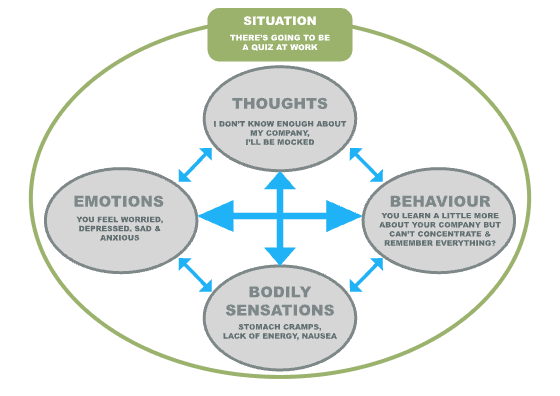
Each of these elements has an effect on the other, and is a part of a "vicious circle". Our thoughts related to our problem affect how we feel both physically and emotionally - they also have an effect on our behaviour and can change them.
Negative thinking creates a negative "vicious circle", worsens our mood and often leads to the formation of new negative situations that will further deepen and strengthen our unhelpful belief system…that we are not able to solve our problems.
When we are depressed it is easier to see the world through a "black eye" and draw hasty conclusions.
Thoughts that guide our actions are called ‘automatic’ because they occur quickly and involuntarily. Our initial thoughts are only the outer layer of our entire thought process, deeper layers are formed so deep beliefs (core beliefs), become rooted beliefs - about ourselves, others and the world around us.
Deep beliefs are built from our experiences, memories and knowledge. They are formed from the moment we are born; from interacting with our family and with people from our immediate environment: be it a neighbour, priest, teacher, colleagues…they all shape and effect how we see ourselves, others and the world around us.
If for example you come from a so-called broken family or am a child of say ‘an alcoholic’ you would probably often hear comments such as "you’ll never be able to do (things)” or “you have two left hands." If we are told these things repeatedly as children, we accept them as our beliefs, that they are ‘factually’ the truth about us.
From that moment onwards we think about ourselves as ‘misfits’ or ‘losers’ with little self-worth and therefore it’s easy to allow our adult lives to be ruled by these events - leading to situations which only seek to confirm those beliefs; we disregard or belittle any positives facts of our lives, which contradict it.
Our inner ‘core beliefs’ shape our views about ourselves, others and the entire world. They become like "contact lenses" through which we perceive reality and affect how we interpret it. If our "contact lenses", our own beliefs, way of thinking are the cause of our problems, it is wise to replace them with those that are more helpful. It is true that each of us in a specific way perceives, understands and interprets what is happening in our life in our own particular way. This is how we evaluate our life situations, affects the emotions we experience, and consequently our behaviour.
Cognitive-behavioural therapy allows us to replace negative ways of coping, thinking, feeling with more positive behaviour that is more useful. Our ways of thinking, feeling and behaviour were learnt during childhood and adolescence but in adulthood they can be unlearnt. Each of us has the capacity to re-learn and think in a new way - about themselves, the world and other people so as to cope better with everyday life and make it easier.
What Does a Session Involve?
During each stage of our therapy we decide about what we want and need to focus on and how fast to move.
This is assessed and discussed at the start of each following meeting. The therapist does not do anything and does not take any action without expressed consent.
During a session we disseminate any major issue into smaller parts in a similar manner in which it was demonstrated in the example given above. Then, together analyse each problem/situation, thought, feelings and behaviour in order to determine whether they are reasonable and helpful, or irrational and undesirable.
During the next stage of treatment we move on to try to understand how best to change unwanted thoughts and behaviour with positive ones. This involves the gradual replacement of our old beliefs and the introduction of new ways of thinking that will serve us better.
During each session, we will discuss our progress and changes that we have introduced into our lives since the last meeting. If it turns out that some of the tasks are too overbearing or difficult, or not having the desired effect, we will agree on other arrangements.
Cognitive-Behavioural Therapy allows us to practice and develop skills even after the end of our session. This, in turn, reduces the potential for recurrence of our problems and related symptoms.
An emotional disorder is a very unpleasant experience, which seriously hampers our lives and our ability to enjoy it. Cognitive-Behavioural Therapy helps us keep control of undesirable symptoms and regain the joy of life.
This article was prepared by Barbara Paczkowska, MSc., C.B.T. Psychologist and Therapist -
January 2014
MORE POSTS
The Benefits of Treating Depression with Cognitive Behavioural Therapy
Important: TherapyRoute does not provide medical advice. All content is for informational purposes and cannot replace consulting a healthcare professional. If you face an emergency, please contact a local emergency service. For immediate emotional support, consider contacting a local helpline.
Find Therapists
Must Read
Creating Space for Growth: How Boundaries Strengthen Relationships
Setting healthy boundaries fosters respect, protects emotional well-being, and strengthens relationships by defining personal limits and maintaining self-care.
International Mutual Recognition Agreements for Mental Health Professionals
Mutual recognition agreements for mental health professions are rare and uneven, with major gaps in counselling, social work, and allied therapies. Read on to understand ...
Mental Health Licensing & Regulation in New York State: 2026 Guide
Mental Health Licensing & Regulation in Singapore: 2026 Guide
Jumping to Conclusions
Jumping to conclusions is a thinking habit where we assume the worst or make judgments without enough evidence. By recognising this pattern, therapy can help you slow dow...
About The Author

“I am Barbara Paczkowska, an experienced Psychologist, Psychotherapist, and the Founder and Clinical Director of Select Healthy Mind in Windsor and Eton. I hold a Master’s degree in Cognitive Behavioural Therapy and a BSc (Hons) in Psychology. As a fully accredited CBT Therapist, a Consultant EMDR Europe Psychotherapist and Supervisor, and an IFS Level 1 Therapist, I am dedicated to providing highly specialised, evidence-based care. Having built my foundational expertise as a high-intensity CBT Therapist within the NHS, I transitioned to private practice to offer a more bespoke and flexible therapeutic experience. I specialize in working with adults facing depression, mood disturbances, anxiety disorders, and OCD. I also have extensive expertise in treating complex trauma and PTSD, particularly addressing childhood issues that continue to impact adult life. My therapeutic philosophy centers on treating you as a unique individual, rather than simply addressing a label or a set of symptoms . I recognize that no single type of therapy fits everyone, which is why I integrate multiple therapeutic models to deliver treatment customised to your specific needs. My goal is to create a safe, compassionate, and non-judgmental environment where you feel genuinely seen and understood, building a foundation of trust and collaborative partnership to support your healing journey. Professional Credentials: Accredited by the British Association for Behavioural and Cognitive Psychotherapies (BABCP) Consultant EMDR Supervisor (EMDR UK & Ireland / EMDR Europe / EMDRIA) Level 1 Therapist, IFS Institute Honorary Member of the British Psychological Society (BPS)”
Barbara Paczkowska is a qualified Psychotherapist (Registered), based in Windsor, United Kingdom. With a commitment to mental health, Barbara provides EMDR, Individual Therapy and CBT.
