
The Servant Problem

Farhad Dalal
Psychotherapist and Group Analyst
Devon, United Kingdom
❝It’s time we reflected on our attitudes towards domestic help, an integral part of our households.❞
As one one who lives abroad, to make any comment on middle-class Indian life could be risky. When I speak my mind, I’m often told that I do not understand what it’s like to live in India. But isn’t it possible for me—as one who makes annual visits to my family in India—to understand and yet disagree?
Let’s consider the sensitive subject of The Servant, without whom nothing much would function in most Indian middle- and upper-class Indian households. In the UK, where I live, I too employ a cleaner for three hours a week. So this isn’t about whether or not one should have servants; it’s about the attitude to the servant. Nor is this about extreme horror stories like that young maid in New Delhi, who was locked in a flat by her employers who went abroad for days. Instead, I speak of the everyday norms witnessed in the homes of good, decent people.
Therapy should be personal. Therapists listed on TherapyRoute are qualified, independent, and free to answer to you – no scripts, algorithms, or company policies.
Find Your Therapist
I was 10 years old and it was my first few days at a boarding school in Nainital. There, I accidentally bumped into another child in the playground, and said sorry. My peers laughed and mocked me for apologising a servant’s child. Recently, when an acquaintance heard this story he exclaimed, “But these were children! We adults are not like that.”
The frailty of that defence is revealed when we ask, “But how did the children come by these attitudes in the first place?” They could only have absorbed them from the conventions of their families as expressed by the adults they respect.
Nevertheless that defence also serves as a reminder that not every Indian lives by these sorts of values. The other day, in Mumbai, I was in the back seat of a car, being given a lift by a friend, who sat in the front passenger seat. On peeling an orange, my friend offered the first segments to the person seated next to him, his driver. First, this vignette demonstrates that not all Indians share the same disparaging attitude towards the so-called serving classes. But, second, is it not curious that I found myself struck by this simple gesture? I think I was struck by it precisely because it stood out from the norm. Here was a courtesy of the kind that one extends to an equal—which was also my ‘mistake’ in the playground decades ago.
Given that the conventions of my family home were (and are) no doubt similar to those of my peers at the boarding school, how was it that I found myself at odds with them? Maybe I committed that faux pas because I did not see who I had bumped into and my uttering “sorry” was an automatic one—I’m not so sure now. So I cannot claim any moral superiority for myself.
These examples show that the attitudes between and also within households is not uniform. Tied into these attitudes towards servants is another similar attitude towards anything manual—menial tasks, as they are called.
I was about 16 and staying in another family’s home. The father of the household asked me to accompany him to his car, which was covered with a plastic weather protector. He also called out the servant girl. He asked her to lift the cover over a part of the bonnet up, and then proceeded to ask my advice about a scratch in the paintwork. The thing that sticks in my mind is the fact that he thought that it was beneath him to lift the cover himself, and he must have also felt that he ought not to insult me by asking me to do it. There we were, man and boy, in discussion; and there was the servant girl, quietly doing what she was bid.
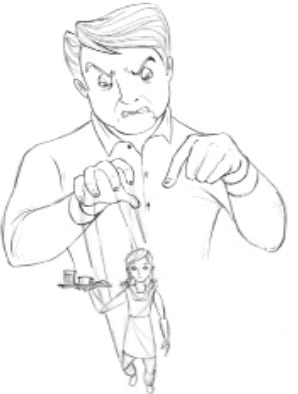
To my mind the function of many of these conventions is actually to reinforce the distinction between master and servant, and this invariably involves the exercise of power, which makes the employer feel bigger in relation to the servant, and crucially, better than them.
Power is continually being exercised in all kinds of ways. The servant is habitually called from one room to another to fetch and carry, to do this and to do that, as though the people doing the calling were handicapped.
In a psychological sense, the householder has indeed become disabled. To sit and boss someone around, feeds the ego, and is addictive. This becomes their main daily occupation. In some Indian households the routine work of the matriarch is to follow the servant around, scolding continually to make sure she does her work properly. By the end of the day the matriarch is herself exhausted by this onerous responsibility.
It was late one morning in a family home after everyone had showered. As you might expect, some fallen hair had collected on the shower drain. Seeing this, a member of the family went to the kitchen, called the servant out, walked her to the bathroom, pointed to the hair, and told her to pick it up. The way this was done was not only the exercise of power (and a waste of time and energy), it was to me an exercise in humiliation—a way of keeping them in their place.
Another little drama took place entirely non-verbally: an elderly man finished eating an apple and beckoned his servant. She came forward warily. He thrust his chewed apple core into her hand, and waved her away. To have his spittle-coated apple core in her hand was (to put it mildly) distasteful to her. Although upset, she said nothing.
Mostly, such activity of daily insult and humiliation of servants is not so crude. But it is so integral a part of the communication pattern that it is not even thought of as insult. This is most clearly evident in the tone of voice with which the serving classes (waiter, porter, driver or maid) are spoken to: mostly in the imperative. (Do this now! Fetch that! Turn that down!) Mostly, they are shouted at in the same way as to working animals or troublesome children.
In his great work Pedagogy of the Oppressed, Paulo Freire describes the attitude of the oppressor towards the oppressed in Latin America almost a hundred years ago. When I first read it, I was astonished to find almost exactly the same attitudes that were familiar to me as a boy growing up in India.
The belief: They are dirty, greedy, untrustworthy, stupid, selfish, and thoughtless. We find the same theses recurring in other parts of the world in all eras. This was also what many British colonialists thought of the Indian. Today, racists everywhere continue to speak of people they happen to hate in exactly these terms (White to Black, Hindu to Muslim, Protestant to Catholic, Serb to Bosnian, and vice versa).
The less powerful are stigmatised by the more powerful. The stigmatised are thought of as not quite human, and therefore falling outside the orbit of the moral code applicable to human beings. Rather shockingly, contemporary Indian attitudes towards the servant are much like those of Whites towards Blacks in the former apartheid South Africa; in both, servant and Black are not quite human. The middle class Indian cannot even begin to countenance the notion that their experience of “the servant” is in part ideologically driven. But put this same middle class Indian in Britain today, and they will be quick to feel slighted and offended when they themselves are the object of exactly these attitudes.
The servant’s position is a paradoxical one. While servants are at the centre of domestic life, necessary and critical to it, he or she is always Other.
Consider this. It is not an uncommon practice that on entering the home, servants are required to immediately wash their hands (nothing untoward in that, you might say). However, I have noticed that in many households they are required to use the soap especially set aside for them: the “servant soap.” There is also, often enough, a cup and plate set aside for the servant. Why?
“Because you don’t know where they have been and what sort of germs they are bringing in.”
But curiously this self-same (potentially germ-carrying) servant is also the one who cooks the family’s meals and is even trusted with the care of the family’s infant. Therein lies the paradox.
In speaking in this way, I do not wish to fall into the opposite error of romanticising and idealising the serving classes as somehow being better people. They are not better people, they are just people. Some servants lie and cheat; but so do “we” (corruption is rife at all levels of society). Some servants are lazy; but then so are many of us. Some servants steal; but so do the masters (what else would you call the commonplace practice of hiding income from the taxman?).
To my mind servants deserve, at the very least, to be treated with dignity and courtesy.
I was struck when a friend of mine spoke of her childhood in Germany in the 1950s. The family employed a live-in maid who helped look after the children and did much of the housework. But here is the thing: at meal times she sat at the dinner table, was a part of the conversation, and ate the same food as the family with the family. Can you imagine the same taking place in your household? If not, why not?
About the Author
Farhad Dalal is a psychotherapist and group analyst, who also works with organisations. He is a training analyst and supervisor for the Institute of Group Analysis, London, and a founding member of the South Devon Psychotherapy and Counselling Service. He is the author of Taking the Group Seriously (1998) and Race, Colour and the Processes of Racialisation (2002).
Important: TherapyRoute does not provide medical advice. All content is for informational purposes and cannot replace consulting a healthcare professional. If you face an emergency, please contact a local emergency service. For immediate emotional support, consider contacting a local helpline.
Find Therapists
Must Read
Creating Space for Growth: How Boundaries Strengthen Relationships
Setting healthy boundaries fosters respect, protects emotional well-being, and strengthens relationships by defining personal limits and maintaining self-care.
International Mutual Recognition Agreements for Mental Health Professionals
Mutual recognition agreements for mental health professions are rare and uneven, with major gaps in counselling, social work, and allied therapies. Read on to understand ...
Mental Health Licensing & Regulation in New York State: 2026 Guide
Mental Health Licensing & Regulation in Singapore: 2026 Guide
Jumping to Conclusions
Jumping to conclusions is a thinking habit where we assume the worst or make judgments without enough evidence. By recognising this pattern, therapy can help you slow dow...
About The Author

TherapyRoute
Mental Health Resource
Cape Town, South Africa
“Our mission is to help people access mental healthcare when they need it most.”
TherapyRoute is a mental health resource platform connecting individuals with qualified therapists. Our team curates valuable mental health information and provides resources to help you find the right professional support for your needs.



