
Healing Wounded History

Gottfried M. Heuer
Jungian Psychoanalyst
London, United Kingdom
❝Jung and his ‘Twin-Brother’1: From Sibling-Rivalry and Fratricide towards Redemption❞
Jung and his ‘Twin-Brother’1:
From Sibling-Rivalry and Fratricide towards Redemption
Looking for evidence-based support? Find a qualified psychologist near you through TherapyRoute.
Find a Psychologist
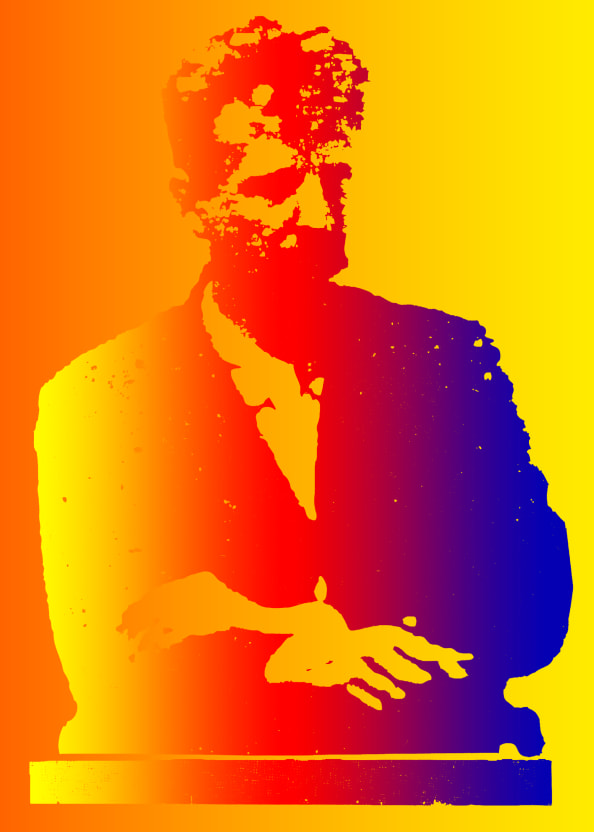
Image credit: Stone-Balance and Photograph: Gottfried M. Heuer, Iona, Scotland, 2014.

Introduction
‘I have only mixed with anarchists and I declare myself to be an anarchist. I am a psychoanalyst and from my experience, I have gained the insight that the existing order of the family is a bad one. Authority in the family as the source of authority per se has to be changed – [. . .] and since I want everything changed, I am an anarchist.’2 – This is what Otto Gross told the psychiatrists some hundred years ago. They diagnosed his politics as pathological.
‘Healing Wounded History’3 – in terms of an engagement with the past in order to heal its wounds and hopefully achieve a better future, we might see therapists as historians of the individual – or a small group – and the historian as the therapist of the wider collective. Just as therapy has a spiritual dimension, the philosopher Walter Benjamin correspondingly calls upon the historian to ‘be a prophet turned backwards’, 4 and invokes the angel ofhistory: His face is turned towards the past. [. . .] The angel would like to stay, awaken the dead, and make whole what has been smashed. But a storm is blowing from Paradise, it has got caught in his wings [. . .] that the angel can no longer close them. The storm irresistibly propels him into the future to which his back is turned.5
Otto Gross, 1877 – 1920, constitutes a wound in our collective past: barely a year after his death, a friend wrote of him as ‘known only to very few by name – apart from a handful of psychiatrists and secret policeme – and among those few only to those who plucked his feathers to adorn their own posteriors.’6 Our gathering here this morning, then, is part of an undoing of the damnatio memoriae, as the Romans called the efforts to write somebody out of history: in helping the repressed to return, we are, together, healing wounded history.
I shall begin by introducing Gross’s life and work, followed by a brief outline of my approach to history, which originated from concepts Gross was the first to formulate. I then speak about the relationship between Gross, Jung – and Freud, and how the latter two conspired, with Gross’s father, to silence him.
‘A man is only then truly dead, when nobody thinks of him anymore.’7
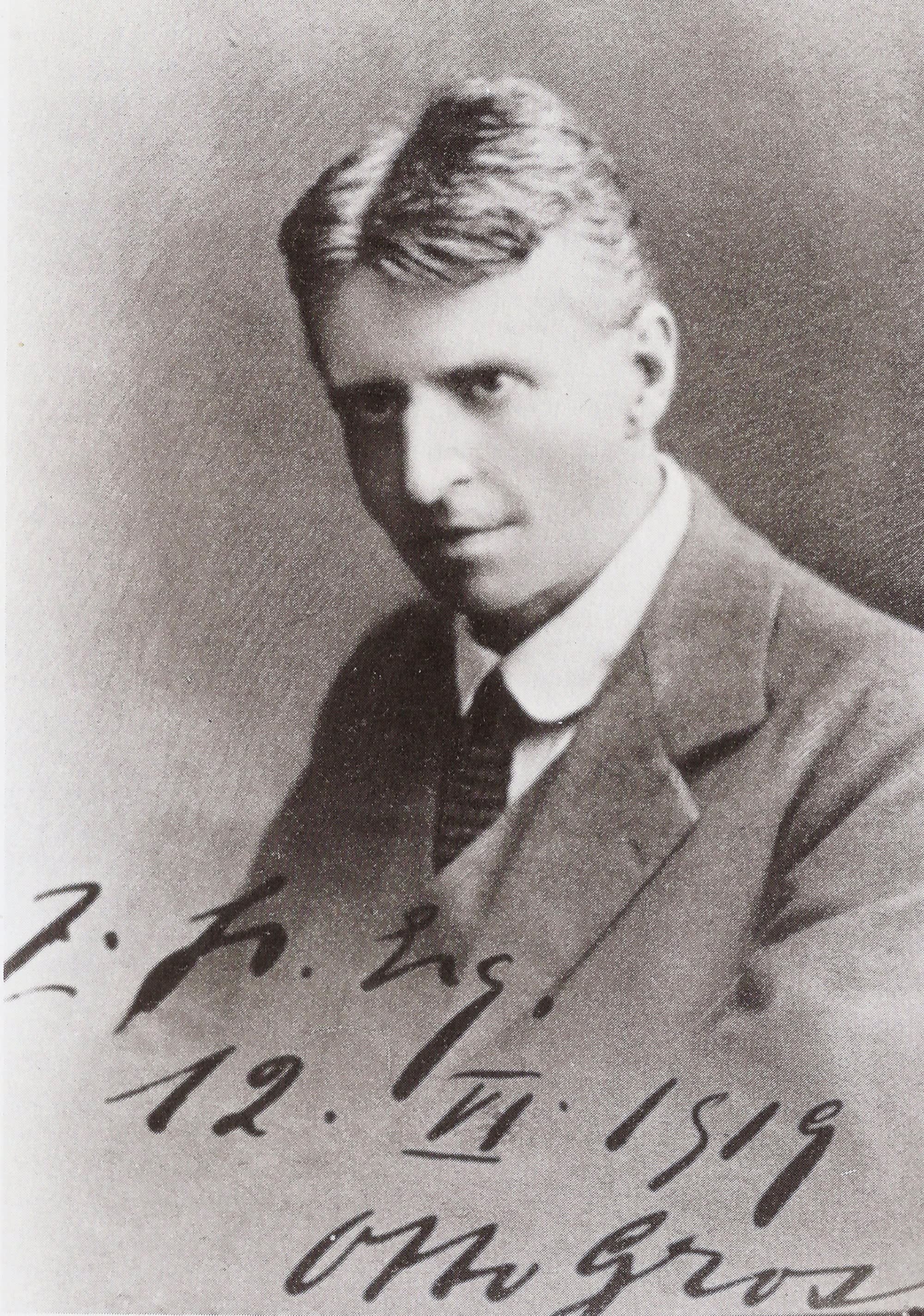
Otto Gross ,
was born in 1877 in a village in south-east Austria. His father Hans (1847 – 1915) an examining magistrate and professor of criminology became the leading authority worldwide in this field, seen as the father of Criminal Investigation. The 1893 publication of his Handbook for Coroners, police officials, military policemen, ‘known as the Bible of crime detection’8 was translated into many languages and reprinted until the 1960’s.
His wife Adele wrote about their ten-year-old son Otto as ‘our wicked boy, whose main striving is not to be the way he is supposed to be,’9 whilst the father warned visitors, ‘Careful, he bites!’ Gross was sexually traumatized: his lawyer later stated, the boy ‘was kept overlong in the parents’ bedroom, where [. . .], he witnessed their most blissful moments.’ 10 Gross himself recalled, ‘I was terribly frightened by my parents’ sexuality; as a five-year-old, I linked it with an image of stabbing chicken to death, and I had a sense of rape.’ 11
As an adolescent he became addicted to drugs: first arsenic, wide-spread among young men of his generation, believed to increase virility, later to cocaine and morphine. In 1899, Gross qualified as a medical doctor and was treated for drug addiction in 1902 – by C.G. Jung – at the Burghölzli Clinic, Zürich. Eugen Bleuler, the director, wrote to his father ‘we are happy for [Dr. Gross] to do voluntary work here.’12 In the same year, he was the first to introduce Freud’s psychoanalysis to academia as he lectured on it at Graz University – this at a time when Jung, according to his memoirs, had not even properly read Freud’s work.13
A year later, Gross married, yet remained financially dependent throughout his life on his parents.
In 1905, Gross travelled for the first time to Ascona in Switzerland, then the countercultural capital of Europe, where he met the anarchists Erich Mühsam and his partner Johannes Nohl. Gross’s rebelliousness received a wider theoretical grounding: he became the first analyst to link psychoanalysis with actively revolutionary politics, and the three conceived of a three-way dialectics between the personal, the collective/political, and the spiritual:
In an individual, nothing happens independently of these equally important aspects of the psyche: [sexuality], religion and sociability [i.e social relationality]. We might understand sexuality as the relating of people to the individual, sociability as the interpersonal relationship, and religiosity as the relationship of the individual to the cosmos. [They are three coordinated and mutually inclusive aspects]. [. . . E]ach of these flows into the other, that there are no boundaries, and [. . .] each of these aspects embraces the other two. [...] It should be our task to heal not only the sexual "complexes" but maybe, even more, the social and the religious ones, to help the individual develop a sense of community and to re-experience the buried beauty of the world. 14
Here, Gross encountered the concept of mutuality: the Russian anarchist Peter Kropotkin had published his anti-Darwinist book Mutual Aid: A Factor in Evolution, in 1902. Gross transferred his idea into his analytic practice.
In 1907, he became assistant psychiatrist with Emil Kraepelin in Munich and began to thrive in the Bohemian circles of Schwabing, the city’s countercultural quarter. He had a strong influence on most of the German-language writers of his generation: Brod, Kafka, Musil, Werfel, and many others. What united them was the rebellion of the sons against the generation of their fathers, to which Gross contributed a foundation of analytic theory. He practised mutual analysis with these friends – mostly in the cafés of Schwabing. He was not just preaching the sexual revolution, a term he is said to have coined,15 but was living it ? as he understood it: in 1907, after the birth of their son Peter, his wife invited her friend Else Jaffé to visit. Gross had a sexual relationship with her, resulting in the birth of a boy, whom she gave the same first name, without any of this clouding the friendship between the two women. Jaffé, in turn, praised Gross to her sister, Frieda Weekley, who also had an affair with Gross. Shortly afterwards, Weekley met, then married D.H. Lawrence. Through her, Gross’s ideas influenced him and he thus impacted Anglo-American literature.
In 1908, Gross presented at the 1st Psychoanalytic Congress in Salzburg. Freud reprimanded Gross for his political activism, ‘We are doctors, and doctors we shall remain’16 — virtually the beginning of Gross’s exclusion from the psychoanalytic movement: his politics – and his lifestyle – had become no longer acceptable to those striving for scientific respectability.
Yet for Ernest Jones Gross was ‘the nearest approach to the romantic ideal of a genius I have ever met’. He ‘was my first instructor in the technique of psycho-analysis.’17 The writer Emil Szittya called Gross ‘a friend of Dr Freud and the intellectual father of Professor Jung.’18 Still, in 1910, Ferenczi wrote about Gross to Freud, ‘There is no doubt that, among those who have followed you up to now, he is the most significant.’19 As late as 1986, the eminent German scholar of psychoanalysis Johannes Cremerius writes about the Jung of 1909: ‘He is still completely and entirely the pupil of Otto Gross.’20
After the Congress, Freud referred Gross to Jung for further treatment of his drug addiction. A month later, the writer Regina Ullmann who had been Gross’s patient and lover gave birth to their daughter Camilla († 2000). Although Gross wrote that ‘the coming revolution is a revolution for matriarchy’,21 we need to see that, from today’s perspective, his sexual revolution – just as the one of ‘the summer of love’ – 50 years ago this year! – was, of course, a predominantly male enterprise.
Gross fell in love with a Munich art student who subsequently committed suicide in 1911 by overdosing on his cocaine. Gross was suspected of having assisted her. He was wanted by the Swiss police, hospitalized in Switzerland, then Austria.
He moved to Berlin where he befriended and influenced the writers and artists of the Dada-movement. Gross published some of his most important papers in the radical journal Die Aktion.
In November 1913, partly based on Jung’s diagnosis, Gross’s father had him arrested by German police as a schizophrenic and dangerous anarchist and forcibly interned in psychiatric institutions in Austria. The psychiatrists I quoted from earlier, diagnosed his early sexual traumatisations as ‘obvious errors of memory’, declaring him insane ‘in the legal definition’.22 He was transferred to an asylum at the eastern borders of the Austrian empire because violent attempts by his radical friends to liberate him were anticipated.
By the time he was released some six months later, following an international press campaign initiated by these friends, Gross had started to treat patients at the clinic. Nevertheless, in a series of lawsuits, Hans Gross succeeded to have his son placed under his guardianship. In 1914, Gross was further analysed by Wilhelm Stekel, who deemed Jung’s diagnosis of schizophrenia ‘incorrect’. Gross began a relationship with a nurse working at the clinic, Marianne Kuh. The analysis ended with the outbreak of the Great War.23 Gross volunteered to work as a military doctor and – surprisingly, considering his legal status – was accepted to practice in and head military hospitals in the Balkans.
In December 1915, his father died. A year later, Gross and Kuh had a daughter, Sophie – who today lives in Berlin and is the Honorary President of the International Association for Otto Gross Studies. Gross considered publishing a Journal against the Will to Power. Another, also unrealised project was to edit a journal together with Kafka.
Having met Gross, Marianne Kuh, their baby daughter Sophie and Kuh’s brother, Kafka recalled:
I realised that there was something essential here that at least with its hand reached out of the ‘ridiculous’. The perplexed frame of mind of his friends and relatives [. . .] was somewhat reminiscent of the mood of the followers of Christ as they stood below him who was nailed to the cross.24
Gross was in Munich and/or Berlin during the revolutionary uprisings at the end of the Great War, inspired and encouraged by the October Revolution in 1917, and briefly succeeding in establishing the Bavarian Soviet Republic. The failure of this revolution and its violent suppression must have been traumatic for Gross: his life seemed to spin ever further out of control. Restlessly, he stayed with his mother in Graz, travelled to Vienna, Prag, Budapest, finally Berlin, ‘writing feverishly’,25 as his addiction worsened. Only weeks before his death, he announced that ‘at The Free High School for Proletarian Culture he plan[ned] to teach courses on The Psychology of the Revolution.26
Earlier, he had written, ‘The psychology of the unconscious is the philosophy of the revolution.’27
Gross died of pneumonia in February 1920 in Berlin, two days after having been found in a doorway, nearly starved and half-frozen.
One of the very few eulogies published, said,
Germany’s best revolutionary spirits have been educated and directly inspired by him. In a considerable number of powerful creations by the young generation, one finds his ideas with that specific keenness and those far-reaching consequences that he was able to inspire.28
The only reaction to Gross’s death within the psychoanalytic world came from Wilhelm Stekel: ‘I know only that I am acquainted with no one who more terribly laid waste to his powers, no one who might have done greater things,’29 than ‘[t]his highly talented physician, to whom we owe [some] of the most stimulating works in psychoanalytic literature.’30 The writer Franz Werfel later wrote, ‘Even [Gross’s] fiercest opponents agreed that he was one of the most important men of his time.’31
Apart from healing the wound in our collective past of the brutal exclusion of Gross from the history of psychoanalysis, called ‘Stalinist’ by Erich Fromm – and which continues to this day! – why should we bother? What are the feathers colleagues ‘plucked [. . .] to adorn their own posteriors’? 32
Gross’s transferring Kropotkin’s anarchist principle of mutual aid into clinical practice marks the beginning of the psychoanalytic revolution that has been called ‘the relational turn’, and the psychodynamic dialectics of intersubjectivity. This changes Freud’s initial ‘one-person psychology’, where the focus is on the patient alone to a ‘two-person psychology’, where the psyche of the therapist is equally taken into account – the birth of the transference/countertransference concepts.
Gross was the first to see the personal as political, to actively link radical politics with psychoanalysis. Leaving out politics, Jung conceptualized this in his Tavistock Lectures of the mid-1930’s as the identity of the innermost personal and the collective. From the start, earlier than any other analyst, Gross brought an ethical concern to analysis – although, from today’s perspective he behaved rather unethically himself in terms of what we would today call sexual abuse of patients. In contrast to both Jung and Freud, there is no trace of racism in neither Gross’s published nor his private letters and notes. Gross was the first psychoanalyst who did not see same-sex desire as pathological; he was also the first to link analysis with spirituality – years before Jung.
In his 1909 paper on ‘The significance of the Father in the life of the individual’ Jung initially stated, that ‘These experiences and those gained more particularly in an analysis carried out jointly with Dr Otto Gross’.Falsifying authorship and history, Jung deleted this in subsequent editions. Acknowledged, though, by Jung, was Gross’s important influence on his typology, the introvert and the extrovert. There are conceptualisations in Gross’s writings of what Jung later termed individuation, as well as the unus mundus – the interconnectedness of all and everything. As mentioned, Jung’s emphasis on the numinous can be found much earlier in Gross’s works. The term schizophrenia, coined by Eugen Bleuler, derives from translating the Latin term Gross had previously used, dementia sejunctiva, into Greek. Gross accused him of intellectual theft. With his concept of dialectical relating, Gross was also a decisive influence on Martin Buber and his philosophy of the I-Thou-relationship.
Maybe most important in Gross’s legacy is his assertion that ‘the highest goal of every revolution’ as replacing the will to power with the will to relating.’ 33 This implies the relational intersubjectivity of a dialectics between equals. Nowhere in Gross’s works is this more apparent than when he movingly writes of the situation of the child in the family:
In the existing family the child, with his beginning capacity to experience, experiences that his inborn character, his inborn will towards his own, his desire to love in the way that is inborn, is neither understood nor wanted by anyone. There is no response to his longing to be redeemed: to keep his own individuality and to be allowed to love according to his own inner laws. Nobody replies to this longing but his own realisation to be rejected and suppressed without defence, the realisation of the immense loneliness all around. And to this infinite fear of the child in his loneliness the family, as it exists today, has only one response: be lonely or become the way we are. No human can live without love already as a child. That is impossible [. . .] In the existing family the child has to become like those who surround him [. . .] The fear of loneliness [. . .] forces the child to adapt.34
Written in 1914, this anticipates Freud’s later thoughts on the formation of the super-ego and the identification with the aggressor, as well as the work of Reich, Fromm and the Frankfurt School on the Authoritarian Personality. Even more importantly, Gross writes from a perspective of empathy and compassion – unheard of at the time, and for decades to come, in the psychoanalytic attitude towards the experiences of children and adolescents. Just consider the way Freud writes about ‘the Dora case’ or, later, some of Melanie Klein’s projections of probably her own adult aggressions into the infant’s psyche. The degree of Gross’s compassion can only be found decades later in the works of Winnicott and Alice Miller.
On a profound level, this early formulation of ‘Make love, not war’ as ‘replacing the will to power with the will to relating’ can be most fruitfully applied to any kind of relating: intrapersonal, interpersonal, intimate and private, as well as professionally, collectively in national and international politics – universally. It pre-formulates what the philosopher Jürgen Habermas termed ‘the ideal speech situation’, which, according to him, ‘contains an anticipation of a form of life in which truth, freedom and justice are possible’.35
Now, briefly, about My Approach to History
I have introduced a new – and therefore still controversial – methodological approach to engaging with history which I have termed ‘trans-historical’: I do not adhere to the conventionally assumed chronological sequence of past, present and future. My term implies an a-temporal dimension in which these coincide, and which is patterned by meaning. Jung wrote, ‘External change in historical time [. . .] is ultimately an erroneous conception. “Authentic historical change occurs in unconscious time”, for the unconscious is the true reality’. 36 And the conventional ‘arrow of time’ does not exist in the unconscious. This corresponds to leading-edge discoveries in both quantum physics and neurobiology on the nature of time and reality itself.
Central to my approach are dialectics as the intersubjective relating of equals, the dialectics between the individual, the collective/political and the spiritual, as well as those between past, present and future.
I already mentioned the kind of identity I see between psychoanalytic and historical engagements. My approach is thus psychoanalytic – and also ‘poetic’ – used in the sense of the historian Edmund Jacobitti paraphrasing Nietzsche, ‘To bring [. . .] the past to life so it can serve the present and reach into the future is to bring “the soul of historiography” under the dominion of “aesthetical criteria”,’37 ‘and thus coming close to free poeticizing.’ 38 The correspondence to analytic free associating and reverie is obvious. Jacobitti speaks of ‘history as contemporary politics’,39 assuming historians having a present motivation to turn to the past – exactly the same as what happens in therapy. When we are unwell individually, we use ‘the talking cure’ when we are unwell collectively, we use history for the very same purpose.
Just as Jung wrote of the analytic process, ‘For two personalities to meet is like mixing two chemical substances: if there is any combination at all, both are transformed’,40 the Jungian Roman Romanyshyn assumes a meaningful dialectic between the researcher and his/her chosen subject.41 Just as 19th century historian Wilhelm Dilthey had argued that ‘once a historian became engaged in the hermeneutic process, greater self-knowledge would result’.42 Jungian Pinkola Estés speaks of ‘soul-to-soul resuscitation’.43 This would imply that not only did I choose Gross as my subject of historical research, he equally chose me as his historian/healer. I already mentioned that, with Gross and Jung concerning analysis, and with Walter Benjamin with respect to history, I am assuming a spiritual, numinous/dimension in my approach to history, as well as political one. In linking the personal and the political with the sacral in analysis as well as history, my goal is transformation, redemption – healing.
Freud spoke of the return of the repressed. Touchingly, the philosopher Henry James’s a hundred years ago wrote, ‘recovering the lost [is] at all events [. . .] much like entering the enemy’s lines to get back one’s dead for burial’.44 For me, reclaiming Gross from the ‘enemy lines’ of repressed and wounded psychoanalytic history, relates to the dimension the Talmud offers to in ‘to redeem one person ( to save a life ( is to redeem the world’.45 – Gross wrote, ‘The psychoanalyst’s practice contains all of humanity’s suffering from itself.’46
Otto Gross and Carl Gustav Jung
Of all his psychoanalytic colleagues, Gross’s relationship with Jung was the closest — with fateful consequences for both: twice, Gross was Jung’s patient, and they also analyzed each other. What had happened between the two who, at one point, had felt so close that Jung experienced Gross ‘like my twin brother’? 47 They were of almost the same age, Gross being only two years younger than Jung. Earlier, Freud had written to Jung ‘You are really the only one capable of making an original contribution; except perhaps for Otto Gross.’48 Was Freud – consciously or unconsciously – from the perspective of family dynamics initiating a sibling rivalry? Certainly aware of parental dynamics in his relationship with Jung, Freud has addressed Jung as ‘my son and heir’, ‘the crown prince’ – and now Jung learns that there might be someone else . . . In addition, there is also a competitive aspect in the ‘father/son’-dynamic: Jung is the chief physician in one of Europe’s most renowned psychiatric institutions, has a degree of grounding in psychiatry which Freud lacks, and admires in Jung. Dementia praecox in particular – later termed schizophrenia – is the much-discussed new diagnosis – put flippantly, it’s ‘the flavour of the month’. When Freud refers Gross to Jung, he intends this to just be a provisional holding treatment: ‘don’t let him out before October when I shall be able to take charge of him’.49
Yet Jung grabs the opportunity, writing to Freud, ‘I have let everything drop and have spent all my available time, day and night, on Gross, pushing on with his analysis. [. . .] Whenever I got stuck, he analysed me. In this way, my own psychic health has benefited’50 – documented evidence of the first mutual analysis! Importantly, Jung explicitly notes the benefit for himself in the context of this mutual analysis. Freud encourages, ‘Gross is such a worthy man, and such a strong mind, that your work must be regarded as an important achievement for society’, continuing with a subtle rebuke, ‘I must say I am amazed about the speed of youth that is able to finish such tasks in only two weeks, with me it would have taken longer’.51
However, the situation is more complicated: months before this analysis with Jung began, others were involved: Gross’s father, a world-renowned authority of criminology, who has published papers by both Freud and Jung in his journal, turns to Eugen Bleuler, director of the Burghölzli, ‘I implore you [. . .] for all the world, to admit my son, maybe to initially just speak with him about treatment, then use a reason for internment’, 52 actually asking Bleuler to trick his son into being sectioned. Although a genuinely loving concern is also expressed in these and other letters, a despair about his son’s ideas and lifestyle, which from the father’s perspective cannot but appear highly dangerous, the only solution he can envisage in his distress is the use of force to control his wayward son — by any means possible, medical, psychiatric, even legal. In a fatally tragic dialectic, father and son polarize towards ever greater extremes with ‘the law of the father’ at one end of a spectrum, and total revolutionary liberation on the other. In the context of the patriarchal society of the early 20th century, theirs becomes a paradigmatic generational struggle of near-archetypal dimensions.
Was Jung trying to justify his behaviour when he said of Gross, ‘He is a man whom life has to cast out’,53 as he assumed the roles of both judge and executioner? Killing not just two birds with one stone, Jung delivers as ordered by Hans Gross: he diagnoses Gross as incurably schizophrenic, likely to spend the rest of his life institutionalised. At the same time, he excels in ‘father’ Freud’s eyes – and gets rid of his rival twin-brother: right from the start, Ernest Jones expressed concern to Freud, ‘Jung does not find it easy to conceal his feelings and he has a pretty strong dislike to Gross’.54 Adding later, ‘Jung [. . .] had the laudable ambition to be the first to analyse a case of dementia praecox, and he worked hard at the task,’ 55 implying not only that Jung’s damning diagnosis of Gross fulfilled his ambitious striving, but that it seems almost to have been a foregone conclusion before the analysis had even started.
However, Gross became aware of the trap set for him:
When I realised that I was no longer being understood, I did not want to stay [at the Burghölzli]. I knew that I was listed with the diagnosis of dementia praecox, and I knew that I would have no future [. . .]. Therefore I decided to escape. 56
In the fictional account of the film, A Dangerous Method,57 Jung somewhat wistfully says to Gross, ‘I’d say the analysis was not too far from completion.’ To which Gross replies, ‘Mine – yes. – I’m not so sure about yours.’
Four years later, in an ironic reversal of fate, when his own sanity started to be questioned by Freud and his followers, Jung complained, ‘I am forced to the painful conclusion that the majority of [psychoanaly]sts misuse [psychoanalysis] for the purpose of devaluing others [. . .] (as though that explained anything. A wretched theory!)’ 58
In the long run, psychodynamically speaking, Jung’s ruthless ambition does not stop at fratricide, the character assassination of his ‘twin brother’: 25 years later, in his infamous interview with Radio Berlin, just after the Nazis have come to power and publicly burnt Freud’s works, Jung’s applauds the political changes in Germany and curries favour by condemning the Jew Freud, using some of the very same terms the Nazis used when committing his books to the flames. In this ‘making a deal with the devil’, and adding father-murder to brother-murder, he is reaching for the top position in psychoanalysis.
Around the same time, Jung writes,
I have known Dr. Otto Gross well. [. . .] He was plagued by never-ending addictions which he preferably fed with alkaloids that from time to time put him into a psychotic state. [. . .] I cannot say anything definite about his later life, which [. . .] lasted only for a few more years. [. . .] He was interned twice at the Zürich Clinic where I treated him both times mainly for cocainism. He delighted in an unlimited megalomania and always thought that he himself was treating the doctors psychically, myself included. [. . .] He was morally and socially totally derelict and physically run-down, too, as a consequence of the excesses. [. . .] He mainly hung out with artists, writers, political dreamers and degenerates of any description, and in the swamps of Ascona he celebrated miserable and cruel orgies. [. . .] I tried to do my best for him during his stay at the institution, albeit without any success whatsoever.59
Apart from Jung’s continuing angry contempt – covering up his hurt? – these lines are important for what they do not contain, which is any mentioning of schizophrenia: could he have become doubtful? Was he tacitly revoking his diagnosis?
My trans-historical approach of ‘healing wounded history’ retrospectively aims for redemption that extends to all involved. This includes transgenerational links between us and all those who came before us. Here are some steps so far towards undoing of the curse of Gross’s damnatio memoriae:
Emanuel Hurwitz, the psychiatrist/psychoanalyst holding Jung’s post at the Burghölzli in 1960 discovers Jung’s case-notes in the archives there and writes the first decisive account of Gross’s life and work. Taking also into account the early conceptualising of schizophrenia, he finds no trace of it in what is known of Gross.
My research on Gross from the mid-1990’s onwards leads to my initiating the International Otto Gross Society, together with Gross’s grandson, and recently The International Association for Otto Gross Studies, gathering together scholars from a wide variety of disciplines – philosophers, psychoanalysts, psychiatrists, historians, scholars of literature and art, sociologists, etc. So far, ten international congresses followed, in Berlin, Graz, London, Moscow, Munich, Vienna, and Zurich with over 5000 pages of proceedings published. At the millennium, we were invited to hold the second of these at the Burghölzli, the very place where Jung had diagnosed Gross as incurably insane. – And last year we gathered for the 10th in Moscow, coinciding with the 100th anniversary of the October Revolution – a bit more about that at the end.
Conclusion
‘A hundred years ago,’ a colleague wrote, ‘Otto Gross wrote the theory for the therapy of tomorrow’.60 Many of the ideas he initiated have continued to be at the leading edge of therapeutic developments in critical analytic theory and clinical practice.
At present, these developments peak with Birgit Heuer’s 2015 PhD thesis, Towards Sanatology: A Clinical paradigm of Health and Healing in the Context of Quantum Research and Mysticism. Gracefully, Heuer combines a critical approach with a synthetic transpersonal perspective. She elaborates an epistemological dimension – clinical paradigm – which contains socio-political, ontological and religious views that tacitly precondition clinical practice. These have a direct bearing on the relational atmosphere in the consulting-room, as well as underlying professional politics. Heuer explains the normative function of such implicit beliefs and her critical analysis of this is profoundly political in the Grossian tradition. In addition to this political analysis, she explores the idea of healing in a transpersonal context which she explicates via quantum physics. This Heuer translates into analytic practice, offering a clinical account of the sacral intentions of Gross’s project in the sense of
actualising the ideas and values he traditionally emphasized as feminine, expressed more recently as, ‘the future of the world depends on the full restoration of the Sacred: its tenderness, passion, divine ferocity, and surrendered persistence’.61 Heuer’s work can also be understood as detailing Gross’s central tenet of ‘the highest goal of every revolution’ as replacing the will to power with the will to relating.62
In terms of my trans-historical approach, considering today Gross’s life, work and his lasting influence hopefully have a retroactive redemptive effect on the conflicts torturing him, his colleagues and family. ‘Healing wounded history’ means invoking ‘The holiest of all spot on earth [. . .] where an ancient hatred has become a present love’. 63 It leads the writer A. S. Byatt commenting on Gross’s encounter with Jung, ‘They were angels wrestling, you must understand’. 64 Her gentle, forgiving perspective corresponds with both the spirit of Gross’s ‘Make love, not war’ – as we might express it today – and also with Freud’s ‘Essentially, one might say, the cure is effected by love.’ 65 Might it possibly be most healing for everyone involved in this drama – Gross and his father, Jung, Freud, and all others mentioned, including ourselves – to consider a similar perspective in the final analysis?
_________________________
Behold, I show you a mystery;
We shall not all sleep, but we shall all be changed.
In a moment, in the twinkling of an eye, [. . .]
the trumpet shall sound, and the dead shall be raised incorruptible,
and we shall be changed . . .
Death is swallowed up in victory.66
References
Benjamin, W. (1973). Illuminations. London: Fontana.
Benjamin, W. (2010). Über den Begriff der Geschichte. Berlin: Suhrkamp.
Bertschinger-Joos, E. (2014). Frieda Gross und ihre Briefe an Else Jaffé. Mrburg: LiteraturWissenschaft.de.
Berze, J., D.K. Stelzer (1913). Befund und Gutachten, Gegner, 1999/2000: 24 – 36.
Byatt, A. S. (2009). The Children’s Book. London: Chatto & Windus.
Cremerius, J. (1986). Vorwort. Sabina Spielrein, A.Carotenuto, ed.: Freiburg: Kore: 9 – 28.
Cronenberg, D. (2011). A Dangerous Method. Culver City: Sony.
Estés, C. P. (2011). Untie the Strong Woman. Boulder, CO: Sounds True.
Farmelo, G. (2010). The Strangest Man. The Hidden Life of Paul Dirac, Quantum Genius. London: Faber & Faber.
Freud, S. and S. Ferenczi (1993). The Correspondence I. Cambridge: Belknap.
Freud, S. & E. Jones (1993). The Complete Correspondence Cambridge: Harvard.
Freud, S. and C.G.Jung (1974) The Freud/Jung Letters. London: Hogarth, Routledge and Kegan Paul.
Gross, O. (1913). On overcoming the cultural crisis, International Journal of Jungian Studies, 2009: 1: 1: 78 – 80.
Gross, O. (1914). On the symbolism of destruction, Selected Works, New York: Mindpiece.
Gross, O. (1919). Zur funktionellen Geistesbildung des Revolutionärs, Werke 1901 – 20. New York: Mindpiece.
Held, D. (1995). Introduction to Critical Theory. Horkheimer to Habermas. Cambridge: Polity.
Hurwitz, E. (1979). Otto Gross. Paradiessucher zwischen Freud und Jung. Zurich: Suhrkamp.
Jacobitti, E. E. (2000). The role of the past in contemporary political life, in Composing Useful Pasts. History as Contemporary Politics, Albany: University of New York: 1 – 51.
James, H. (1917). The Sense of the Past. London: Collins.
Jones, E. (1990). Free Associations. London: Transaction.
Jung, C. G. (1931). Problems of Modern Psychotherapy. CW 16.
Jung, C.G. (1936). Letter to Fritz Wittels, in Heuer (2001). Jung’s twin brother, Journal of Analytical Psychology, 46: 4: 655 – 688, 681 – 2.
Jung, C. G. (1963). Memories, Dreams, Reflections. London: Collins.
Jung, F. (1921). Von geschlechtlicher Not zur sozialen Katastrophe, in Michaels, J., 1983, Anarchy and Eros. Otto Gross’ Impact on German Expressionist Writers. New York: Lang, 183 – 219.
Kafka, F. (1983): Briefe an Milena. Frankfurt: Fischer.
K(aus)., O. (1920). Mitteilungen, Sowjet, 8 / 9: 53 – 7.
Kocher, G. (2005). Neues über Hans Gross, op. cit., Dienes, G., A. Götz v. Olenhusen, G.
Heuer, G. Kocher, eds. (2005)., Gross gegen Gross. Marburg: LiteraturWissenschaft.de., 95 – 110.
Küchenhoff, B. (2002). Otto Gross im Spannungsfeld von Psychiatrie und Psychoanalyse – aus dem Blickwinkel des Burghölzli, op.cit., Heuer, ed., Heuer, G., ed., 2. Internationaler Otto Gross Kongress. Marburg: LiteraturWissenschaft.de. 49 – 62.
Kuh, A.(1921). Juden und Deutsche. Berlin: Reiss.
Lu, K. (2011). Jung and History: Adumbrations of a Post-Jungian Approach to Psychohistory, in Heuer, ed., Sacral Revolutions. Reflecting on the Work of Andrew Samuels. Cutting Edges in Psychoanalysis and Jungian Analysis. London, New York: Routledge, 11 – 34.
Madison, L. (2001). Otto Gross. http/www.mindpiece.com/OttoGross.html Acc. Feb. 2001.
C. Hirte, ed. (2000). Erich Mühsam und Otto Gross. Lübeck: Erich-Mühsam-Gesellschaft.
Nietzsche, F. (1874). On the Use and Abuse of History for Life. https://records.viu.ca/~Johnstoi/nietzsche/history.htm Acc. Apr. 2015
Parker, R. (2001). Healing Wounded History. Cleveland: Pilgrim.
Schucman, H., W. Thetford (1999). A Course in Miracles. New York: Viking.
Stekel, W. (1920). Gross, Otto. Drei Aufsätze über den inneren Konflikt, Psyche and Eros, 57 – 9.
Stekel, W. (1920a). In Memoriam, in Dienes, G., A. Götz v. Olenhusen, G. Heuer, G. Kocher, eds. (2005) Gross gegen Gross. Marburg: LiteraturWissenschaft.de, 43 – 4.
Szittya, E. (n.d.). Er sucht einen Namen für seine 80 Jahre. Unpublished, Marbach: Deutsches Literaturarchiv.
Werfel, F. (1990). Barbara oder Die Frömmigkeit. Frankfurt: Fischer.
Wilson, C. (1990). Written in Blood. A History of Forensic Detection. London: Grafton.
Wittler, M. (2010). Leben nach dem Tod? Lübecker Nachrichten, 7/8 Feb., 6.
Dr. Gottfried M. Heuer, is a Jungian Training–psychoanalyst and –supervisor, and also a Neo-Reichian body-psychotherapist with some 40 years of clinical practice in West-London; an independent scholar with more than 70 published papers, he has taught and lectured internationally in many European countries, North, Central and South America, Africa and Australia; his books include A Translucent Turtle Ascends to the Stars: Hypnosis, reincarnation and Biodymic Psychology (London/Berlin: Paradise Now!, Die Villa, \1984); 10 congress–proceedings for the International Otto Gross Society (which he co-founded); Sacral Revolutions (Routledge, 2010), Sexual Revolutions (Routledge, 2011; Russian edition published 2017) and Freud's 'Outstanding' Colleague/Jung's 'Twin Brother'. The suppressed psychoanalytic and political significance of Otto Gross (Routledge, 2017). He is the founder (1995) and keeper of the Otto Gross Archive, London, and recently initiated the International Association for Otto Gross Studies (see https :// ottogross . org where he also presents a filmed discussion about Gross @ this website, https :// vimeo . com / 196609212 ). In addition, he is a published graphic artist, photographer, sculptor and poet.
End Notes
1 Freud/Jung, 1974: 156.
2 In Berze/Stelzer, 1913: 24.
3 Parker, 2001.
4 Benjamin, 2010: 125 (quoting the 18th/19th century philosopher Friedrich Schelling).
5 Benjamin, 1973: 259f.
6 Kuh, 1921s161f.
7 Brecht, in Wittler, 2010.
8 Wilson, 1990: 25.
9 In Kocher, 2005: 98.
10In Bertschinger-Joos, 2014: 243.
11 In Berze/Stelzer, 1913: 25.
12 In Küchenhoff, 2002: 51.
13 Jung, 1963: 169.
14 Mühsam, 2000:15f.
15 Werfel, 1990: 349.
16 In Gross, 1913.
17 Jones 1990: 173f.
18 Szittya n.d.: 211
19 Freud/Ferenczi, 1993: 154.
20 Cremerius 1986: 20.
21 Gross 1913:
22 Berze/Stelzer, 1913: 35f.
23 Ibid.: 44.
24 Kafka, 1983: 78f.
25 F. Jung, 1921: 219
26 1919; spacing here and elsewhere follows the way of emphazising in the respective original texts.
27 1913.
28 1920: 55.
29 1920: 49.
30 Ibid.: 57.
31 1990: 354f.
32 Kuh, 1921:161f.
33 1919: 355.
34 1914: 266; translation modified.
35 Held, 1995: 130f.
36 In Lu, 2011: 17.
37 Jacobitti, 2000: 33.
38 Nietzsche, 1874.
39 Jacobitti, 2000.
40 Jung, 1931: 71.
41 2007.
42 In Meyer, 2007: 7.
43 2011: 362.
44 1917: 48.
45 Sanhedrin 37a.
46 1914: 265.
47 Freud/Jung, 1974.: 156.
48 Ibid., 126.
49 Ibid.: 147
50 Ibid.: 153.
51 Ibid.: 154
52 In Hurwitz, 1979: 134.
53 Freud/Jung, 1974: 156.
54 Freud/Jones, 1993: 1.
55 Jones, 1990: 164.
56 in Berze/Stelzer, 1913: 32.
57 Cronenberg, 2011.
58 Freud/Jung, 1974: 526.
59 Jung 1936; emph. G.H
60 Madison, 2001.
61 Harvey in Estés, 2011: 01.
62 1919: 355.
63 Schucman/Thetford, 1999: 562
64 2009: 505.
65 Freud/Jung, 1974: 12 – 13.
66 1 Cor.: 16: 51f., 54.
Important: TherapyRoute does not provide medical advice. All content is for informational purposes and cannot replace consulting a healthcare professional. If you face an emergency, please contact a local emergency service. For immediate emotional support, consider contacting a local helpline.
Find Therapists
Must Read
Creating Space for Growth: How Boundaries Strengthen Relationships
Setting healthy boundaries fosters respect, protects emotional well-being, and strengthens relationships by defining personal limits and maintaining self-care.
International Mutual Recognition Agreements for Mental Health Professionals
Mutual recognition agreements for mental health professions are rare and uneven, with major gaps in counselling, social work, and allied therapies. Read on to understand ...
Mental Health Licensing & Regulation in New York State: 2026 Guide
Mental Health Licensing & Regulation in Singapore: 2026 Guide
Jumping to Conclusions
Jumping to conclusions is a thinking habit where we assume the worst or make judgments without enough evidence. By recognising this pattern, therapy can help you slow dow...
About The Author

TherapyRoute
Mental Health Resource
Cape Town, South Africa
“Our mission is to help people access mental healthcare when they need it most.”
TherapyRoute is a mental health resource platform connecting individuals with qualified therapists. Our team curates valuable mental health information and provides resources to help you find the right professional support for your needs.
