Five Tips On How To Have A Happier Family

Licensed Marriage and Family Therapist
West Hollywood, United States


❝As a Family Systems Therapist, I work to help families feel closer and more connected in an effort to reduce symptoms and increase well-being.❞
In my work as a family therapist in Los Angeles, my goal is to help family members feel more connected and closer.
I work using a Family Systems lens which has the fundamental belief that we don't exist in a bubble, but in a system. Part of what this means is that a behaviour or feeling in one person in the group affects everyone else. It also means that our sense of 'self' comes from the relationships we have within our family. By improving the relationships with family members, we will ultimately have a stronger sense of 'self' to live a better, happier and more adjusted life.
Family dynamics can be complex. A family therapist can help you navigate challenges and strengthen your relationships.
Find a Family Therapist
Here are some of my top tips on how to get your family happier:
1. Dinner Time
If you are able to have the family be in the same place and time together a few evenings a week, without the interruptions of TV and cell phones, we see in various studies that children benefit in many ways.
Some of the work I do in family therapy is to help members become more vulnerable with each other and open up about their thoughts, feelings and fears. This can take some time in therapy if the family is in high conflict or very stressed.
When it's time for families to terminate, I suggest they keep up this part of the work in a more fun way and recommend using dinner time to continue the deeper conversations.
I like using
www.tabletopics.com
which provides a variety of question boxes that can get to some wonderful rich conversations which help members of the family become closer.
2. Self Care
When a child in a family is having difficulty, most parents anxiously want to fix the problem. They often have a hard time in looking at themselves as a caregiver, who has needs and wants that are separate from the child.
When anxiety builds in an individual, both brain and body chemistry respond and we can sometimes see symptoms such as depression, feelings of being overwhelmed, and conflict as a result. Children can often tell when their parents are worried about them and absorb that anxiety themselves and will carry it around often becoming symptomatic too.
When a parent starts to take care of them self, in their own
therapy
, or by finding times to detach from family worries, they can help the child by turning that worry into more productive feelings.
By taking care of you, you're taking care of your family.
3. Extended Family
As society has become more mobile, it has been easier for individuals to move and relocate to different communities. In doing so they aim to provide new opportunities for their immediate family, but also have fewer members of their extended family to help raise children. This increases significantly the amount of pressure on parents to raise children or pay for help that was, a few centuries ago, provided by extended family members.
When we look at studies of children who are raised with the help of grandparents or from extended family members, we see a significant increase in their well being and lower levels of anxiety.
It's not always possible to involve grandparents or extended family members, but I often see that when relationships with these family members become more involved or closer, then the family itself becomes less stressed. This doesn't mean you have to move your mother-in-law in with you, but it might be helpful to your entire family if relationships between your partner and their mother are improved. In Family Systems theory, this is addressing 'emotional cut-off'.
4. Communication
I think the role of communication in families is significantly misunderstood. Communication involves the ability to pay attention to what others are thinking and feeling - meaning it is not just talking, but listening to what others have to say.
Effective communication is a major characteristic of strong families and is seen as the glue that keeps a family together and functioning well during stressful times. Studies in family communication show an impact on well-being when communication skills are improved.
When we feel understood or 'seen', we start to feel connected and closer to people. I encourage families to use 'I' statements to better express themselves and encourage more disclosure of feelings to help with intimacy and understanding.
Download that feelings wheel and get practising!
5. Partnerships
Children often feel they must take care of the emotional needs of parents, particularly if there is conflict in the marriage or partnership. This is a pressure that can leave a child with feelings of anxiety and depression.
If a child experiences conflict or emotional distance at home with his parents, he will most likely carry that pattern and the anxiety associated with it, when they leave the home as adults.
Working on the marriage in couples therapy, or with a family-therapist helps prioritize the emotional needs of the parents. When these needs are met, parents are more likely to offer their children a sense of stability and security from which to experience the world. For many parents I work with, the concepts covered in Family Systems work helps provide a better foundation for their relationship and the family.
Oliver Drakeford is a Licensed Marriage and Family Therapist in Los Angeles. #LMFT 104987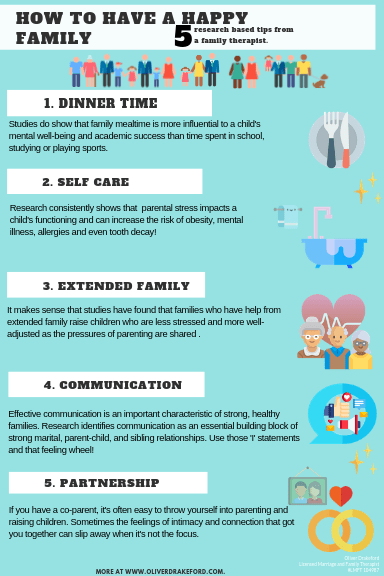
Important: TherapyRoute does not provide medical advice. All content is for informational purposes and cannot replace consulting a healthcare professional. If you face an emergency, please contact a local emergency service. For immediate emotional support, consider contacting a local helpline.
Find Therapists
Must Read
Creating Space for Growth: How Boundaries Strengthen Relationships
Setting healthy boundaries fosters respect, protects emotional well-being, and strengthens relationships by defining personal limits and maintaining self-care.
International Mutual Recognition Agreements for Mental Health Professionals
Mutual recognition agreements for mental health professions are rare and uneven, with major gaps in counselling, social work, and allied therapies. Read on to understand ...
Mental Health Licensing & Regulation in New York State: 2026 Guide
Mental Health Licensing & Regulation in Singapore: 2026 Guide
Jumping to Conclusions
Jumping to conclusions is a thinking habit where we assume the worst or make judgments without enough evidence. By recognising this pattern, therapy can help you slow dow...
About The Author

“As the Clinical Director of an adolescent residential treatment center, I enjoyed working with families and providing systemic treatment for families and couples.”
Oliver Drakeford is a qualified Licensed Marriage and Family Therapist, based in West Hollywood, United States. With a commitment to mental health, Oliver provides Family Therapy, Relationship Counseling and Psychodynamic Therapy.