
10 Tips to Help You Stop Overthinking

❝Overthinking can be a significant obstacle in daily life. It often leads to anxiety and can prevent you from making decisions effectively.❞
Ever replayed a conversation ten times in your head? Or lost sleep worrying about something that might happen — but probably won’t? You’re not alone. Overthinking has a way of hijacking your peace, leaving you feeling stuck, anxious, and emotionally drained.
It’s not just in your head — it is exhausting. And here’s the thing: overthinking is not a personal flaw or weakness. It’s a deeply ingrained habit — one that often forms as a way to cope, plan, or protect yourself. But like any habit, it can be unlearned with time, practice, and the right tools.
If you’ve ever found yourself spiralling in “what-ifs” or second-guessing every decision, you’re likely searching for ways to break the cycle. This guide offers 15 grounded, practical strategies on how to stop overthinking, so you can reclaim your focus, clarity, and — most importantly — your sense of calm.
Let’s help your mind slow down and breathe again.
Table of Contents | Jump Ahead
- What Is Overthinking and Why It Happens?
- What Kind of Overthinker Are You? Recognising the Patterns That Hold You Back
- What Are the Warning Signs of Overthinking?
- Struggling with Overthinking? Here are the 15 Ways to Break Free
- Looking for Support? TherapyRoute Is Here for You
- Conclusion
- Frequently Asked Questions
What Is Overthinking and Why It Happens?
Psychologically, overthinking often stems from anxiety and rumination, where your brain gets caught in a loop trying to predict or fix outcomes. It’s a survival mechanism gone into overdrive, fuelled by fear of making mistakes or losing control.
One simple way to begin breaking the cycle is to pause and focus on your breath, even just a few minutes of deep breathing or mindfulness can help calm the mind and create space between you and your thoughts.
Managing anxiety is easier with the right support. TherapyRoute connects you with qualified therapists who specialise in anxiety and stress.
Find an Anxiety TherapistIt often starts with good intentions, trying to avoid mistakes or prepare for the unknown. But instead of clarity, you get spirals of doubt. Common overthinking symptoms include restlessness, indecision, and trouble sleeping.
If you’ve ever wondered how to stop overthinking, or how to sleep without overthinking, you’re not alone. Many people struggle with how to overcome, control, or reduce overthinking, especially at night.
The key? Learning how to avoid overthinking triggers and gently shifting your focus, one step at a time.
What Kind of Overthinker Are You? Recognising the Patterns That Hold You Back
Ever feel like your brain just won’t give you a break? Overthinking doesn’t always look the same. For some, it’s lying awake at night, reliving awkward moments on a loop. For others, it’s an endless search for the “right” decision, second-guessing every move, never feeling sure, never moving forward.
The truth is, overthinking wears many faces. It can chip away at your confidence, cloud your mental clarity, and even affect your physical health if it goes on for too long. The first step in learning how to stop overthinking is recognising what type of overthinking you’re dealing with.
Let’s break down the most common patterns, so you can name it, face it, and begin to let go.
1. Rumination: Stuck in the Past
This type of overthinking involves replaying past mistakes or painful experiences over and over. It often sounds like: “Why did I say that?” or “I should’ve known better.”
- It creates negative thought patterns that can last for long periods of time.
- Often linked with mental health conditions like depression.
- Can lead to trouble concentrating, loss of energy, and even physical symptoms.
- The first step is recognising when you’re caught in this vicious cycle, then gently shifting your focus.
If you find yourself ruminating on a past conversation, journal your thoughts and ask yourself, “What would I say to a friend going through this?” This helps shift perspective and loosen the loop.
2. Worrying: Fear of the Future
Worrying is future-focused overthinking, imagining hypothetical scenarios that haven’t happened (and may never happen).
- A classic coping mechanism for people with chronic anxiety or high stress levels.
- Tied to the fear that bad things are always just around the corner.
- You may constantly seek second opinions to ease the fear, yet feel no relief.
- Set a specific time for “worry time” during the day, so it doesn’t bleed into everything else.
Schedule a “worry window”, which is a 15-minute block during the day when you’re allowed to worry. Outside of that, gently tell your brain, “We’ll worry about that later.”
3. Analysis Paralysis: Too Many Choices, No Decisions
This is overthinking in disguise: weighing every option until you’re emotionally and mentally drained.
- Commonly, when we crave a sense of control but fear making the wrong choice.
- Leads to mental clutter, less time for action, and decision fatigue.
- Often worsened by excessive information intake (hello, Google rabbit holes).
- Combat it by setting time limits for decisions and trusting your instincts.
Use a timer and give yourself 10–15 minutes to research or consider options, then commit to a decision. Trust that you can course-correct if needed.
4. Catastrophising: The Worst-Case Spiral
You jump from a small worry to the worst possible outcome in seconds.
- This type of thinking often stems from unresolved mental health issues or past trauma.
- It’s a bidirectional relationship; catastrophising worsens anxiety, and anxiety fuels more catastrophising.
- Over time, it affects your mental clarity, physical health, and confidence in daily life.
- Physical activity, grounding exercises, or talking in a safe space can help break the loop.
When your mind spirals, write down the worst-case scenario, then follow it with the best-case and most likely outcomes. This balances the narrative and helps you stay grounded.
5. Identity-Based Overthinking: “This Is Just Who I Am”
Some people believe overthinking is a fixed trait, part of who they are. But it’s not.
- Over time, this belief can mask deeper mental health disorders and prevent change.
- The good news? There are always better ways to respond.
- You don’t have to live inside your head. Learning to challenge this internal story is a powerful first move toward freedom.
Next time you catch yourself saying, “That’s just me,” pause and ask, “What’s one small way I could respond differently?” Even micro-shifts build momentum.
Ready to break free from overthinking? Try applying these tips today and feel the difference.
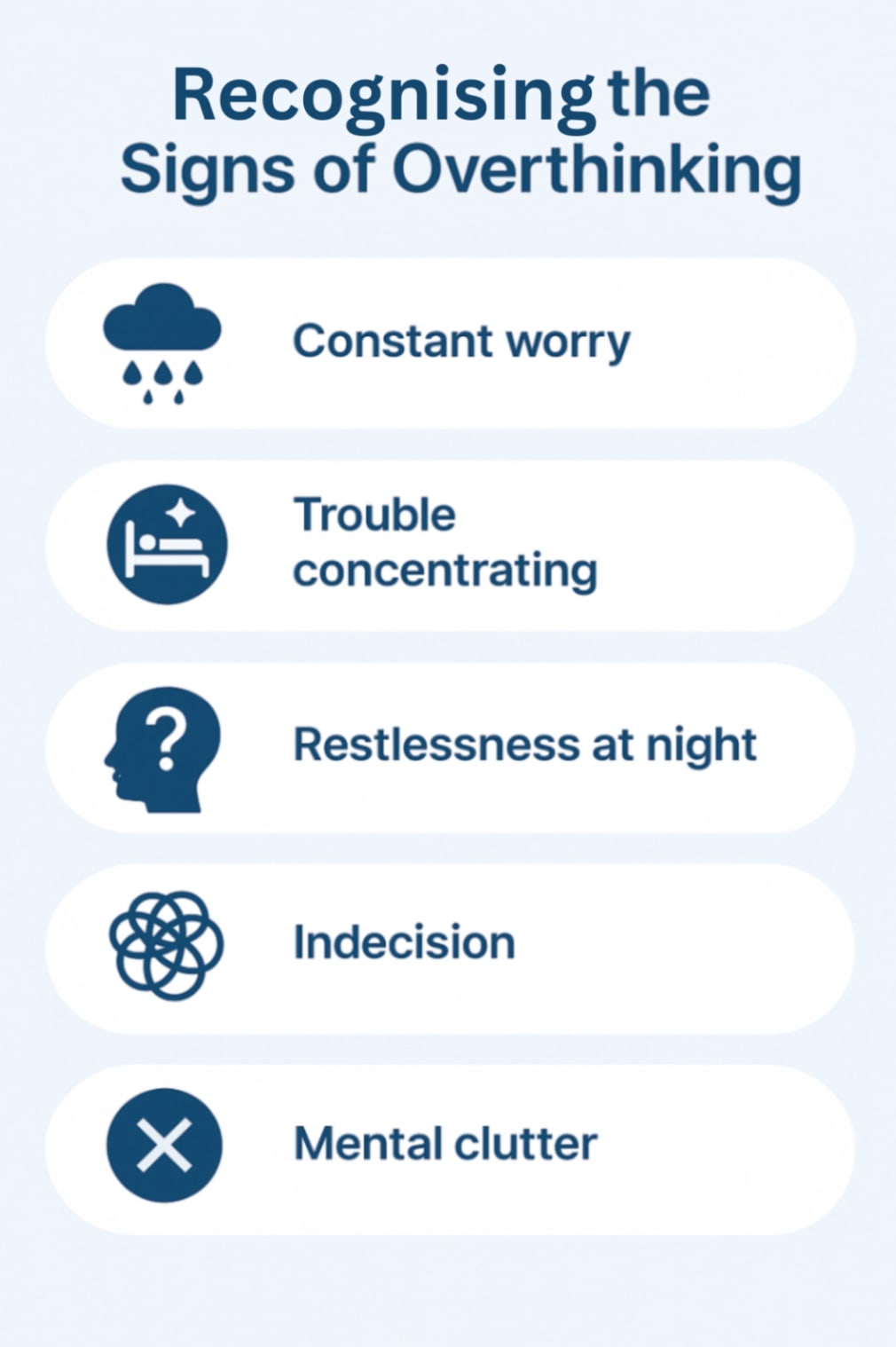
What Are the Warning Signs of Overthinking?
Overthinking can creep in slowly, but once it takes hold, it can drain your mental and emotional energy. Here are some common signs to look for:
- Constant worry: You find yourself obsessing over the “what ifs” and hypothetical scenarios, often about things that may never happen.
- Trouble concentrating: Your mind keeps drifting, making it hard to focus on the present moment or tasks at hand.
- Restlessness at night: Overthinking makes it difficult to sleep without overthinking, your mind races, keeping you awake.
- Indecision: Struggling to make even small decisions because you’re constantly second-guessing yourself.
- Mental clutter: Your thoughts feel overwhelming, and you can’t seem to clear them, causing stress and loss of energy.
If any of these sound familiar, you're likely in a cycle of overthinking. Recognising the signs is the first step in learning how to stop overthinking and finding a way to regain mental clarity.
Struggling with Overthinking? Here are the 15 Ways to Break Free
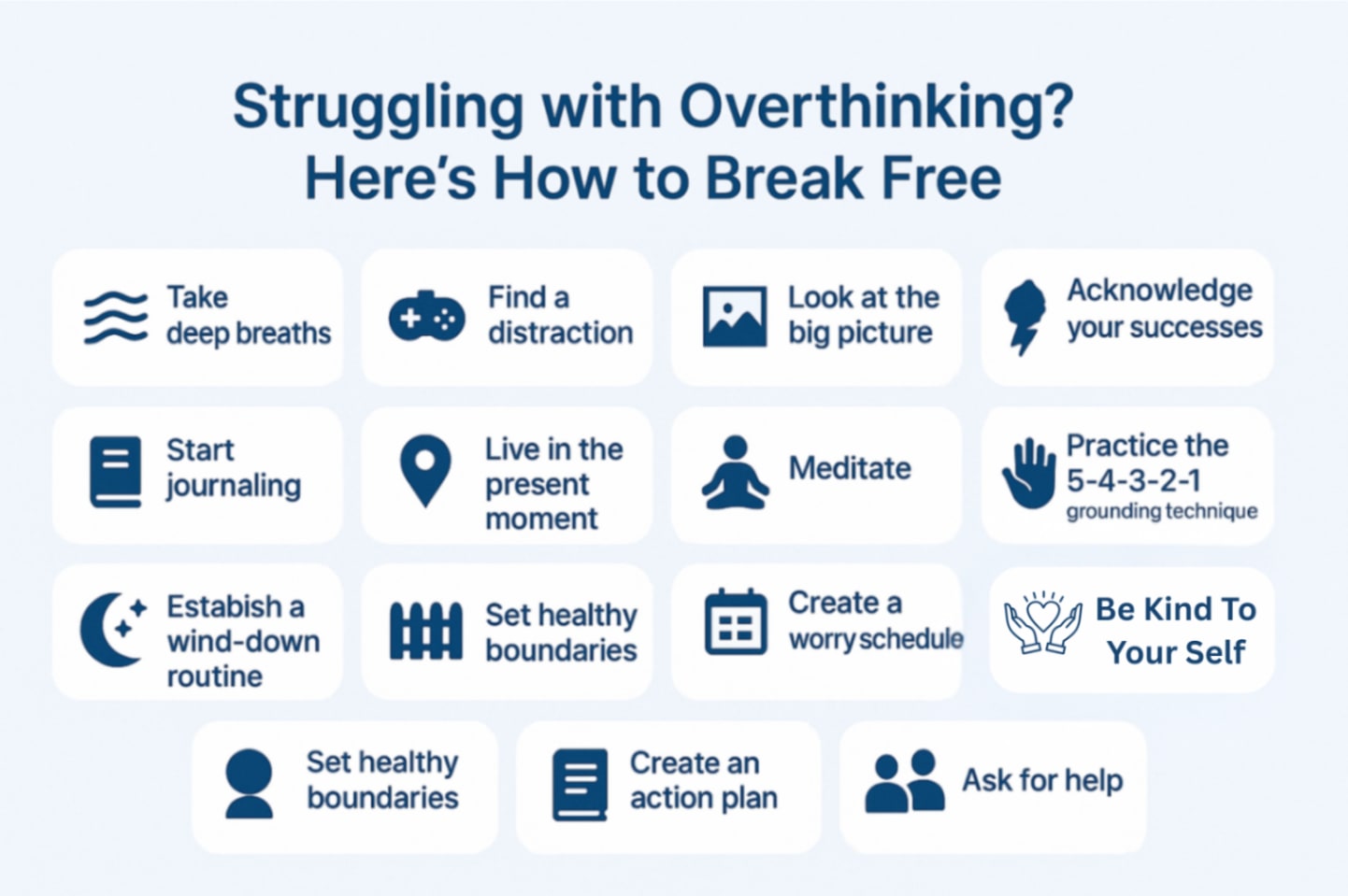
Overthinking can feel like an endless cycle of stress and doubt, leaving you mentally drained and overwhelmed. But the good news is, you don’t have to stay stuck in this loop. The key is learning how to manage those thoughts and regain control of your mind. Here’s a step-by-step guide to stop overthinking and bring peace back into your life.
1. Take deep breaths
When overthinking takes hold, your body follows, your heart races, your muscles tense, and your thoughts spin.
Try the box breathing technique:
- Inhale for 4 seconds
- Hold for 4 seconds
- Exhale for 4 seconds
- Repeat 4 times
This helps calm your nervous system and gives your mind space to pause.
2. Find a distraction
When your thoughts are stuck on repeat, give them something else to do.
- Go for a brisk walk
- Listen to music
- Watch a feel-good film
- Organise your space
These healthy distractions shift your focus and create distance from obsessive thoughts
3. Look at the big picture
Overthinking magnifies the small stuff. Ask yourself:
“Will this still matter in a week? A year?”
Putting things in perspective helps you realise most situations are smaller than they feel in the moment.
4. Acknowledge your successes
Overthinking often fixates on mistakes, but what about your wins?
- List 3 things you accomplished today
- Recall a time you handled something well
- Keep a small “victories” notebook
Shifting focus to your strengths builds confidence and reduces mental spirals.
5. Embrace your fears
Avoiding fears gives them power. Acknowledge what you’re afraid of and ask:
“What’s the worst that could happen, and how would I handle it?”
Naming the fear lessens its grip and helps you move forward.
6. Start journaling
You don’t need to journal for hours. A few quick prompts can help:
- What’s bothering me right now?
- What do I actually know vs. what am I imagining?
- What do I need in this moment?
Writing helps untangle thoughts and get clarity.
7. Live in the present moment
Overthinking pulls you into the past or future.
To return to now:
- Focus on your breath
- Notice the textures or colours around you
- Chew slowly and savour each bite
These small mindfulness moments anchor you to the present.
8. Meditate
Even 5–10 minutes of guided meditation daily can train your brain to pause before spiralling.
Apps like Calm or Insight Timer are great places to start.
With regular practice, you’ll learn how to observe thoughts, not be ruled by them.
9. Create a worry schedule
Rather than letting worry creep in all day, set aside 10–15 minutes just for worrying.
If a worry shows up outside that time, mentally say:
“I’ll think about that during my worry time.”
This simple boundary can reduce mental overload.
10. Practice the 5-4-3-2-1 grounding technique
Feeling anxious or overwhelmed? Try this sensory grounding tool:
- 5 things you see
- 4 things you touch
- 3 things you hear
- 2 things you smell
- 1 thing you taste
It brings you back to the present, perfect for quieting your mind, especially at night.
11. Establish a wind-down routine
Struggling with how to sleep without overthinking? Build a calming routine:
- Gentle stretches
- Warm shower
- Reading (not doom-scrolling)
- Herbal tea
Consistency tells your brain: it’s safe to relax now.
12. Set healthy boundaries
Overthinking often comes from mental overload.
Say no to draining commitments, limit toxic interactions, and unplug from digital noise when needed.
Creating space allows your brain to breathe.
13. Create an action plan
When stuck in indecision, break tasks into smaller steps.
Ask:
- What can I do right now?
- What’s the next micro-step?
Action reduces rumination; even imperfect action is progress.
14. Ask for help
You don’t have to untangle overthinking alone.
- Talk to a trusted friend
- Join a support group
- Speak to a therapist
Sometimes, a fresh perspective is all it takes to break the spiral.
15. Be Kind to Yourself — This Takes Practice
Overthinking is a habit, not a flaw.
Progress isn’t about perfection, it’s about small steps and self-compassion.
You’re already doing the work by reading this.
Looking for Support? TherapyRoute Is Here for You
If overthinking is affecting your mental well-being, seeking professional support can make all the difference. TherapyRoute helps you find experienced therapists and counsellors who specialise in anxiety, stress, and overthinking. Whether you need in-person therapy or online counselling, we’re here to connect you with a professional who understands your unique needs.
Start your journey towards clarity by exploring therapists who can help you regain peace of mind
Click here to view our therapist directory, choose a professional that suits your needs, and book a session directly online.
Conclusion
Overthinking can feel like an endless loop of anxiety, doubt, and stress. But the good news is that you don’t have to stay trapped in this cycle. By recognising the patterns that lead to overthinking, practising grounding techniques, and learning to manage your thoughts, you can regain control of your mind. With time and consistent effort, you’ll begin to feel more focused, less anxious, and more at peace with the present moment.
Remember, it’s okay to ask for help along the way. Whether it's through mindfulness practices, journaling, or seeking professional support, there are countless ways to stop overthinking and start living more freely.
Frequently Asked Questions
How do I stop being an overthinker?
To stop being an overthinker, try grounding techniques, set limits on worry, practice mindfulness, and focus on the present. Create healthy boundaries and learn to challenge negative thought patterns to regain control over your mind.
Why am I an overthinker?
Overthinking often stems from anxiety, fear of making mistakes, or a desire for control. It may also be linked to unresolved emotional issues or past experiences that keep your mind racing with worries.
What is overthinking a symptom of?
Overthinking is a common symptom of mental health conditions like anxiety, depression, or chronic stress. It can also be linked to self-doubt, low confidence, or an attempt to avoid uncomfortable emotions.
How to comfort an overthinker?
Comfort an overthinker by listening without judgment, offering reassurance, and helping them focus on the present. Encourage them to challenge their thoughts and gently guide them to take things one step at a time.
How to Stop Overthinking?
To stop overthinking, practice mindfulness, set specific times to worry, and redirect your focus. Use grounding techniques like deep breathing and journaling to clear mental clutter and create an action plan to reduce anxiety.
Important: TherapyRoute does not provide medical advice. All content is for informational purposes and cannot replace consulting a healthcare professional. If you face an emergency, please contact a local emergency service. For immediate emotional support, consider contacting a local helpline.
Find Therapists
Must Read
Creating Space for Growth: How Boundaries Strengthen Relationships
Setting healthy boundaries fosters respect, protects emotional well-being, and strengthens relationships by defining personal limits and maintaining self-care.
International Mutual Recognition Agreements for Mental Health Professionals
Mutual recognition agreements for mental health professions are rare and uneven, with major gaps in counselling, social work, and allied therapies. Read on to understand ...
Mental Health Licensing & Regulation in New York State: 2026 Guide
Mental Health Licensing & Regulation in Singapore: 2026 Guide
Jumping to Conclusions
Jumping to conclusions is a thinking habit where we assume the worst or make judgments without enough evidence. By recognising this pattern, therapy can help you slow dow...
